
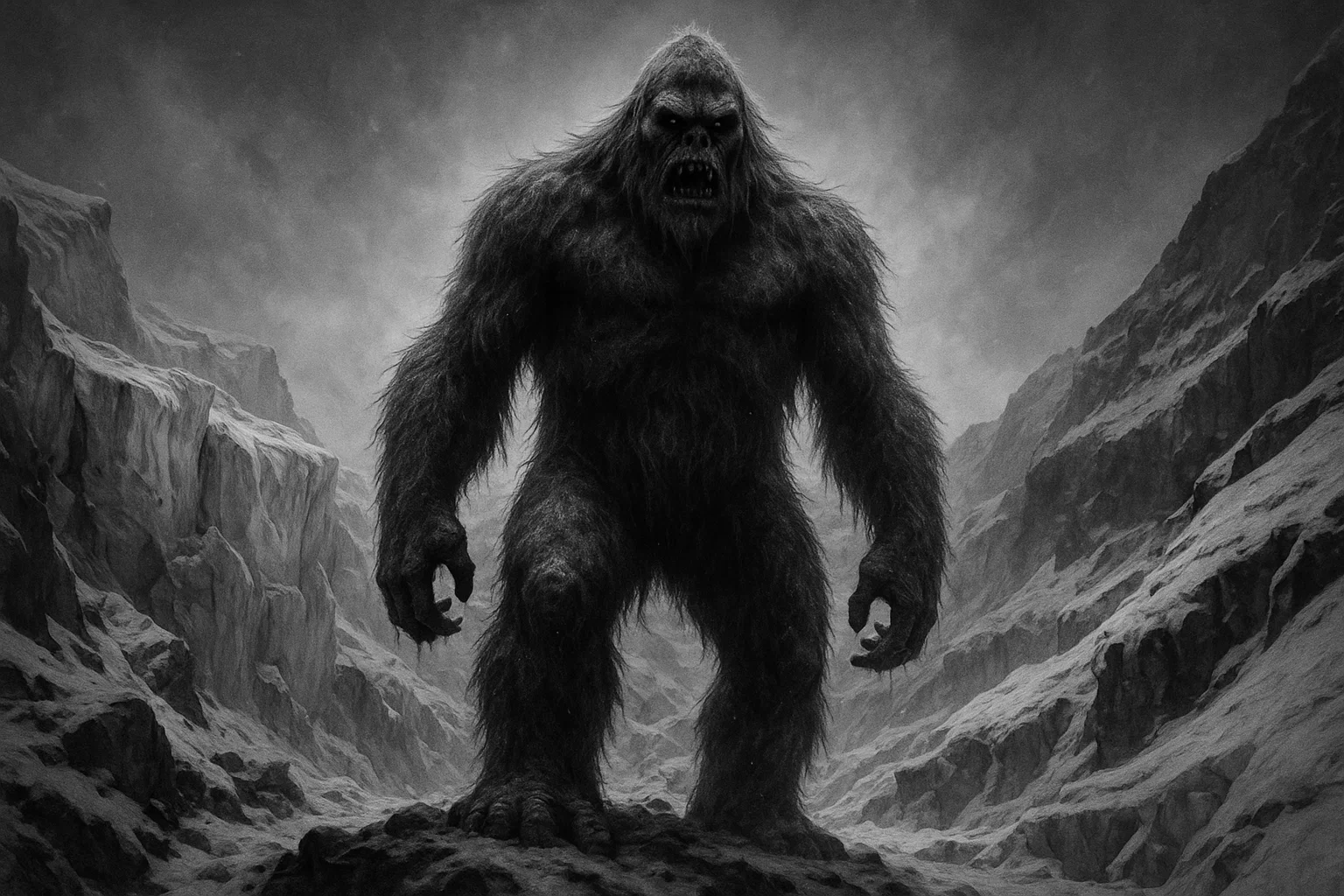

The Abominable Snowman, more widely recognized as the Yeti, is a legendary hominid said to inhabit the high-altitude, snow-covered regions of the Himalayan mountains in Nepal and Tibet. However, its existence is largely based on anecdotal evidence, unclear photographic evidence, and the discovery of large, unidentifiable footprints in the snow.
Summary
Overview
| Attribute | Details |
| Name | Abominable Snowman |
| Alternative Names | Yeti, Meh-Teh, Migyur, Dzu-Teh, Meti, Migo, Kang-mi |
| Similar Monsters | Bigfoot, Sasquatch, Skunk Ape, Yowie, Almas, Orang Pendek, Fouke Monster, Nephilim |
| Etymology | English: ‘Abominable’ suggesting something vile or horrible; ‘Snowman’ referring to its habitat. ‘Yeti’ is derived from the Tibetan ‘yeh-teh’ or ‘met-teh,’ possibly meaning ‘little hairy man’ or ‘manlike animal.’ |
| Gender | Male, Female |
| Classification | Cryptid |
| Species | Beast / Humanoid |
| Origin / Culture | Tibetan and Sherpa people (Himalayan range, Nepal, Tibet) |
| First Recorded | 1832 – Journal of the Asiatic Society of Bengal (B.H. Hodgson) |
| Active Period | Always active / Unknown |
| Size | 1.8–3 m tall, often described as larger than a human |
| Lifespan | Unknown |
| Diet | Omnivorous (small animals, roots, berries, occasionally livestock) |
| Habitat | Alpine and subalpine zones, dense forests, and high-altitude snowfields |
| Powers & Abilities | • Immunity to extreme cold • Camouflage in snowy environments • Climbing ability |
| Weaknesses | • Avoids human habitation • Extreme heat |
| Reproduction / Creation | Natural birth (Primates/Hominids) |
| Behavior | Solitary and elusive animal, generally avoids confrontation with humans |
| Modern Sightings | 1920s–present, Nepal, Tibet, Bhutan, India (Sikkim) |
| Pop Culture | Tibet in the 1950s (Herge’s Tintin), “Monsters, Inc.” (2001), “Smallfoot” (2018), “Rudolph the Red-Nosed Reindeer” (1964) |
Description
The Abominable Snowman is a monster generally depicted as a large, bipedal ape or hominid that roams the remote, icy peaks of the Himalayas.
The creature’s primary distinction from known primate species lies in its consistently reported upright posture and its habitat in extreme, high-altitude environments (which are typically inhospitable to large, tropical apes).
Loren Coleman Cryptozoology A to Z – Up to 46% OFF!
This authoritative encyclopedia catalogs hundreds of mysterious creatures in accessible A-to-Z format, authored by leading experts Loren Coleman and Jerome Clark. From classic Sasquatch sightings to exotic global cryptids, with cross-references, bibliography, and evocative illustrations – ideal for dark curiosity cabinets, paranormal studies, or sparking hunts for the world’s hidden beasts.
Etymology & Origins
The name Abominable Snowman is a Westernized and somewhat sensationalized translation of local terms. The most common alternative name, Yeti, is derived from the Tibetan language.
While the precise root is debated, it is often linked to the term yeh-teh, which translates to something akin to “little hairy man” or “animal man.” Regional variations exist, such as Meh-Teh (Man-Bear) and Dzu-Teh (Cattle-Killer), reflecting local fears or interpretations of the creature.
The origins of the creature’s legend are ancient, deeply embedded in the Sherpa and Tibetan folklore of the Himalayan region. Before the arrival of Western explorers and climbers, the Yeti was an integral part of the local spiritual world, often viewed as a supernatural being, a kind of mountainous spirit, or simply an unknown wild animal.
The earliest written documentation of the creature by a Western source was in 1832, when B. H. Hodgson recorded an account of a tall, shaggy, bipedal creature observed by his native servants in northern Nepal.
The persistent sightings and the resulting Western media attention, particularly following a 1921 Mount Everest expedition, cemented the creature’s place as a global cryptid.
Appearance
The appearance of the Abominable Snowman is consistently described as being large, heavy-set, and resembling a great ape or a primitive human. Estimates of its height range from 1.8 to 3 meters (6 to 10 feet), with a muscular build that allows it to get through the rugged, steep terrain of its habitat.
Its body is uniformly covered in a dense coat of shaggy, coarse hair, believed to provide insulation against the severe Himalayan cold. This fur is usually reported to be off-white, snow-white, or sometimes a dingy reddish-brown or black.
Descriptions often focus on a conical or pointed head, a short neck, and broad, flat feet that are responsible for the creature’s massive, distinctive footprints. Some accounts also note a strong, unpleasant body odor, sometimes likened to sulfur or foul animal scent.
Unlike typical apes, the Yeti is typically described as walking in a fully upright, bipedal manner, with long arms hanging by its sides.
Powers & Weaknesses
Powers
The powers and abilities of the Abominable Snowman are largely derived from its purported physical resilience and adaptation to an extreme environment, rather than purely supernatural magic:
- Immunity to extreme cold: The Yeti is believed to possess a thick coat of fur and a specialized metabolism that allows it to survive temperatures far below zero, where unprotected humans would quickly succumb to hypothermia.
- Camouflage in snowy environments: The white or gray coloration of its fur provides excellent natural camouflage against the glaciers and snowfields of its habitat, making it difficult to spot and remain mysterious.
- Climbing ability: Accounts imply the creature has the immense physical strength and agility necessary to traverse the sheer rock faces, crevasses, and ice formations of the high Himalayas.
Weaknesses
Because the Abominable Snowman is primarily regarded as an unknown animal or cryptid rather than a demonic or mythical being, its weaknesses are generally biological and behavioral rather than ritualistic:
- Avoids human settlements: The cryptid has a deep-seated instinct to avoid areas populated by humans, including villages and established mountain trails, which prevents widespread evidence of its existence. Its extreme shyness is often cited as the main reason for the rarity of clear sightings.
- Heat: Given its adaptation to a cold, high-altitude environment, it is logically implied that the creature would be unable to survive or thrive in warmer, lower-altitude climates, making the lower valleys and plains a natural boundary it cannot cross.
Myths, Legends & Stories
The lore of the Abominable Snowman is less a collection of structured myths and more a body of persistent folklore, eyewitness testimonies, and the documentation of physical evidence, mainly footprints.
The First Major Footprint Discovery (1921)
During the 1921 British reconnaissance expedition to Mount Everest, led by Lieutenant-Colonel Charles Howard-Bury, one of the most famous early encounters occurred.
While descending from the Lhakpa La pass at an altitude of approximately 6,400 meters (21,000 feet), Howard-Bury observed large, dark, human-like tracks in the snow. The tracks were noticeably larger than human footprints. They were not identifiable as belonging to any known animal in the region. The local Sherpa guides informed the expedition that these prints were made by the Metoh-Kangmi (man-bear snow-man).
The expedition’s local translator reportedly translated this term to “Abominable Snowman” for Western journalists. This term gained immediate and sensational traction globally.
Ultimate Family Co-op Adventure – Horrified: Universal Monsters
Ravensburger’s acclaimed co-op Horrified Board Game masterpiece: Defend against Dracula, The Mummy, Invisible Man, and other icons in a beautifully themed village. Tactical pick-up-and-deliver gameplay, escalating tension, and endless variety. Ideal gateway game for families & friends, 1-5 players, 10+, with 4.8/5 star rave reviews.

Shipton’s Iconic Photo (1951)
One of the most compelling pieces of physical evidence was produced in 1951 by the British mountaineer Eric Shipton. While exploring the Melung Glacier with his Sherpa guide Sen Tenzing, Shipton photographed a sequence of clear, enormous footprints in the snow.
The best photograph showed a single, wide, five-toed print that measured approximately 33 centimeters (13 inches) long and 20 centimeters (8 inches) wide.
These prints were, in particular, different from those left by bears. Their clarity and size were instrumental in fueling public interest and scientific debate about the creature’s existence, making Shipton’s photograph the most widely reproduced image associated with the Yeti.
Tenzing Norgay’s Encounter
Tenzing Norgay, the Sherpa mountaineer who, with Sir Edmund Hillary, was one of the first two individuals to summit Mount Everest, claimed to have had a personal encounter with the Yeti.
Norgay described the experience from his youth, stating that his father-in-law had seen a Yeti twice. He described it as a large, squat, and ape-like creature that was very aggressive.
On a later climb, Norgay himself claimed to have seen a creature that he believed to be the Yeti, describing it as a shy animal that would retreat when approached by humans. His testimony, coming from an esteemed local figure, lent significant credibility to the folklore among the climbing community.
Symbolism
The Abominable Snowman primarily functions as a symbol of the unexplored and un-domesticated wilderness. It represents the vast, unconquered realms of the high-altitude mountains, embodying the secrecy and inaccessibility of the Earth’s most remote regions.
In local Himalayan culture, the Yeti symbolizes the raw power and environmental hazards of the mountains, acting as a natural guardian of the high peaks whose territory is rarely and perilously breached.
Its continued elusiveness symbolizes the limits of human knowledge and the possibility of significant unknown species surviving away from human observation, making it a profound symbol of mystery and the unknown.
Tags:
Related Monsters…
Antaeus (Invincible Earth Giant)
January 5, 2026
January 12, 2026
Azazel (Fallen Angel Turned Demon)
January 15, 2026
Aswang (Philippine Vampire Shapeshifter)
January 14, 2026
Baku (Dream-Eating Japanese Monster)
February 24, 2026
