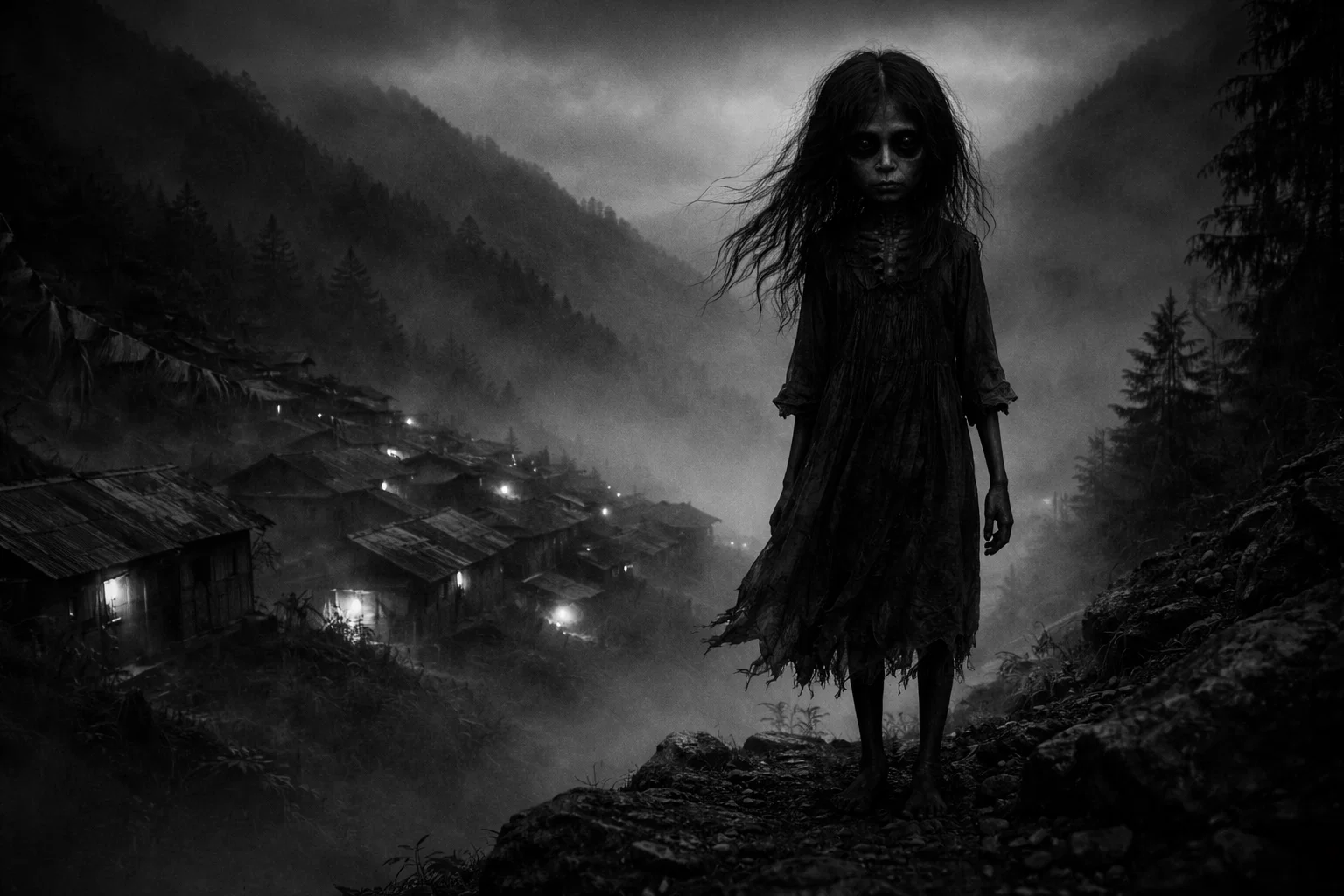

The Acheri is a creature from Indian folklore, especially among the hill tribes of the Himalayas. It is known as a spirit that brings illness, mainly affecting children and young people. People have long believed it is the ghost of someone who died and now haunts the mountains. When an Acheri is near, a certain sound is said to warn of an outbreak of sickness or a wasting disease.
Summary
Overview
| Attribute | Details |
|---|---|
| Name | Acheri |
| Alternative Names | Acheri-Geri, Rakshasi (regional variant), Hill Spirit |
| Similar Monsters | Banshee, Onryō, Striga, Pontianak, Lamashtu, Lilith, Jinn, Rusalka, Moroi, Pishacha, Vetala, Draugr, Gaki, Preta, Keres, Empusa, Lamia, Myling, Huldra, Dearg Due |
| Etymology | Likely from Hindi or local Pahari dialects; associated with the concept of “shadow” or “shade.” |
| Gender | Female |
| Classification | Demonic Entity |
| Species | Spectral |
| Origin / Culture | Indian (Himalayan regions of Kumaon and Garhwal) |
| First Recorded | Oral tradition; documented in British ethnographic surveys c. 19th Century. |
| Active Period | Nocturnal / Night only |
| Size | Size of a young human child |
| Diet | Life force / Health of the living |
| Habitat | Mountain peaks and remote valleys |
| Powers & Abilities | • Shadow projection • Disease induction • Invisibility during daylight • Auditory omens |
| Weaknesses | • Red clothing • Red thread • Sunlight • Iron implements |
| Reproduction / Creation | The spirit of a girl who died an unnatural or premature death. |
| Behavior | Solitary ambush predator targeting the vulnerable. |
| Pop Culture | Supernatural (TV Series) / Lore (Podcast) / The Elementopedia of Magical Creatures / Shin Megami Tensei (series) |
Description
The Acheri is a supernatural being that represents disease and bad luck. Unlike ghosts that haunt places to settle personal issues, the Acheri seeks to spread sickness. It usually stays in the mountains and only comes down to villages at night.
This spirit is seen as very dangerous because it mainly targets people with weak immune systems. Stories say that just being near the Acheri can make someone waste away. It does not fight or attack directly. Instead, it is believed to harm people by casting its shadow over them, causing a slow and sometimes deadly illness.
The Mythical Creatures Bible. Flash Sale – Up to 23% OFF!
This beautifully designed paperback is the ultimate reference to legendary beings across history and cultures: From Biblical leviathans and behemoths to Asian kitsune, European fae, African tricksters, and ancient chimeras. Alphabetical entries with vivid illustrations, cultural context, and fascinating facts – essential for witchy libraries, ritual symbolism, or creature design inspiration.
Etymology
The name “Acheri” comes from the languages of the Himalayan hill tribes, especially in Kumaon and Garhwal in Uttarakhand. In these dialects, the word is closely tied to the idea of a “shadow” or “shade.” This meaning is not just about its ghostly form, but also describes how it attacks.
The origin of the word shows the belief that the Acheri is a leftover spirit, a dark version of a life ended too soon. Sometimes, it is considered a type of “Rakshasi” (female demon), but “Acheri” is the name for this specific mountain spirit that brings the “sickness of the heights.”
How to Pronounce “Acheri” in English
In English, “Acheri” is usually pronounced as uh-CHAIR-ee. The first part is a soft sound, the middle rhymes with “hair,” and the last is a long “e.” Some people say it with a hard “k” (uh-KEER-ee), but the “ch” like in “church” is the most common in studies of myths.
Appearance
The Acheri appears as a small girl who has not yet reached puberty. She looks extremely thin, with skin that is pale or almost see-through, sometimes with a bluish or gray color. Her eyes are often shown as very large or hollow, showing her ghostly nature.
Even though it is a spirit, the Acheri is almost always shown wearing old, torn clothes that are dark or have no color. This dull look is important in its stories because it is the opposite of the bright colors that are said to keep it away. The Acheri is also described as giving off a sense of cold, with long, dark, messy hair that hides part of its thin face.
Powers & Weaknesses
Powers
The main power of the Acheri is spreading disease by casting its shadow. It does not have to touch anyone; just letting its shadow fall on a sleeping person can cause deadly illnesses like smallpox, cholera, or wasting fevers. The Acheri can also move quickly across the mountains, sometimes looking like a blur or a flickering light from far away.
The Acheri can also make a haunting, musical sound, sometimes described as bells or a soft cry. Hearing this sound is seen as a sign of death. The Acheri cannot be seen during the day and only appears after sunset.
Weaknesses
The Acheri is strongly affected by color and light. Its biggest weakness is the color red. People believe the Acheri cannot stand red, which stands for life and energy, the opposite of what it is. The Acheri is also powerless during the day because sunlight makes it disappear and keeps it from acting in the world.
Metals, especially iron, are believed to block the Acheri. People often use charms made of iron or steel to protect their homes. The Acheri also does not usually go down to the hot plains, staying instead in the cold, thin air of the mountains.
Yokai and Supernatural Beings Hardcover Book – Up to 28% OFF!
Explore 100 authentic illustrations of Japan’s most haunting creatures in this premium 240-page volume. From ape-like hihi kidnappers to smirking hannya and shape-shifting bakeneko, drawn from rare historical sources including first-time reproduced monster parade scrolls. Curated by a leading authority on Japanese prints – an indispensable guide to yokai horror and folklore for altars, shelves, or spooky reading.

Myths, Legends & Stories
The Birth of the Hill Shade
The story of the Acheri begins with a tragic death. Himalayan traditions say the Acheri is not a god or demon, but the spirit of a young girl who died in great sadness, neglect, or violence.
If a girl dies too young, especially if she was mistreated or her funeral was not done properly, she cannot move on. Instead, her spirit stays in the cold, lonely mountains. At first, the spirit is said to be confused and lonely, looking for people to be with.
But because she is no longer alive, her touch and even her presence are harmful to living people. Her longing for company turns into a cycle of spreading illness.
The Singing in the Valley
One well-known legend about the Acheri is the “Singing Omen.” In many mountain villages, elders tell of nights when strange, beautiful music comes from the high ridges. The story says a group of travelers once followed this music, thinking it was a festival in another village.
As they climbed higher, the air became strangely cold, and the music turned into a cold, rhythmic chant. The travelers realized too late that an Acheri was luring them. The adults ran away after seeing a thin, ghostly girl dancing in the moonlight, but the children started to get sick the next morning.
Within a week, all the children in that valley died from a sudden fever. This story marks how the Acheri changed from a lonely ghost to a feared bringer of disease.
The Red Thread Protection
A popular folk tale tells of a smart mother who saved her village from an Acheri. The village had seen many strange deaths, and the local shaman said a spirit from the “Black Crag” was to blame.
The mother, remembering old stories, collected all the red wool she could find. She tied a red thread around each child’s neck and hung red cloth over every doorway. That night, when the Acheri came, she saw the village glowing with red. The bright color drove her away, and she went back to the mountains.
Undead Japanese Samurai Zombie – Limited Edition Resin Statue
Command attention with this intricately crafted Japanese-style Oni mask warrior sculpture from LOOYAR. Hand-painted resin/PU material captures the terrifying horns, fangs, and armored menace of the legendary demon guardian. Perfect for altars, shelves, desks, or gothic displays – a striking blend of folklore horror and samurai strength for home or office decor.
Symbolism
The Acheri is a strong symbol of how fragile life can be in tough places. In the high Himalayas, where there was little medicine, the Acheri stood for the sudden and mysterious deaths of children. It represents the “cold” and “dark,” which are the opposite of the warmth and safety of home.
The Acheri also stands for the cycle of grief. When a child is lost, their spirit may return and cause more loss, showing how one tragedy can hurt a whole small community. The story also highlights the need for proper burials and respect for the dead, to keep them from coming back as harmful spirits.
Can Acheri Be Defeated?
The Acheri is a spirit and cannot be killed in the usual way, but it can be kept away with certain protections. The most common way is to use the color red. People often tie red ribbons or threads around children’s necks, since the Acheri is said to be unable to look at red without feeling pain or confusion.
Besides using red, people also use amulets and herbal remedies. Amulets with mountain herbs or bits of iron are often put under children’s pillows to keep the Acheri’s shadow away. If someone is already sick from the Acheri, healers may ring brass bells and burn special resins to try to drive out the spirit’s cold influence.
The only real way to win against an Acheri is to prevent it from coming. Once it is driven away and the sun rises, the danger is gone. Many communities also hold yearly ceremonies to honor the “restless dead,” hoping this will keep young spirits from becoming Acheri.
Tags:
Related Monsters…
Antaeus (Invincible Earth Giant)
January 5, 2026
February 26, 2026
Azhi Dahaka (Persian Three-Headed Dragon)
January 19, 2026
January 12, 2026
Acheri (Indian Disease Spirit)
January 29, 2026
Abominable Snowman (Himalayan Beast)
December 1, 2025
