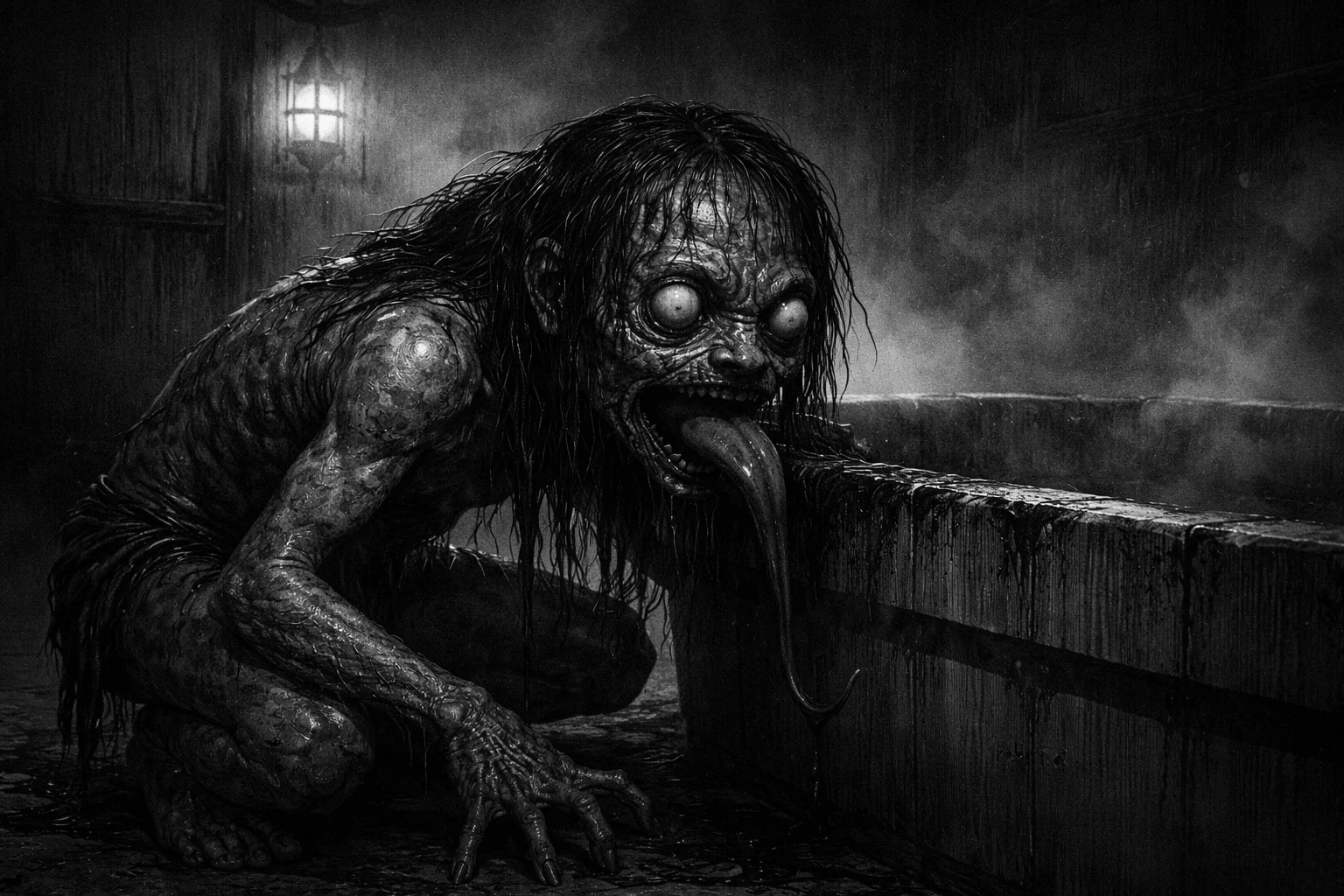

Akaname is a specific type of Japanese yokai characterized by its singular obsession with filth and unhygienic environments. Traditionally associated with the bathhouses of the Edo period, this entity is both a literal and metaphorical manifestation of household grime.
While generally considered non-hostile toward humans, its presence is viewed as a sign of neglect and a harbinger of potential illness, making it a persistent monster in Japanese urban folklore.
Summary
Overview
| Attribute | Details |
| Name | Akaname |
| Alternative Names | Filth Licker, Bath Sucker |
| Similar Monsters | Otohime, Kappa, Hyosube, Nurarihyon, Mokumokuren, Ittan-momen, Gashadokuro, Rokurokubi, Abura-akago, Tenjo-name, Umibozu, Noppera-bo |
| Etymology | Japanese: ‘aka’ (filth/grime) and ‘name’ (to lick) |
| Gender | Male, Female |
| Classification | Yokai |
| Species | Humanoid |
| Origin / Culture | Japanese (Honshu) |
| First Recorded | 1776 – Gazu Hyakki Yagyō by Toriyama Sekien |
| Active Period | Nocturnal |
| Size | Size of a human child |
| Diet | Bathwater scum, mold, skin flakes, and bathroom grime |
| Habitat | Bathrooms, toilets, and neglected bathhouses |
| Powers & Abilities | • Disease transmission through saliva • Invisibility to the clean • Wall-crawling |
| Weaknesses | • Sanitation and scrubbing • Coarse salt • General cleanliness |
| Reproduction / Creation | Spontaneous manifestation from accumulated grime and neglect |
| Behavior | Solitary scavenger |
| Pop Culture | Yo-kai Watch / Shin Megami Tensei series / GeGeGe no Kitaro |
Description
Akaname is a supernatural entity from Japanese folklore that functions as a personification of filth. It is a creature of habit that specifically targets the most private and damp areas of a household, primarily the bathroom.
The entity is not known for predatory behavior or physical aggression; instead, it remains focused on consuming waste products. It is often described as a shy creature that avoids direct sunlight and human interaction, preferring to appear only when a household is asleep.
The presence of an Akaname is considered a biological hazard. Although the act of licking a bathtub clean might seem helpful, the creature’s saliva is believed to be toxic or laden with bacteria, leading to the spread of infections or skin diseases.
Consequently, the entity is a folk deterrent against laziness, encouraging homeowners to maintain rigorous hygiene standards to prevent the creature from taking up residence in their pipes or corners.
Yokai and Supernatural Beings Hardcover Book – Up to 28% OFF!
Explore 100 authentic illustrations of Japan’s most haunting creatures in this premium 240-page volume. From ape-like hihi kidnappers to smirking hannya and shape-shifting bakeneko, drawn from rare historical sources including first-time reproduced monster parade scrolls. Curated by a leading authority on Japanese prints – an indispensable guide to yokai horror and folklore for altars, shelves, or spooky reading.
Etymology
The name Akaname is derived directly from Japanese. It is a compound of two distinct words: “aka” and “name.” The term “aka” refers to the reddish-brown grime, scale, or “scum” that accumulates in bathwater or on the skin of people who have not washed thoroughly. It can also refer to the sediment found in stagnant water. The second half of the name, “name,” comes from the verb “nameru,” which means “to lick.”
In some regional dialects and older texts, the name is written using characters that imply “red lick,” referring to the creature’s frequent depiction with reddish skin.
However, the most common interpretation remains “filth-licker.” This linguistic structure is typical of many yokai names, which describe the creature’s primary function or physical habit in a literal, straightforward manner to ensure the warning it represents is easily understood by all social classes.
Appearance
Akaname is generally depicted as a small, humanoid creature roughly the size of a young child or a goblin. Its skin is frequently described as being a mottled reddish or pinkish color. However, some accounts suggest a dark, muddy brown color consistent with the filth it inhabits.
Its most prominent and defining feature is an unnaturally long, prehensile tongue that it uses to reach into crevices and corners to extract filth.
The creature typically has a single, large claw on each foot and hand, which helps to cling to slippery surfaces such as wet wood or stone. Its hair is often described as greasy, matted, and unkempt.
In many traditional woodblock prints, it is shown wearing a simple loincloth or appearing entirely naked. Its eyes are often bulging or wide, suited for seeing in the dim light of late-night bathrooms. Despite its humanoid shape, its posture is usually crouched or animalistic.
Powers & Weaknesses
Powers
Akaname has several supernatural traits specialized for its niche environment. Its primary ability is its specialized tongue, which is coated in a unique mucus that can dissolve hardened grime and mineral deposits instantly. This tongue is long enough to reach deep into plumbing systems or behind heavy structures.
The creature also exhibits a high degree of stealth, moving silently across wet or slick surfaces without slipping.
What’s more, Akaname has a minor form of selective invisibility or spiritual masking. It is rarely seen by those who maintain a clean lifestyle, manifesting only in environments that meet a certain threshold of decay.
While it doesn’t have offensive magic, its biological makeup is highly infectious. Any surface it touches with its tongue becomes a breeding ground for supernatural or mundane pathogens, causing those who use the contaminated bath to fall ill with mysterious fevers or rashes.
Weaknesses
The primary and most effective weakness of Akaname is mundane cleanliness. The creature cannot manifest or survive in an environment that is thoroughly scrubbed and disinfected.
Regular maintenance of a bathroom acts as a permanent repellent, as the creature relies on “aka” (filth) for both its physical sustenance and its ability to anchor itself to the human world. If a bathroom is cleaned while an Akaname is present, it will flee or simply vanish.
In traditional folklore, coarse salt is also used as a deterrent, as salt is a purifying agent in Japanese Shinto traditions. Sprinkling salt in the corners of a bathroom or near the drain is believed to burn the creature or prevent it from entering.
Additionally, the yokai is highly susceptible to light; it is a nocturnal being that avoids bright lanterns or sunlight. If caught in the light, it becomes sluggish and vulnerable, though it will usually attempt to hide rather than fight.
Myths, Legends & Stories
Origins
The Akaname first appeared in the Japanese public’s consciousness during the Edo period. Unlike many yokai born from ancient spirits of nature or vengeful ghosts, the Akaname is a “tsukumogami-adjacent” entity, born from human collective neglect.
Legend suggests that when filth is allowed to accumulate for too long in a single location, the concentrated negative energy of the decay takes a physical form. This manifestation was first formally documented by the artist Toriyama Sekien in his 1776 work, Gazu Hyakki Yagyō.
Sekien’s inclusion of the creature helped codify it as a staple of Japanese urban legend, moving it from a vague superstition to a recognized supernatural inhabitant of the city.
The Warning of the Bathhouse
In the mid-19th century, stories circulated among the owners of public bathhouses (sentō) regarding the “Licker of the Night.” One popular account involves a bathhouse owner who grew lazy and stopped scrubbing the wooden slats of the bathing area.
Customers began to complain of a foul smell and a feeling of being watched. One night, the owner hid behind a screen and witnessed a small, red-skinned creature appeared from the shadows. The creature spent the night licking the mold from the floor.
However, the next day, every customer who used the bath developed painful, weeping sores on their legs. The owner realized that the creature was not a helper, but a plague-bearer, and he spent three days scrubbing the building with salt until the creature never returned.
Undead Japanese Samurai Zombie – Limited Edition Resin Statue
Command attention with this intricately crafted Japanese-style Oni mask warrior sculpture from LOOYAR. Hand-painted resin/PU material captures the terrifying horns, fangs, and armored menace of the legendary demon guardian. Perfect for altars, shelves, desks, or gothic displays – a striking blend of folklore horror and samurai strength for home or office decor.
The Grime of the Samurai
Another legend tells of a low-ranking samurai who lived in a dilapidated estate. He was a proud man but lived in squalor, refusing to perform “menial” cleaning tasks. He woke one night to the sound of wet, rhythmic slapping coming from his washroom.
Peering through a crack in the door, he saw an Akaname perched on the rim of his tub, its tongue reaching into the drain. The samurai, terrified by the sight of the monster, attempted to strike it with his sword. However, the creature was as slippery as the slime it consumed, and it slid through his fingers like oil, escaping into the night.
The samurai fell ill shortly after, and the story was used to teach that no amount of social status could protect a person from the consequences of poor hygiene.
Symbolism
The Akaname is a powerful symbol of the relationship between physical purity and spiritual health. In Japanese culture, the concept of kegare (impurity or defilement) is both a physical and a religious concern.
The Akaname acts as the physical embodiment of kegare. It symbolizes the creeping nature of sloth; just as grime builds up slowly and unnoticed, the Akaname manifests only after a long period of moral or physical laxity.
By transforming a mundane household chore—cleaning the bathroom—into a defense against a supernatural monster, Akaname folklore reinforces the societal values of discipline and respect for one’s living space.
Tags:
Related Monsters…
January 28, 2026
Baku (Dream-Eating Japanese Monster)
February 24, 2026
Azhi Dahaka (Persian Three-Headed Dragon)
January 19, 2026
Black Annis (Blue Hag of Leicestershire)
February 18, 2026
Hitotsume kozō (Japanese One-eyed Boy)
March 9, 2026
Acheri (Indian Disease Spirit)
January 29, 2026
