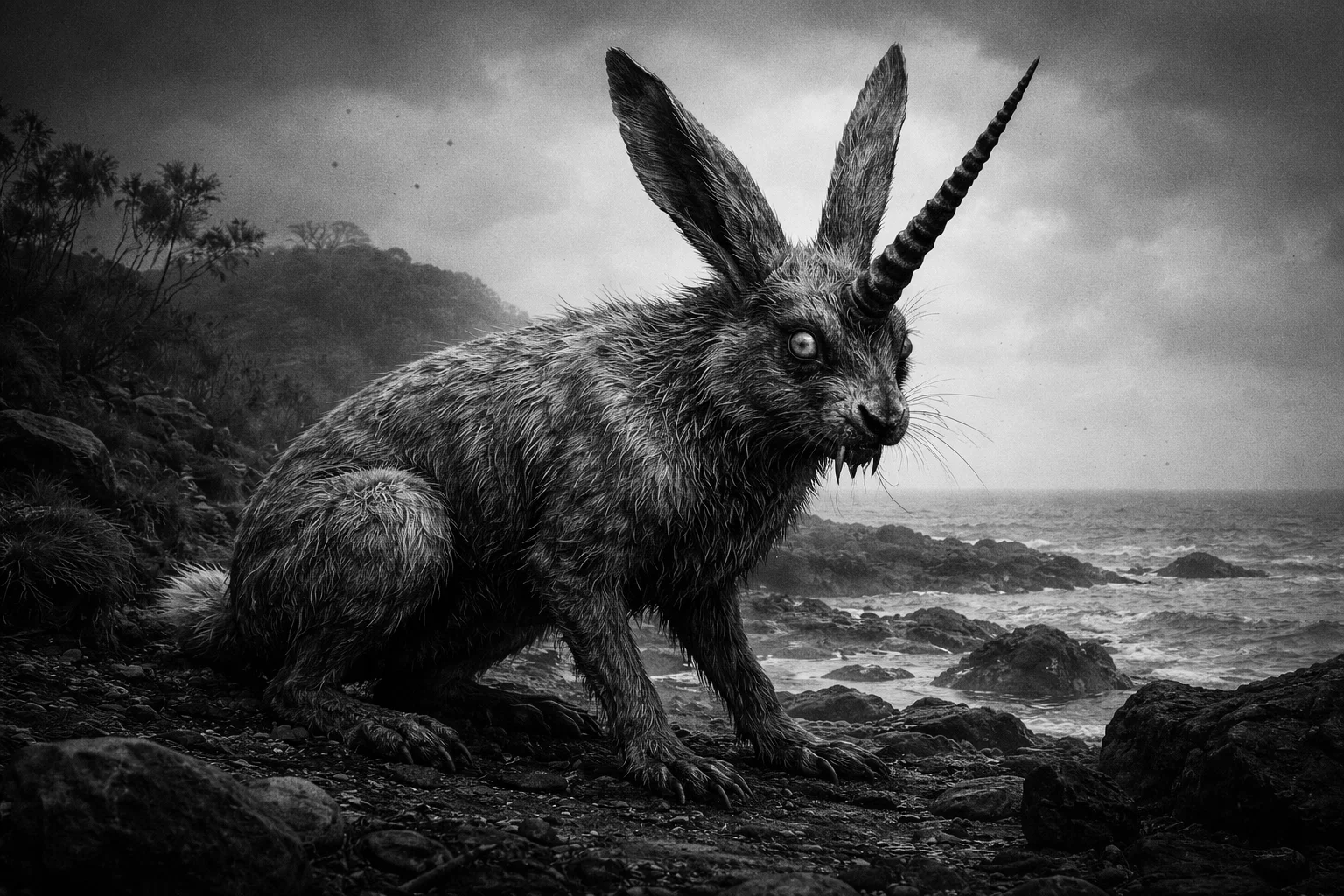

Al-mi’raj is a legendary creature from medieval Arabic stories and geography. It is mainly known as a fierce inhabitant of a mysterious island in the Indian Ocean.
Although it is small and might seem harmless, historical accounts describe it as a territorial and aggressive predator that can kill much larger animals. Its mix of ordinary animal traits and unusual features has fascinated explorers and scholars for centuries, owing to its fierce reputation.
Summary
Overview
| Attribute | Details |
| Name | Al-mi’raj |
| Alternative Names | Al-miraj, Almi’raj, Al-Mi’raj, Al-Mir’aj |
| Similar Monsters | Jackalope, Wolpertinger, Skvader, Rasselbock, Lepus Cornutus, Unicorn, Bicorne, Bicorn, Camahueto, Karkadann, Indrik, Qilin, Shadhavar, Peryton, Monoceros, Re’em |
| Etymology | Arabic “al-mi’raj” likely referring to the creature’s single horn or “ascension,” though its specific application to the beast is localized to medieval texts. |
| Gender | Male, Female |
| Classification | Beast |
| Species | Hybrid |
| Origin / Culture | Arabian (Indian Ocean islands / Medieval Islamic geography) |
| First Recorded | c. 13th Century – Zakariya al-Qazwini’s ‘Aja’ib al-makhluqat’ |
| Active Period | Always active |
| Size | Equivalent to a large hare or rabbit |
| Diet | Carnivorous (predatory) |
| Habitat | Jazirat al-Tinnin (Dragon Island) in the Indian Ocean |
| Powers & Abilities | • Supernatural speed • Immunity to conventional fear • Predator-deterrent horn |
| Weaknesses | • Divine/Prophetic intervention • Specialized charms or sorcery |
| Reproduction / Creation | Natural biological reproduction |
| Behavior | Solitary ambush predator |
| Pop Culture | D&D 1e Fiend Folio, Dragon Quest series, Final Fantasy series, Pathfinder RPG |
Description
Al-mi’raj is known for being extremely territorial and surprisingly predatory. Historically, it is linked to the remote island of Jazirat al-Tinnin, which is often called the Island of the Dragon.
Unlike most herbivores of its kind, Al-mi’raj is described as a fierce carnivore that attacks animals much bigger than itself. Medieval sailors and geographers mentioned it in their accounts of the wonders of the eastern seas.
In Islamic folklore, Al-mi’raj is seen as a “wonder” (ajā’ib), showing the strange and sometimes dangerous variety of life in unknown parts of the world. It is not thought of as a spirit or demon, but as a rare and unusual animal. Its reputation was so frightening that people in the areas where it lived reportedly asked outsiders for help to control it.
Loren Coleman Cryptozoology A to Z – Up to 46% OFF!
This authoritative encyclopedia catalogs hundreds of mysterious creatures in accessible A-to-Z format, authored by leading experts Loren Coleman and Jerome Clark. From classic Sasquatch sightings to exotic global cryptids, with cross-references, bibliography, and evocative illustrations – ideal for dark curiosity cabinets, paranormal studies, or sparking hunts for the world’s hidden beasts.
Etymology
The name Al-mi’raj comes from Arabic. Although “Mi’raj” is best known for its link to the Prophet Muhammad’s “Night Journey and Ascension,” in this case, the word is usually seen as separate. It refers to the “rising” or “protruding” single horn of the creature.
In classical Arabic, the word “Al-” is added to the noun. Language experts believe the name points to the creature’s most important feature: its single horn. Some researchers think the name changed in pronunciation as the story spread along trade routes from the Indian Ocean to major Middle Eastern cities like Baghdad and Cairo.
How to Pronounce “Al-mi’raj” in English
In English, the name is usually pronounced as al-mi-RAHJ (æl mɪˈrɑːʒ). The first part, “Al,” rhymes with “pal.” The second, “mi,” sounds like “me” or like “mi” in “mineral.” The last part, “raj,” is stressed and sounds like “raj” in “Maharaja,” with a soft “j” as in “measure” or a regular “j” sound.
Appearance
Al-mi’raj appears to be a large rabbit or hare. Its most noticeable feature is a single, black, spiraled horn that grows from the middle of its forehead. This horn is about two spans long (roughly 1.2 to 1.5 feet) and is very sharp.
The creature’s fur is usually shown as bright yellow, though some old stories say it is golden. Even though it has a small, rabbit-like body, its face and posture are often described as intense and predatory rather than gentle.
The mix of its soft, familiar body and its hard, dark, obsidian-like horn gives Al-mi’raj a unique look. The horn’s spiral shape is like a narwhal’s tusk or a unicorn’s horn, but much smaller.
Powers & Weaknesses
Powers
Al-mi’raj is much stronger and more aggressive than its size suggests. Its main skill is fighting, and it can kill animals as big as wolves, lions, or even elephants with its single horn. This hints at some supernatural strength or accuracy.
The creature also shows a kind of fearlessness, attacking top predators without hesitation. It is known for its great speed and agility, which makes it almost impossible to catch or hit in the usual ways. Its horn is said to be nearly unbreakable and can pierce thick hides that normal steel weapons cannot.
Weaknesses
Even though Al-mi’raj is deadly in battle, it is not unbeatable. Old stories say it is vulnerable to holy or divinely protected people. The most well-known legends claim that only a “true prophet” or someone with special spiritual power could handle or stop the creature.
Al-mi’raj is not protected against magical charms or spells meant to calm or drive away wild animals. Since it acts on instinct and is very territorial, it can be tricked or trapped if the bait appeals to its hunting instincts. It also has no known resistance to poisons or elemental attacks, so if it is hit, it can be hurt like any other animal.
NECA Collectible Texas Chainsaw Massacre Ultimate Leatherface
Horror masterpiece from NECA: 7” articulated Leatherface with swappable heads (terrifying masks and expressions), chainsaw with sound potential in pose, hammer, meat hook, and extra hands for dynamic displays. Authentic film-accurate detailing in a collector-friendly window box – perfect for witchy altars or creepy collections.

Myths, Legends & Stories
The Island of the Dragon
The primary narrative regarding Al-mi’raj begins on a remote island in the Indian Ocean known as Jazirat al-Tinnin.
According to the accounts of the 13th-century geographer Zakariya al-Qazwini, the island was once plagued by a massive dragon that descended from the mountains to consume the livestock and people of the local inhabitants. The people were helpless against the dragon’s scales and fiery breath.
Seeking salvation, the islanders appealed to Alexander the Great (known in many Islamic traditions as Dhul-Qarnayn) during his travels through the East.
Alexander, known for his wisdom and tactical brilliance, devised a plan to kill the dragon by feeding it two oxen hides stuffed with sulfur, lime, and iron hooks. When the dragon consumed the bait, the mixture ignited, and the hooks snagged its throat, killing the beast.
The Reward of the Horned Hare
Once the dragon was slain, the inhabitants of the island were filled with gratitude. As a gift to Alexander, they presented him with a creature found only on their island: the Al-mi’raj. This was the first time the creature was documented in the annals of history.
Alexander was said to be fascinated by the animal. He noticed that, even though it looked like a harmless rabbit, local animals—including lions and tigers—ran away in fear when it approached. This story highlights the “wonders of creation” (Ajā’ib), a common idea in medieval Islamic writing that shows God’s power through animals that break the usual rules of nature.
The Prophet’s Mastery
In later variations of the lore, the Al-mi’raj became a symbol of the necessity of divine order. Stories circulated that the creatures were so aggressive that they threatened to overpopulate the island and kill all other life. It was said that only a man of pure spirit and prophetic lineage could approach an Al-mi’raj without being gored.
In these stories, the creature would lower its head and become calm when a holy person was near, with its horn touching the ground as a sign of submission.
This changed the Al-mi’raj from just a monster into a test of character and spiritual purity. If someone met the beast and survived, it was seen as proof of their goodness or that they were protected by a higher power.
Symbolism
Al-mi’raj is a strong symbol of how appearances can be deceiving. Its rabbit-like shape makes it seem gentle and weak, but its horn and actions show it is actually very dangerous. This mix reflects the medieval Islamic belief that nature hides many truths and that you should not judge by looks alone.
The creature also symbolizes the wild and amazing parts of the world beyond civilization. More broadly, it shows that even the smallest animal can have the power to defeat much bigger ones if it has the right qualities.
Can Al-mi’raj Be Defeated?
Trying to defeat an Al-mi’raj by force is usually seen as impossible for most people. Its speed and sharp horn make fighting it up close very dangerous. People typically protect themselves from the creature by using special talismans or by staying away from its territory.
In medieval stories, travelers were told to carry amulets with special verses or powerful names to protect themselves from the creature. Some stories also say that mirrors could confuse Al-mi’raj, since it might attack its own reflection, giving someone a chance to get away.
However, the most reliable way to deal with Al-mi’raj is not to kill it, but to tame its spirit. Old texts say that the only certain way to protect a community is for a spiritual leader or wise person to use prayers or sacred words to calm the animal.
There are no stories of using special plants or stones as weapons against Al-mi’raj. Instead, these items were used in larger protective rituals to make a safe space where the creature could not enter.
Tags:
Related Monsters…
Akkorokamui (Ainu Monstrous Sea Kraken)
January 8, 2026
December 3, 2025
Azhi Dahaka (Persian Three-Headed Dragon)
January 19, 2026
Black Shuck (Ghost Dog from East Anglia)
January 26, 2026
Alkonost (Russian Half-Bird, Half-Woman)
December 8, 2025
