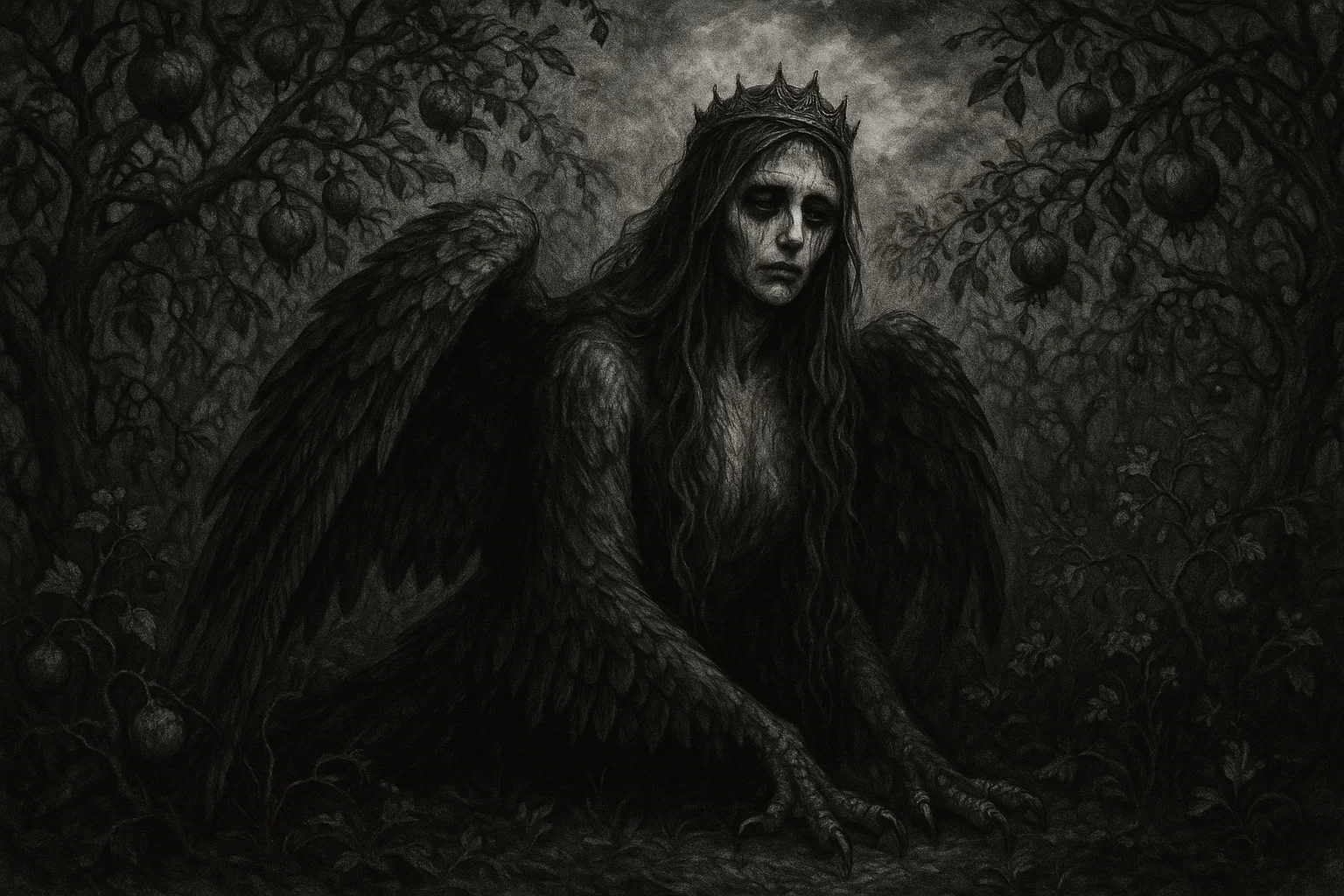

The Alkonost is a hybrid monster most commonly mentioned in the East Slavic mythology and Russian folklore. This legendary creature is portrayed as a beautiful woman with the body, wings, and talons of a large bird of prey.
Unlike other mythical beings, the Alkonost is often seen as a beneficial or non-malicious entity whose actions directly affect the physical world, making it a focal point in the understanding of the environment and seasonal change in East Slavic mythology.
Summary
Overview
| Attribute | Details |
| Name | Alkonost |
| Alternative Names | Alkonos |
| Similar Monsters | Sirin, Gamayun, Harpy, Siren, Rusalka, Lilitu, Lamia, Garuda, Zhar-Ptitsa, Simurgh, Sphinx, Peryton |
| Etymology | From Old East Slavic ‘alkonst’ (алконост), which is an adaptation of the Greek ‘alkuōn’ (ἀλκυών) meaning ‘kingfisher’ or ‘halcyon’ |
| Gender | Female |
| Classification | Mythological Bird |
| Species | Hybrid |
| Origin / Culture | East Slavic (primarily Russian) |
| First Recorded | 12th Century CE – The Izbornik of Sviatoslav |
| Active Period | Always active |
| Lifespan | Unknown |
| Diet | Unknown |
| Habitat | The Garden of Eden (or paradise), sometimes associated with Buyan Island |
| Powers & Abilities | • Producing music and sounds that cause forgetfulness, joy, or trance • Ability to control or affect the weather by laying eggs • Creating a windless, calm sea period |
| Weaknesses | None |
| Reproduction / Creation | Unknown; appears to be a creature of primordial or divine creation |
| Behavior | Usually solitary; sings songs that are pleasant but can be dangerous to humans |
| Pop Culture | Slavic fantasy art (numerous artists) / Russian coinage designs / “The Witcher” (video game series, as a variant of the Harpy) |
Description
The Alkonost is a creature from East Slavic mythological and religious traditions, primarily functioning as a celestial being or a resident of paradise. She is often placed in proximity to the divine or in the mythical land of Buyan Island.
The creature’s existence is not defined by predation or malevolence towards humans. Rather, it is characterized by its powerful songs and the profound, though often inadvertent, effect these songs have on any listener.
The Alkonost is an interesting creature, especially when it comes to its role in nature and the sea. She’s known for her ability to calm storms, which brings good weather and peaceful conditions for navigation.
Bulfinch’s Mythology Leather-Bound Classics Edition – Up to 43% OFF!
Own the timeless masterpiece in luxurious flexi leather-bound format from Canterbury Classics. Thomas Bulfinch’s complete compilation: The Age of Fable (Greek/Roman gods & heroes), The Age of Chivalry (King Arthur & knights), and Legends of Charlemagne – over 800 pages of elegantly retold ancient myths, Norse lore, and medieval romances. Gilded edges, ribbon marker, and premium binding make this a stunning heirloom for occult libraries or dark academia shelves.
Etymology & Origins
The name Alkonost is derived from an Old East Slavic corruption of the Greek name for the Kingfisher, alkuōn (ἀλκυών), or the concept of the Halcyon. This etymological root strongly suggests a transmission of the creature’s lore from Byzantine Greek sources into the early East Slavic cultures, likely through translated Christian texts.
In Greek tradition, Halcyon Days were a period of calm, windless weather surrounding the winter solstice, attributed to the kingfisher laying its eggs on the sea, which calmed the waves.
The creature’s earliest known appearance in East Slavic culture is in the Izbornik of Sviatoslav, a translated compilation of Byzantine texts dating to the 12th century CE. In these early sources, the Alkonost is mentioned alongside its mythological counterpart, the Sirin.
Her mention in religious or semi-religious manuscripts suggests its immediate integration into a framework that often blended pre-Christian folklore with Christian concepts, where it was frequently interpreted as a creature of paradise. The myth evolved when it comes to medieval Russian religious and apocryphal literature.
Appearance
The Alkonost is a hybrid being. She has the head and bust of a woman and the full body of a bird. The female portion is typically depicted with a beautiful and often sorrowful face, complete with long hair (which is sometimes covered by a crown or a veil).
The bird components are invariably massive and powerful, usually resembling a large bird of prey (such as an eagle or a falcon). These features include large, feathered wings, a raptor’s body, and powerful talons.
Unlike the Greek Sirens, the Alkonost is less frequently shown with exposed human arms and is primarily a feathered creature from the neck down. Her size is a lot larger than that of any natural bird, making it a formidable presence in the air.
Powers & Weaknesses
Powers
The central power attributed to the Alkonost resides in her voice and song. Her vocalizations are reported to be so exquisitely beautiful that anyone who hears them is rendered incapable of remembering anything. The songs induce a state of profound peace and joy, causing the listener to forget all grief, sorrow, and worldly desires, potentially leading to a spiritual or mental detachment from reality.
However, it is worth mentioning that this effect is not necessarily malevolent but rather an overwhelming and trance-like spiritual experience.
What’s more, the Alkonost has a power linked to the control or temporary cessation of natural phenomena, specifically the sea. Following the Greek Halcyon tradition, it is believed that the Alkonost lays its eggs directly into the sea, guarding them for seven days.
During this period, the creature calms all storms and winds, creating a period of absolute peace and tranquility, traditionally known as the Halcyon Days.
Weaknesses
According to lore, the Alkonost doesn’t have any obvious weaknesses that can be used to injure, repel, or kill her. While unusual, that may be because the creature is not inherently malicious, which may account for the lack of countermeasures against her. Her power is in its song, and the potential “danger” is a passive result of its divine beauty, not an active threat.
However, the creature’s mythical counterpart, the Sirin (which represents sadness and sorrow), is sometimes warded off by loud noises, such as cannon fire, ringing bells, or horn blasts.
Since the Alkonost’s song induces joy and forgetfulness, it is implied that any strong, jarring earthly distraction could potentially break the trance or lure of its voice, but this is an extrapolation based on the Sirin and not a specific Alkonost weakness.
Myths, Legends & Stories
The Calming of the Sea
The story goes that the Alkonost travels to the edge of the sea, often thought to be the Black Sea, where it lays its eggs. Sometimes she drops the eggs directly into the water, while at other times she places them in a floating seaweed nest.
What’s magical about this moment is that once the Alkonost lays its eggs, the sea becomes completely peaceful for seven days. This calm period is reminiscent of another myth called the Halcyon Days from Greek tradition.
During these seven days, sailors can get through safely, free from the worries of storms and strong winds. However, once the eggs hatch, the tranquility comes to an end, and the sea returns to its usual, unpredictable nature.
Contrast with the Sirin
In Russian folklore, the Alkonost is often mentioned alongside another legendary creature, the Sirin. These two are frequently thought of as sisters living in a mythical place called the Garden of Eden, or Iriy.
What sets them apart is their singing. The Alkonost sings songs that bring happiness and calmness and help people forget the troubles of the world. On the other hand, the Sirin sings beautiful yet sad tunes that can make listeners feel deep sorrow. Those enchanted by the Sirin’s song often feel compelled to follow her, which can lead them to forget their old lives and, in some cases, to despair or death.
So, while the Alkonost’s song invites people to a joyful, peaceful experience, the Sirin’s song carries a darker, more haunting message. Together, they represent two sides of a coin—the Alkonost embodies joy and peace. At the same time, the Sirin symbolizes sorrow and pain.
NECA Ultimate Mummy 7″ Black & White Action Figure – Boris Karloff Classic Deal!
Celebrate the 90th anniversary with NECA’s stunning black-and-white Ultimate Mummy, capturing Boris Karloff’s iconic wrapped horror in exquisite detail. 7-inch scale with interchangeable heads and hands, an opening Egyptian chest accessory, and highly articulated posing. Premium sculpt recreates the legendary makeup – essential for Universal Monsters collectors and dark displays.

Association with Paradise
In later Russian religious art and popular prints known as luboks, the Alkonost is often depicted as a being from Iriy, is realm like the Slavic version of Paradise or the Garden of Eden. In this setting, she isn’t portrayed as a wild creature or a predator but rather as a gentle messenger or a resident of a divine place.
This is why the Alkonost’s song is thought to be beautiful, almost like heavenly music—it offers a glimpse of the joy that awaits good people in the afterlife.
Symbolism
The Alkonost primarily symbolizes Heavenly Peace and the Joys of Paradise within East Slavic culture. Her connection to the Garden of Eden and the inherent joy of its song make it a representation of eternal contentment and spiritual bliss. The concept of total forgetfulness of the earthly world after hearing its voice signifies the ultimate release from suffering and the troubles of mortal life.
What’s more, its ability to calm the sea for seven days strongly associates the Alkonost with Tranquility and Safe Passage, providing a temporary, divinely-granted respite from the dangers of the natural world, particularly for travelers and sailors.
This duality of internal (spiritual joy) and external (natural calm) influence makes the Alkonost a comprehensive symbol of favorable conditions and ultimate well-being.
Tags:
Related Monsters…
Asanbosam (West African Forest Monster)
January 23, 2026
Argus Panoptes (Hundred-Eyed Giant)
January 13, 2026
Acheri (Indian Disease Spirit)
January 29, 2026
Rokurokubi (Japanese Long-Necked Woman)
March 3, 2026
