
Alû is a harmful spirit from ancient Mesopotamian demonology. Often linked to the “Seven Evil Spirits,” it is known for causing sleep troubles and a sense of fear. Alû usually acts at night, going after people to drain their energy or cause distress. Among Sumerian and Akkadian spirits, Alû is seen as a constant danger to both homes and personal well-being.
Summary
Overview
| Attribute | Details |
| Name | Alû |
| Alternative Names | Gallû, Aluu, Alu, Allu |
| Similar Monsters | Mare, Moroi, Alp, Ephialtes, Incubus, Succubus, Pishtaco, Popobawa, Trauco, Koshchei, Baku, Pesanta, Nocnitsa, Batibat, Tikbalang, Lidérc, Karakoncolos, Tiyanak, Bogeyman |
| Etymology | From Akkadian ‘alû’, potentially derived from Sumerian ‘alla’ |
| Gender | Male (occasionally described as genderless) |
| Classification | Demonic Entity |
| Species | Spectral / Amorphous |
| Origin / Culture | Mesopotamian (Sumerian and Akkadian) |
| First Recorded | c. 2100 BCE – Sumerian incantations and royal inscriptions |
| Active Period | Nocturnal |
| Diet | Life force and sleep |
| Habitat | Ruins, abandoned buildings, and bedrooms |
| Powers & Abilities | • Invisibility • Physical constriction • Inducing sleep paralysis • Silence manipulation |
| Weaknesses | • Protective amulets • Ritual incantations • Recitation of specific divine names |
| Reproduction / Creation | Spontaneous manifestation from the netherworld or the offspring of Anu |
| Behavior | Solitary nocturnal predator |
| Pop Culture | Final Fantasy XI / Dungeons & Dragons (as Alu-fiend) / Shin Megami Tensei / The Exorcist (referenced in lore) |
Description
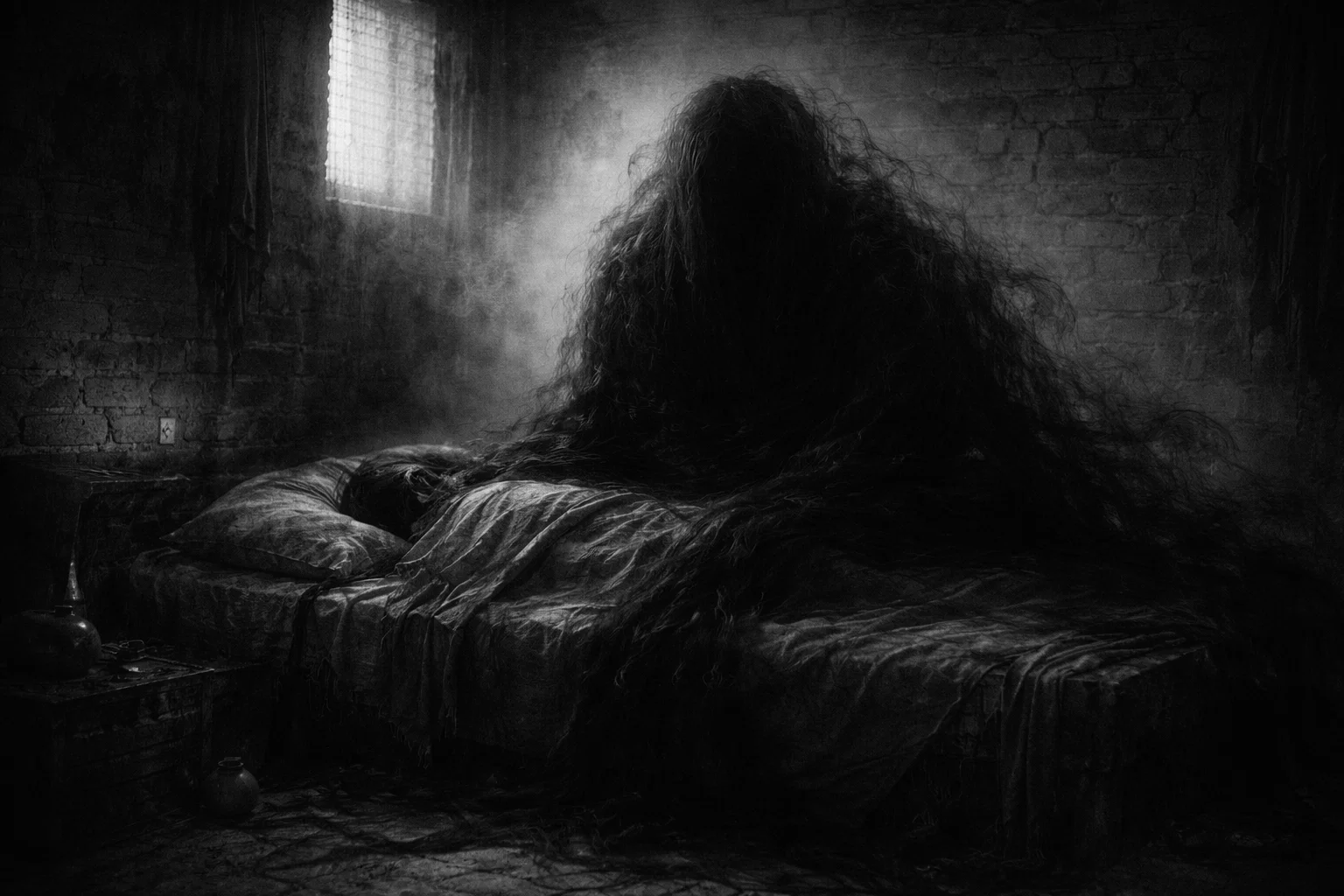
Alû is an evil spirit that sneaks into people’s homes at night. It is called a “demon of the silence” because it can get close to its victims without making any noise.
Unlike other Mesopotamian demons that cause certain illnesses, Alû mainly disrupts sleep and drains a person’s energy. People often describe it as a shadowy or leper-like entity without clear human features, sometimes just a shapeless mass or a faceless being.
Alû’s main purpose is to overpower its victims’ senses. It does not talk or make any sound. Instead, it covers the person, making them feel heavy or unable to breathe. Because of this, some modern scholars think Alû is an early way to explain sleep paralysis. According to lore, one of the seven children of the sky god Anu was sent to trouble humans.
Etymology
The name Alû comes from the Akkadian version of the older Sumerian words “U-Gallu” or “Alla.” The exact meaning is debated, but it is often linked to ideas like “tempest” or “great storm spirit.” In demonology, though, the name came to mean a certain kind of ghost that haunts ruins and dark places.
Some language experts think the name is related to the word for “gall,” which suggests something bitter or poisonous. As the word moved from Sumerian to Akkadian, it kept its meaning as a name for a being that “covers” or “envelops” its victims, showing how it attacks.
How to Pronounce “Alû” in English
In English, Alû is usually pronounced as ah-LOO. The first part, “ah,” sounds like the “a” in “father.” The second part, “LOO,” is stressed and sounds like the “u” in “blue.” Some scholars suggest a slight pause between the syllables, but most people just say it as two simple syllables.
Appearance
It is hard to describe what Alû looks like because it is often said to have no arms, legs, head, or mouth. Ancient writings call it a shapeless or “half-formed” being. When it does take on a form, it might look like a man with leprosy or someone wrapped in funeral cloths, hiding its face. Basically, it is like a shadow that has become solid.
Sometimes, art on cylinder seals or amulets shows Alû with animal features, like dog ears or a lion-like shape. Still, these images are less common than the usual faceless, limbless ones.
People usually sense Alû rather than see it. It is described as a “darkness that stalks,” like a heavy mist or thick cloak that settles on someone as they sleep, making them feel its weight even if they cannot see it.
S. Petersen’s Field Guide to Lovecraftian Horrors Hardcover – Up to 24% OFF!
A beautifully crafted hardcover “field guide” to the terrors of the Cthulhu Mythos by RPG legend Sandy Petersen. Over 100 pages of exquisite full-color artwork depicting classic and obscure entities, with scientific-style entries on appearance, behavior, weaknesses, and distribution. Indispensable reference for Keepers, players, or anyone fascinated by eldritch horrors.
Powers & Weaknesses
Powers
Alû has several supernatural powers, mainly focused on being sneaky and holding people down. Its main ability is to become completely silent and invisible, so it can slip into homes through small cracks in doors or windows without anyone, even dogs, noticing.
When Alû finds a victim, it presses down on their chest, making it hard for them to move or speak. This is called “enveloping” the soul. The demon can also make people feel very tired and confused, slowly draining their energy over several nights. Alû can haunt ruins, too, making these places so frightening that people avoid them.
Weaknesses
Alû’s main weaknesses are ritual magic and help from the gods. It is especially vulnerable to certain Mesopotamian gods, like Enki (Ea) and Marduk. Saying special incantations known as the “Udug-hul” series is said to keep it away.
Light and the sound of certain bronze bells or drums used in rituals can also drive Alû away. People believed that physical barriers marked with special symbols or flour circles could stop it from coming in.
Alû is also limited by certain cosmic rules. It cannot stay in a place where a trained priest, called an “ashipu,” has performed the right purification rituals.
Myths, Legends & Stories
The Seven Evil Spirits
Alû’s origin is connected to the earliest stories of the Mesopotamian universe. Ancient texts say Alû was created along with six other evil spirits. They were the children of the sky god Anu and the earth goddess Ki, though some stories say Anu and the underworld were their parents. Unlike the main gods who kept order, these seven spirits brought chaos.
At first, these spirits had no special jobs in the heavens. Instead, they were sent to the far edges of the earth and deep into the Abyss. Alû became known as the spirit of dark places and the quiet that comes after a storm.
Alû’s job was to be a “limb-less” hunter, something people could not catch or fight with normal weapons. In this role, Alû acted as a kind of divine punisher, bringing “divine madness” to those who angered the gods or ignored their rituals.
The Haunting of the Ruins
As Sumer and Akkad grew, Alû’s role changed from a cosmic force to a threat inside people’s homes. Stories tell of travelers who took shelter in the ruins of old cities or empty temples. In these tales, Alû is called the “King of the Ruins.” One legend tells of a merchant who tried to sleep near a crumbling ziggurat.
When the sun went down, the desert became strangely quiet. The merchant sensed something there, even though it made no sound. As he lay down, Alû came over him like a heavy, cold blanket. The merchant survived because he had a small cylinder seal of the god Enki, which glowed faintly and sent the demon back into the shadows.
The Night Visitor
A common story about Alû concerns is entry into the city of Babylon. During a time of serious illness, people said the demon walked the streets every night. It did not attack healthy people, but went after those already sick with fever.
Stories say the demon slipped through reed mats on doors and appeared as a faceless man. It would sit on people’s chests as they slept, taking their last breaths. These tales were so common that people created “House of the Sick” rituals, where priests stayed up all night chanting to make sure the room was never quiet enough for Alû to appear.
Creepy Gothic Horror Posters – Limited Deal Alert!
Elevate your witchy room with 97 Decor’s masterful unframed posters blending dark gothic aesthetics, horror elements, and creepy occult art. Rich, atmospheric designs with witches, macabre motifs, and vintage spookiness – essential for creating a captivating, moody atmosphere that draws in the shadows.
The Exile of the Faceless One
A later myth tells of a powerful priest-king who faced Alû. The king’s son had been “grasped” by Alû and fell into a sleep he could not wake from. The king went to Eridu to ask the god of wisdom for help. He learned that Alû could not be killed because it was a divine shadow, but it could be sent away.
The king was told to make a figure of the demon, without limbs or a face, out of dark clay and put it at a crossroads outside the city. By naming the demon and using special prayers to move its “heaviness” into the clay, the king was able to free his son from Alû.
Afterward, the king smashed the clay figure. He buried the pieces in the desert, which symbolized sending that form of Alû away to the wasteland.
Symbolism
Alû is a strong symbol of hidden dangers and how vulnerable people are when they sleep. It symbolizes the fear of being awake yet unable to move, serving as a link between the living world and the world of shadows.
Symbolically, Alû represents stagnation and decay. By haunting ruins, it reminds people how fragile civilization is. Its lack of features and voice symbolizes the “void”—the emptiness and silence beyond the safety of society and the gods. More generally, it is like the heavy, frightening feeling of a nightmare.
Can Alû Be Defeated?
Alû is an immortal spirit and cannot be destroyed forever, but it can be driven away, banished, or stopped. Ancient Mesopotamians used both physical and spiritual methods to protect themselves from this night visitor.
Ritual Protection
The main way to guard against Alû was with protective magic. People would put “Pazuzu” heads or amulets around their necks or above their beds. Even though Pazuzu was a demon, he was often called on to protect people from other evil spirits, such as Alû or Lamashtu. People also buried small clay figures of the “Apkallu” (wise spirits) beneath their floors to serve as guardians.
Incantations and Offerings
Professional exorcists, called ashipu, were hired to perform special cleansing ceremonies. These rituals included:
- The Flour Circle: Drawing a circle of specialized flour or powder around a victim’s bed to create a sacred boundary.
- Water Purification: Sprinkling “holy water” from the Euphrates or Tigris rivers, which was believed to carry the cleansing power of the god Enki.
- Incense: Burning cedar, juniper, or bitumen to create a pungent smoke that the “pure” spirit of the demon could not tolerate.
- Substitution: Creating a “scapegoat” or a clay model of the demon to draw the curse away from the human host, which was then cast away into the wilderness.
By using these methods together, ancient people believed they could free someone from the demon, help them recover, and keep their home safe from future attacks.
Tags:
Related Monsters…
Black Annis (Blue Hag of Leicestershire)
February 18, 2026
Akaname (Japanese Filth-Licking Yokai)
January 5, 2026
Akkorokamui (Ainu Monstrous Sea Kraken)
January 8, 2026
Ammit (Egyptian Soul Devourer Demon)
December 8, 2025
