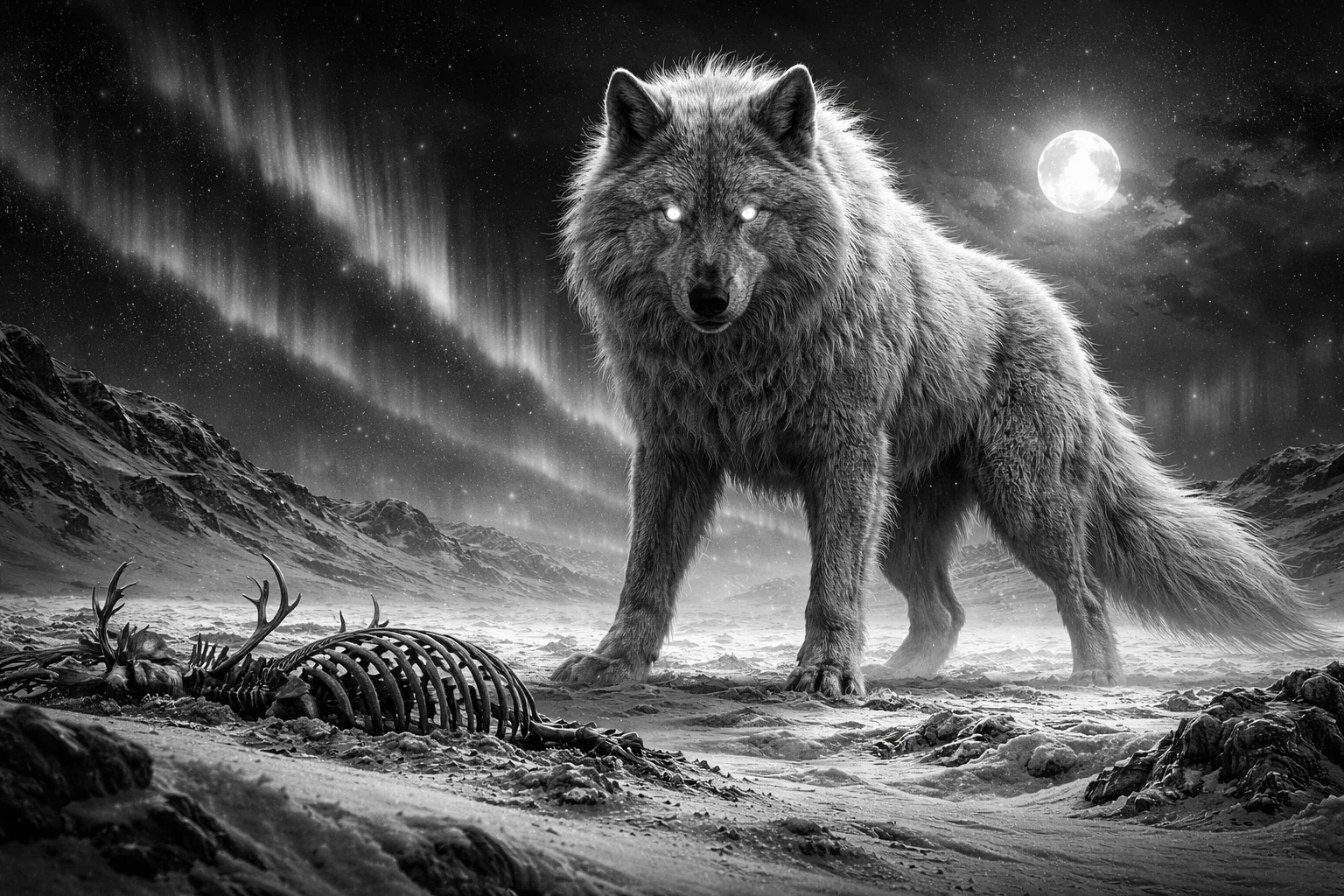

Amarok is a powerful monster in Inuit mythology, a giant wolf who lives and hunts alone. Unlike regular wolves that travel in packs, an Amarok hunts by itself, often going after people who hunt at night or break cultural rules. It acts as both a real predator and a spiritual guardian in the Arctic, symbolizing the wild and dangerous side of the northern wilderness.
Summary
Overview
| Attribute | Details |
| Name | Amarok |
| Alternative Names | Amaroq, Amaguq, Amarog |
| Similar Monsters | Fenrir, Garmr, Akhlut, Waheela, Shunka Warakin, Wheetchala, Cŵn Annwn, Gallytrot, Gytrash, Shuck, Sköll, Hati, vargr, Amarok (modern cryptid), Maheekan, Ti-mene, Kaluapaluk |
| Etymology | Inuktitut: ‘amaruq’ meaning ‘wolf’. |
| Gender | Male, Female |
| Classification | Cryptid, Spiritual Entity |
| Species | Beast |
| Origin / Culture | Inuit (Greenland, Northern Canada, and Alaska) |
| First Recorded | 1875 – Tales and Traditions of the Eskimo by Hinrich Rink |
| Active Period | Nocturnal |
| Size | Significantly larger than a standard gray wolf; often described as the size of an elk or a small house. |
| Diet | Caribou, human flesh |
| Habitat | Arctic tundra, ice fields, and remote wilderness |
| Powers & Abilities | • Soul detection • Spiritual tracking • Enhanced stealth in snow • Bone-crushing bite |
| Weaknesses | • Adherence to social taboos • Daylight • Ritualistic offerings |
| Reproduction / Creation | Natural birth (solitary) |
| Behavior | Solitary ambush predator |
| Modern Sightings | 20th century–present, Keewatin District, Nunavut |
| Pop Culture | “The Jungle Book” (1894) / “The Top of the World” (2000s literature) / “The Secret of Roan Inish” (film references) / D&D 3.5e (Frostburn) |
Description
Amarok is a legendary creature found throughout Inuit folklore in the Arctic. It stands out among mythical beings because it is seen as more than just an animal, but not entirely a spirit either.
Instead, this mystical wolf is a real predator with supernatural qualities. Most wolves in the region hunt in groups, but Amarok is known for always being alone.
The beast is often shown as a guardian of nature, especially watching over caribou herds. People believe it removes the weak and sick animals, helping keep the herd healthy for hunters.
But Amarok is also feared, especially by those who leave their communities or hunt at night. Traditionally, meeting the monster is seen as a result of breaking social rules or not respecting the land’s spirits.
Bulfinch’s Mythology Leather-Bound Classics Edition – Up to 43% OFF!
Own the timeless masterpiece in luxurious flexi leather-bound format from Canterbury Classics. Thomas Bulfinch’s complete compilation: The Age of Fable (Greek/Roman gods & heroes), The Age of Chivalry (King Arthur & knights), and Legends of Charlemagne – over 800 pages of elegantly retold ancient myths, Norse lore, and medieval romances. Gilded edges, ribbon marker, and premium binding make this a stunning heirloom for occult libraries or dark academia shelves.
Etymology
The word “Amarok” comes from the Inuktitut language, spoken by Inuit people in the Arctic. In Eastern Canadian Inuktitut, ‘amaruq,’ and in Greenlandic, ‘amaroq,’ both mean ‘wolf.’ In Greenlandic, this word has long meant ‘wolf,’ referring to the Canis lupus species.
In myths and stories, though, the word takes on a special meaning. It refers to the “Great Wolf.” This difference matters because while a normal wolf is respected but common, an Amarok is seen as a unique and legendary being.
The name suggests something ancient and powerful, meaning “The Wolf” as a single, important creature rather than just any member of a wolf pack.
How to Pronounce “Amarok” in English
In English, people usually say AM-uh-rok, with the first part stressed and sounding like the ‘a’ in ‘apple.’ The middle is a soft ‘uh,’ and the last part, ‘rok,’ rhymes with ‘dock’ or ‘lock.’ Some say AH-ma-rok, using an ‘ah’ sound at the start.
Appearance
Amarok is known for being much larger than an Arctic wolf. It has a thick, heavy coat that can be white, grey, or black, helping it hide in the snow or shadows. Its fur is also rougher and longer than a normal wolf’s.
The beast is very strong and built for endurance. Its huge paws let it run on deep snow without sinking, and its eyes are often said to glow yellow or blue. It has a long, bushy tail, usually held low. Its jaws are so big and strong that they could crush the bones of a caribou or even a person in one bite.
Powers & Weaknesses
Powers
Amarok’s powers go beyond those of a normal animal. It can sense people who have broken cultural rules, no matter how far they run. This ability, sometimes called “soul tracking,” means it never loses track of its chosen target.
Amarok is also incredibly stealthy. Even though it is huge, it can move silently over ice and snow, sometimes seeming to appear out of nowhere. It is tough enough to survive the harshest Arctic storms. Some stories say its bite can “eat the spirit” or paralyze with fear, not just cause physical harm.
Weaknesses
Amarok is limited by the same rules it enforces. Its main weakness is that if people follow community taboos and rituals, it cannot harm them. If a hunter respects all the hunting rules and honors the caribou, Amarok usually stays away and does not interfere.
Daylight is said to keep Amarok away, since it is mostly active at night and during the dark winter. Certain shamanic rituals can also protect people. An Inuit shaman, called an Angakkuq, might use chants or sacred objects to drive Amarok off. Because Amarok hunts alone, a united community’s spiritual strength can also keep it at bay.
Ultimate Family Co-op Adventure – Horrified: Universal Monsters
Ravensburger’s acclaimed co-op Horrified Board Game masterpiece: Defend against Dracula, The Mummy, Invisible Man, and other icons in a beautifully themed village. Tactical pick-up-and-deliver gameplay, escalating tension, and endless variety. Ideal gateway game for families & friends, 1-5 players, 10+, with 4.8/5 star rave reviews.

Myths, Legends & Stories
Origins
Amarok’s appearance is linked to the ancient balance between the Inuit and their environment. Stories say that when people first hunted caribou, they were too successful and killed the strongest animals, which made the herds weak and sick.
To fix this problem, the Great Spirit or nature itself created Amarok. Its job was to hunt only the weak and sick caribou, so the strong ones could survive. From the start, Amarok was seen as a necessary terror, keeping the world healthy by removing the unfit.
The Hunter Who Chased the Night
One well-known legend tells of a hunter who was proud and refused to stop hunting after dark. He ignored his elders’ warnings and went deep into the ice fields during a new moon. While tracking a caribou, he noticed the tundra had become completely silent. He soon realized he was not alone.
Amarok appeared as a huge shadow over his sled, not as a normal animal. It did not attack right away but circled him for three days, waiting for fear to take over. When the hunter’s strength gave out, Amarok finally approached. His family later found him with no bite marks, but his heart had stopped from pure terror.
The Orphan and the Strength of the Wolf
In another story, a young orphan wanted to become strong enough to protect his village. He went into the wild and asked the spirits for help. Amarok appeared and, instead of eating him, challenged the boy to a magical wrestling match.
Every time Amarok threw the boy down, the boy grew stronger. After days of this tough training, the wolf gave some of its power to the boy. He went back to his village as strong as ten men, able to move huge stones and help his people. This story shows that Amarok can both destroy and empower.
The Great Famine of the North
In a time of great cold and hunger, a pack of regular wolves started attacking an Inuit village. As the villagers got ready to defend themselves, they heard a huge howl from the mountains. Amarok came down, but instead of attacking people, it went after the smaller wolves.
The Inuit believed the wolf pack had gone too far by attacking humans, so Amarok stepped in to restore order. By morning, the pack was either gone or defeated, and Amarok disappeared into the mist, allowing the villagers to survive the winter.
Symbolism
Amarok is a strong symbol of natural balance and justice. In the tough Arctic, people rely on healthy caribou herds and working together. Amarok stands for the “necessary predator” that removes the weak so the group can thrive. It also warns against greed.
By going after those who take too much or hunt at the wrong times, Amarok shows how nature pushes back against people who go too far. Its solitary life also symbolizes the loneliness and danger of the empty northern wilderness.
Can Amarok Be Defeated?
According to lore, no ordinary person can defeat Amarok in a fight. Its size and supernatural strength make weapons like spears or bows useless. The best way to stay safe is to strictly follow hunting taboos. By respecting hunting rules, like not hunting at night and honoring the animals, people avoid becoming Amarok’s target.
Shamans are important for protection. They might give hunters amulets made from caribou bone or special furs blessed to hide a person’s spiritual scent. Some chants, called serratit, are used to create a spiritual shield around a camp.
In some stories, Amarok is driven away by Sacred Fire or by someone proving their spiritual worth. Sometimes, throwing a piece of a ‘clean’ kill—an animal hunted properly—away from yourself can distract Amarok. This shows respect for tradition, and Amarok may let the person go.
Tags:
Related Monsters…
Asanbosam (West African Forest Monster)
January 23, 2026
Akkorokamui (Ainu Monstrous Sea Kraken)
January 8, 2026
Black Annis (Blue Hag of Leicestershire)
February 18, 2026
February 3, 2026
Arachne (Ancient Greek Half-Woman, Half-Spider Beast)
February 10, 2026
