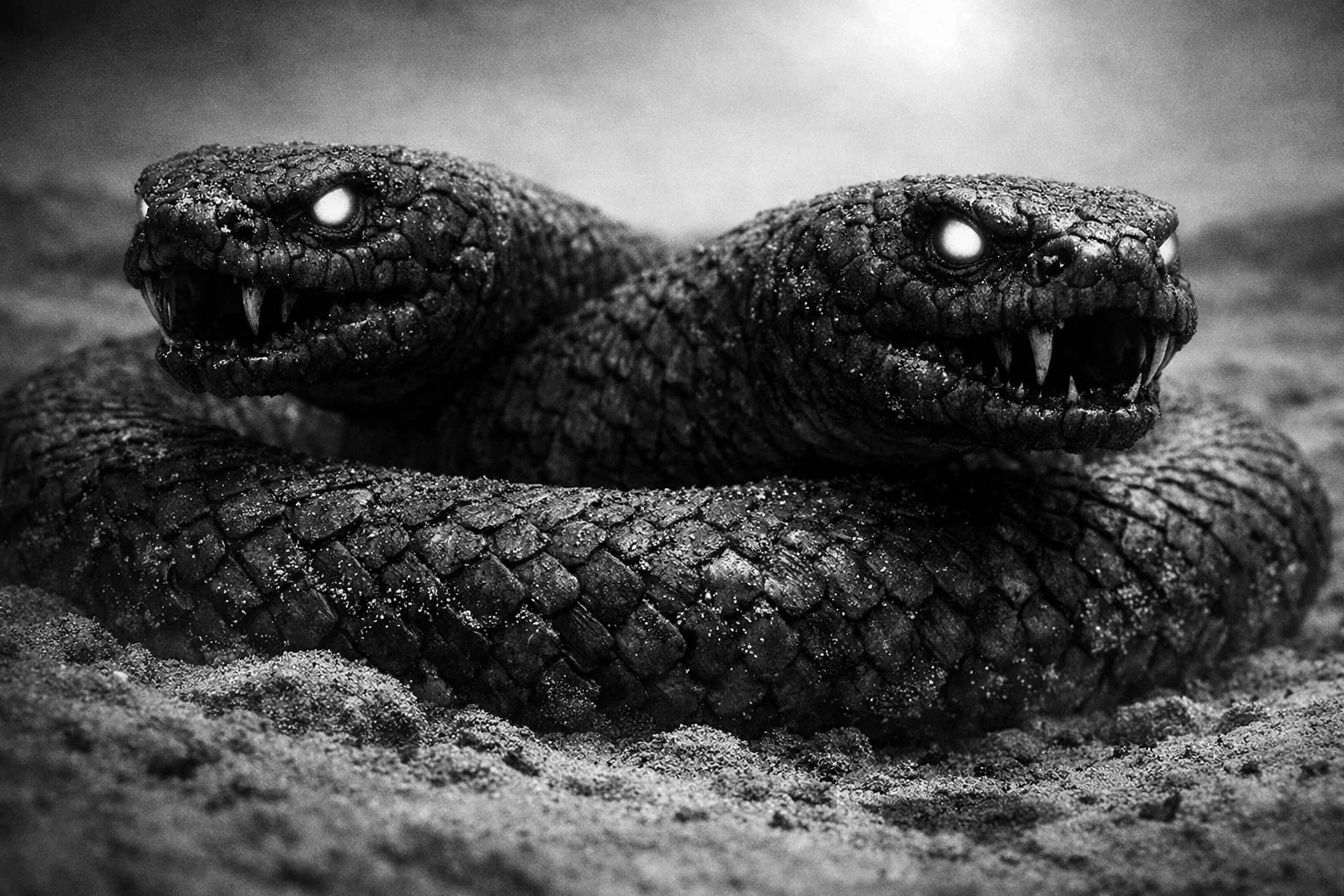

The Amphisbaena is a legendary creature from ancient times, usually described as a serpent with a head at each end of its body. According to Greek mythology, it was born from the blood of a slain Gorgon.
This unusual creature can move in both directions at once and is known for its intense internal heat and supposed medicinal qualities. It has remained a well-known monster in classical natural history and medieval heraldry.
Summary
Overview
| Attribute | Details |
| Name | Amphisbaena |
| Alternative Names | Amphisbaene, Amphisboena, Amphisbaina, Anphivena, Feniseca |
| Similar Monsters | Basilisk, Cockatrice, Ouroboros, Cerberus, Chimera, Hydra, Ladon, Tiamat, Yamata no Orochi, Shesha, Nehebkau, Azhi Dahaka, Aitvaras, Zaltys, Lindworm, Skitalis, Jaculus, Seps, Dipsas, Pareas |
| Etymology | From Greek ‘amphis’ (both ways) and ‘bainein’ (to go) |
| Gender | Male, Female |
| Classification | Mythological Beast |
| Species | Beast |
| Origin / Culture | Greek (Libyan Desert) |
| First Recorded | c. 450 BCE – Herodotus, Histories |
| Active Period | Always active |
| Diet | Ants, carrion |
| Habitat | Deserts, specifically the Libyan Wilderness |
| Powers & Abilities | • Bi-directional movement • Exceptionally high body temperature • Toxic bite • Ability to form a hoop to roll |
| Weaknesses | • Extreme cold • Decapitation of both heads |
| Reproduction / Creation | Born from the blood of Medusa falling onto the Libyan sands |
| Behavior | Solitary scavenger and predator |
| Pop Culture | D&D 5e Monster Manual, Castlevania: Symphony of the Night, Final Fantasy series, Age of Mythology |
Description
The Amphisbaena is a unique type of serpent-like monster. Unlike regular snakes, it has a symmetrical body with no tail. Instead, its body ends in a second, fully functional head. This means the creature can always face forward, no matter which way it moves.
The Amphisbaena is mainly found in deserts, where it lives as a venomous predator. Like other reptiles, it slithers, but its two heads let it form a circle and roll across the ground. In the past, naturalists believed it was real and wrote about its supposed medicinal uses and eating habits as if it were a real animal.
Bulfinch’s Mythology Leather-Bound Classics Edition – Up to 43% OFF!
Own the timeless masterpiece in luxurious flexi leather-bound format from Canterbury Classics. Thomas Bulfinch’s complete compilation: The Age of Fable (Greek/Roman gods & heroes), The Age of Chivalry (King Arthur & knights), and Legends of Charlemagne – over 800 pages of elegantly retold ancient myths, Norse lore, and medieval romances. Gilded edges, ribbon marker, and premium binding make this a stunning heirloom for occult libraries or dark academia shelves.
Etymology
The name Amphisbaena comes from the Ancient Greek word amphisbaina. It combines two Greek roots: amphis, meaning “both ways” or “on both sides,” and bainein, meaning “to go” or “to step.” So, the name literally means “that which goes both ways.”
The name is a functional description of the creature’s primary mythological attribute—its ability to move forward and backward with equal facility due to having a head at each extremity. In Latin, the term was adopted as Amphisbaena, maintaining the same meaning.
Over centuries, the word entered various European languages, sometimes used by naturalists to describe real-world limbless lizards. However, the etymological root remains tied to the Greek observation of its dual-directional movement.
How to Pronounce “Amphisbaena” in English
In English, Amphisbaena is usually pronounced am-fis-BEE-nuh. The first part, “am,” rhymes with “ham,” and “fis” rhymes with “hiss.” The main stress is on “BEE,” which has a long ‘e’ sound. The last part, “nuh,” uses a neutral sound. A less common way to say it is am-fis-BYE-nuh.
Appearance
The Amphisbaena resembles a serpent, with a thick, round body. Unlike normal snakes that get thinner at the tail, its body stays the same width all the way to each end. Each end has a head with jaws and eyes. Old stories often say its eyes glow like lamps or candles.
The Amphisbaena’s scales are said to be very hard and come in different colors, often matching the earth tones of the Libyan desert. Some medieval stories show it with small, bird-like feet or leathery wings. Still, the original Greek version describes it as only a serpent. Its skin is also said to be very tough.
Since it has two heads, the Amphisbaena has no tail. Both heads are the same size and work the same way, so the creature can watch in both directions at once, whether it is coiled up or moving.
Powers & Weaknesses
Powers
The Amphisbaena’s main power is that it can move equally well in both directions without turning around. It also has a very high body temperature, which lets it stay active in freezing weather that would make other reptiles sluggish. Its heat is said to be strong enough to melt snow or warm anyone holding its skin.
The Amphisbaena is very venomous, and both heads can deliver a deadly bite. Its venom is said to work quickly. The creature can also bite one of its own heads to form a circle, letting it roll across the ground much faster than it can slither. This helps it catch prey or escape danger.
Weaknesses
The Amphisbaena’s main weakness is its need for extreme heat. Although it has its own internal warmth, it comes from the hot Libyan desert and can be harmed by long exposure to magical cold or freezing. It is tough, but not immortal, and can be killed by physical injury.
Another weakness is that both heads must be destroyed or disabled to stop the Amphisbaena completely. If only one head is hurt, the other can still control the body or attack.
Because its nervous system is split between the two heads, they sometimes disagree, which can cause hesitation or confusion, especially when it needs to escape in one direction.
S. Petersen’s Field Guide to Lovecraftian Horrors Hardcover – Up to 24% OFF!
A beautifully crafted hardcover “field guide” to the terrors of the Cthulhu Mythos by RPG legend Sandy Petersen. Over 100 pages of exquisite full-color artwork depicting classic and obscure entities, with scientific-style entries on appearance, behavior, weaknesses, and distribution. Indispensable reference for Keepers, players, or anyone fascinated by eldritch horrors.
Myths, Legends & Stories
Myths, Legends & Stories
The existence of the Amphisbaena is ingrained in the chaotic aftermath of a cosmic execution. When the hero Perseus decapitated the Gorgon Medusa, he took flight across the vast expanse of the Libyan desert, the severed head stowed in his kibisis. As he soared, the blood of the monster—which held the power of both life and death—dripped through the fabric of the bag.
Each drop that struck the scorching African sands did not wither; instead, the sun-baked earth acted as a womb for the Gorgon’s gore. From these crimson stains, a legion of serpents slithered forth, but the most unnatural among them was the Amphisbaena.
Born of a curse and the desert heat, it manifested not as a simple predator, but as a biological impossibility: a creature with a head at each end, forever watching both the path ahead and the one left behind.
The March of Cato’s Army
During the Roman Civil War, Marcus Porcius Cato, known as Cato the Younger, led his weary legions on a grueling trek through the heart of the Libyan wilderness. The soldiers were already battling the elements when they encountered the “offspring of the Gorgon.” Lucan’s accounts describe a world where the ground itself seemed to move with shifting, dual-headed shapes.
One story recounts a soldier who, attempting to strike what he thought was a retreating serpent, was horrified to find a second set of jaws lunging from the creature’s tail.
The Amphisbaena did not flee like common vipers; it used its unique anatomy to maintain a constant offensive stance. The legionnaires found themselves in a psychological war, unable to determine the direction of the creature’s movement.
The “doubled” threat of the Amphisbaena became a symbol of the desert’s inherent treachery, where every step forward was met with a gaze that pierced the soldiers’ exhaustion.
The Rolling Hoop of the Desert
In the oral traditions of the ancient Mediterranean, travelers spoke of a terrifying phenomenon known as the “rolling strike.” Unlike other serpents that moved in winding curves, the Amphisbaena was said to possess a specialized hunting technique.
When it spotted prey across a flat salt pan or dune, it would arch its spine, reaching one head toward the other until the jaws of the “tail-head” clamped firmly onto the “lead-head.”
Transformed into a living wheel, the creature would roll across the sand with incredible velocity. Legend tells of a merchant caravan that witnessed a shimmering circle of scales descending a dune at a speed no man could outrun.
This circular form was more than just a mode of travel; it was seen as a sacred geometry of the desert, representing a creature with no beginning and no end, capable of appearing from any horizon in an instant.
The Mother of Ants
Medieval folklore introduced a stranger, more symbiotic relationship between the Amphisbaena and the desert’s smaller inhabitants. It was widely believed that the creature served as a queen or “mother” to the vast colonies of desert ants. According to these legends, the Amphisbaena would lie perfectly still near an anthill, its two heads resting in opposite directions.
The ants would treat the serpent as a guardian, crawling over its scales without fear. The story goes that the Amphisbaena would use its dual heads to lead the ants toward food sources, acting as a living bridge or guide.
However, this was a dark pact; in exchange for its guidance and protection against other predators, the serpent would occasionally consume the very ants it led, a myth that highlighted the creature’s role as a master of manipulation within the hidden hierarchies of the animal kingdom.
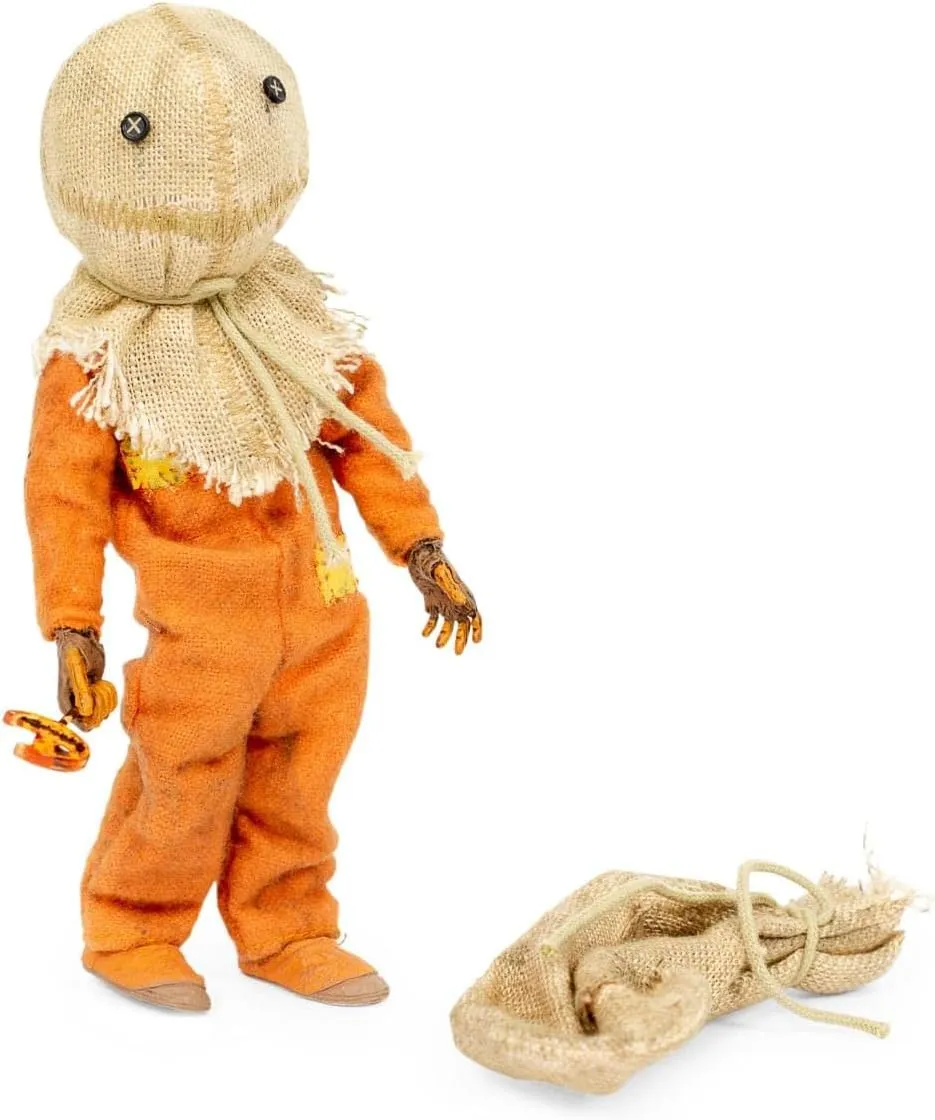
NECA 8″ Clothed Sam Action Figure – Up to 24% OFF!
NECA’s meticulously crafted 8-inch clothed figure of Sam, the sinister spirit from Trick ‘r Treat. Fabric orange pajamas, removable burlap mask revealing his demonic face, lollipop weapon, bitten pumpkin accessory, and extra hands for poses. Fully articulated with real cloth clothing – the perfect eerie guardian for horror collections and year-round spookiness.
The Warmth of the Winter Skin
In the colder regions of the Roman Empire and later in Medieval Europe, a legend persisted regarding the supernatural internal heat of the Amphisbaena. It was said that the creature’s blood burned with the intensity of the Libyan sun that birthed it.
A famous tale involves a woodcutter who found a dead Amphisbaena during a freak winter storm. Remembering the old wives’ tales, he wrapped the serpent’s skin around his frostbitten hands.
The skin immediately radiated a life-saving warmth, supposedly so potent that it could melt snow in a wide radius around the wearer. This legend transformed the monster into a coveted prize for hunters.
People believed that a piece of Amphisbaena skin tucked into a cloak would allow a traveler to survive the most brutal mountain passes. However, the “gift” of the skin was often said to be cursed, eventually drawing other venomous creatures to the wearer’s heat.
The Heraldic Vigilance
As the creature moved into the age of chivalry, its myths shifted toward themes of loyalty and perpetual watchfulness. A popular knightly legend tells of a lord who was betrayed by his own guards while he slept. However, he had a carved Amphisbaena on his bedpost—a gift from a scholar of the East.
According to the story, the carving came to life (or the spirit of the beast intervened). Because the creature has no “blind spot,” it alerted the lord to the assassins approaching from behind his headboard.
Symbolism
Amphisbaena primarily symbolizes duality and paradox. Its two heads, which can go in opposite directions, symbolize inner conflict, indecision, or the challenge of choosing between two equal options. On the positive side, it also represents complete watchfulness and protection. With eyes at both ends, it cannot be ambushed, making it a symbol of an “all-seeing” guardian.
In the past, the Amphisbaena also stood for fertility and the dangers of wild places. In medieval heraldry, it often indicated that someone was ready for anything or possessed many qualities.
Can Amphisbaena Be Defeated?
To defeat an Amphisbaena, you need both skill and the right environment. Old stories say the best way to protect yourself is to use certain herbs or animal-based repellents. People believed that burning galbanum or thick smoke could drive it away, since its two heads are extra sensitive to strong smells.
To kill the creature, both heads must be dealt with. Travelers in the Libyan desert were told to use long weapons to stay out of reach of both heads. Because of its strong internal heat, putting it in cold water or covering it with ice was believed to stop its movement, though this was hard to do in the desert.
Protective amulets also played a role in historical defenses. Pieces of the Amphisbaena’s own shed skin were ironically considered the best protection against its bite, acting as a sympathetic charm. Wearers of these skins, or those carrying jasper stones engraved with the image of a two-headed snake, believed they were rendered invisible to the creature’s thermal-sensitive sight.
In the end, the most common defense mentioned in classical texts was not combat, but avoidance and the use of the creature’s remains for medicinal safety, turning the threat into a source of protection.
Tags:
Related Monsters…
December 3, 2025
Argus Panoptes (Hundred-Eyed Giant)
January 13, 2026
February 3, 2026
December 9, 2025
