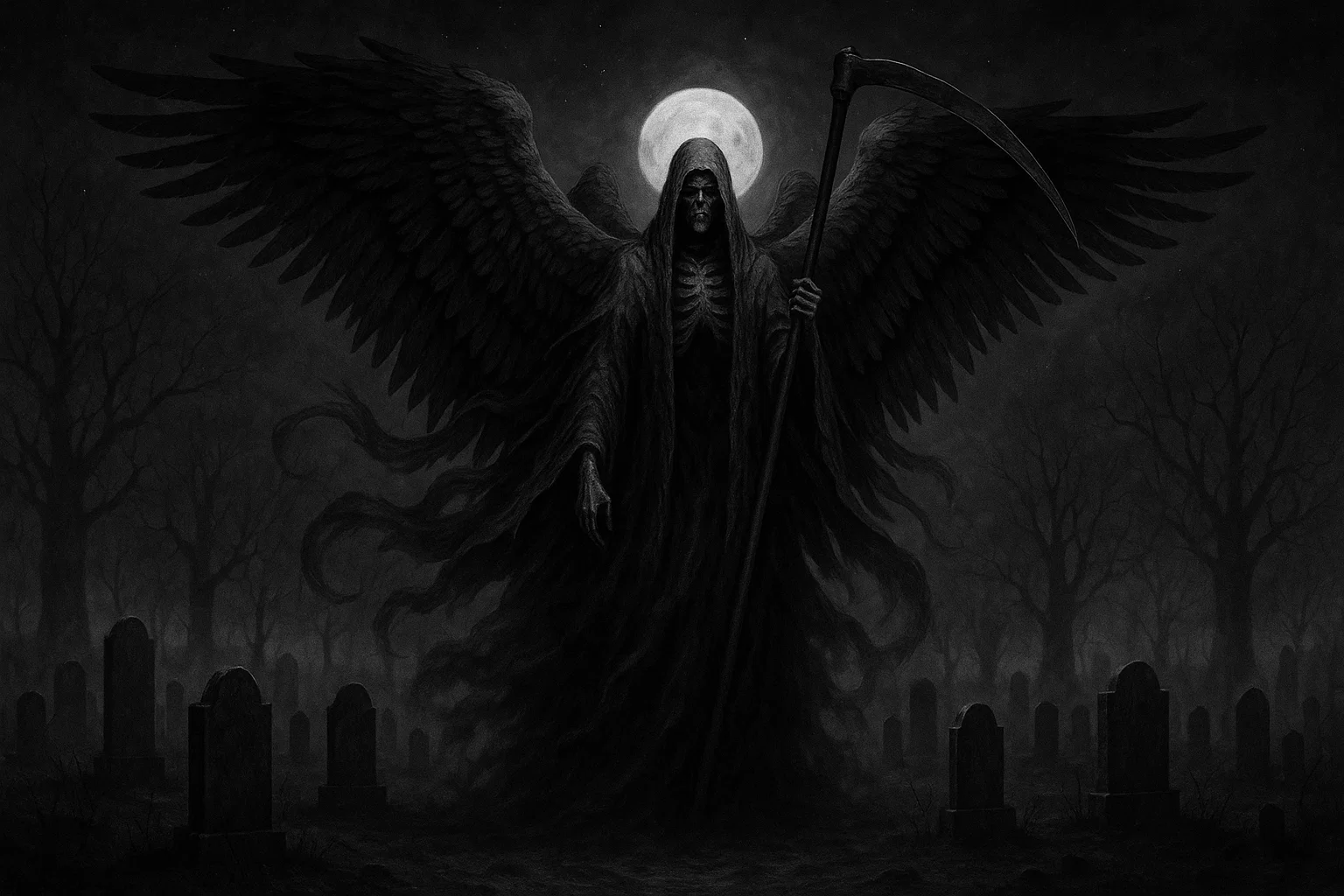

Azrael (the Angel of Death) is a pervasive and complex entity found across numerous religious and mythological traditions. This entity is universally recognized as the psychopomp who guides souls from the physical world into the afterlife.
However, rather than being a single, consistent character, the Angel of Death is a title applied to various figures who embody the finality of existence and the transition beyond it. Its role is critical in theologies concerning predestination and the ultimate fate of all beings.
Summary
Overview
| Attribute | Details |
| Name | Angel of Death |
| Alternative Names | Samael, Azrael, Malach HaMavet, Mūt, Sāryaqīl |
| Similar Monsters | Grim Reaper, Thanatos, Santa Muerte, Yama, Mot, Ankou, Charon, Psychopomp, Death, Old Man Death, Shinigami, Kālī, Gabriel |
| Etymology | English: ‘Angel’ from Greek ‘ággelos’ (messenger) and ‘Death’ from Proto-Germanic ‘dauþuz’ (dying, death) |
| Gender | Male |
| Classification | Celestial Entity, Psychopomp |
| Species | Spectral |
| Origin / Culture | Middle Eastern (Judaism, Islam, Christianity), Persian |
| First Recorded | Tanakh/Old Testament (approx. 6th century BCE), Babylonian Talmud (c. 500 CE) |
| Active Period | Always active |
| Lifespan | Immortal |
| Diet | None (metaphysical function) |
| Habitat | Heaven, Earth (in transit) |
| Powers & Abilities | • Inevitable presence • Ability to strike without fail • Possession of a sword/scythe • Perfect knowledge of all beings • Teleportation between realms • Physical separation of soul from body |
| Weaknesses | • None formally documented, its action is considered Divine Will |
| Reproduction / Creation | Created by God |
| Behavior | Impartial executor of Divine Will regarding the end of life |
| Pop Culture | Dungeons & Dragons 5e Monster Manual (as a type of celestial), “Final Destination” film series, “Good Omens” TV series |
Description
The Angel of Death is a metaphysical entity or spiritual being whose primary function is the cessation of mortal life and the guidance of the soul. This entity is not typically viewed as an agent of evil, but rather as an essential part of the natural, divinely established order. It symbolizes the concept that all life must eventually transition out of the physical world.
The entity’s role is precisely defined in theological texts: to separate the soul from the body at the predetermined time. It is essentially a specialized messenger of God, fulfilling a necessary, if somber, duty.
The Angel of Death operates without prejudice, executing its task irrespective of the mortal being’s virtue or worldly status. The concept serves to point out the inevitability and universality of mortality across all creation.
S. Petersen’s Field Guide to Lovecraftian Horrors Hardcover – Up to 24% OFF!
A beautifully crafted hardcover “field guide” to the terrors of the Cthulhu Mythos by RPG legend Sandy Petersen. Over 100 pages of exquisite full-color artwork depicting classic and obscure entities, with scientific-style entries on appearance, behavior, weaknesses, and distribution. Indispensable reference for Keepers, players, or anyone fascinated by eldritch horrors.
Etymology
The name Angel of Death is a descriptive title rather than a formal, singular name, and it is a direct translation used to designate the entity’s function. The term ‘Angel’ derives from the Greek word ággelos, meaning ‘messenger’ or ‘envoy’. This root highlights the entity’s role as a divine emissary. The name was adopted into Latin as angelus and later into various European languages.
The second part of the title, ‘Death,’ traces its origins back to the Proto-Germanic root dauþuz, which signifies the state of dying or the cessation of life. This root is the source of the English word ‘death’ and focuses on the outcome of the entity’s mission.
In Hebrew, the entity is known as Malach HaMavet (מַלְאַךְ הַמָּוֶת), which literally translates to ‘Messenger of Death’. The Islamic counterpart, Azrael, is thought to derive from the Arabic/Hebrew root words for ‘whom God helps’ or ‘Servant of God’, suggesting a divine assignment rather than an inherent malevolence.
Appearance
The physical appearance of the Angel of Death varies a lot across different traditions, often reflecting the cultural perception of mortality.
In many early Jewish texts, the entity, known as Malach HaMavet, has twelve wings and is covered in eyes. This multi-eyed depiction suggests its ability to see and know all of creation, indicating an omniscient quality regarding the timing of death.
In later Christian and European folklore, the entity is often conflated with the Grim Reaper, whose image is a skeletal monster or an emaciated human form dressed in a dark, hooded robe (usually black) and carrying a large scythe.
Islamic tradition presents Azrael as an entity of immense size, with four faces and four thousand wings, whose body is covered in eyes and tongues, each corresponding to the number of living inhabitants on Earth. In this tradition, he is also frequently depicted holding a celestial book or scroll in which all the names of the living are recorded.
Powers & Weaknesses
Powers
The Angel of Death has several powers that help with its specialized task. The most fundamental power is its inevitable presence and the unconditional ability to strike, meaning it cannot be avoided or defeated by a mortal being. This power is a manifestation of God’s will.
The entity has perfect, instantaneous knowledge of when and how a person is destined to die. It has the power of teleportation, allowing it to move instantaneously between the celestial realm, Earth, and the afterlife.
The Angel of Death can also be invisible to most mortals, appearing only at the moment of transition. Its power includes the physical or metaphysical act of separating the soul from the body, sometimes described as a gentle removal or, in some accounts, a forceful extraction.
Weaknesses
The Angel of Death is generally considered to have no inherent weaknesses that a mortal can exploit for defense or attack. Its nature is that of an immortal, celestial being that acts only on direct divine instruction. Any attempt by a mortal to repel, harm, or defeat the entity is considered futile within theological and mythological contexts.
If the entity is identified with the fallen angel Samael in certain Jewish traditions, then it may be susceptible to the same divine punishment or restriction as other rebellious entities.
While mortal strength is useless, the intense piety or devotion of a great saint or Tzaddik (Righteous One) in Jewish lore can, in rare accounts, temporarily delay or momentarily defy the Angel’s arrival. However, the death itself is eventually unavoidable.
Myths, Legends & Stories
The concept of an Angel of Death originates in the earliest Middle Eastern monotheistic texts, establishing a clear line of divine authority over all life.
Origins in Scripture
The most ancient reference that lays the groundwork for the Angel of Death is found in the biblical narrative of the Exodus.
During the tenth plague on Egypt, an unnamed entity—referred to as the Destroyer or the Angel of the Lord—passes over the land, striking down the firstborn of every Egyptian household, while passing over the homes marked with lamb’s blood.
This act of targeted, divinely sanctioned execution is the foundation for the entity’s eventual personification.
Malach HaMavet and the Righteous
In later Jewish texts, particularly the Talmud and the Midrash, this entity is fully personified as Malach HaMavet. A key narrative involves his interaction with Moses.
When Moses’ time to die arrived, Malach HaMavet approached him. Moses, due to his immense righteousness and spiritual strength, physically fought the Angel and drove him away.
This tradition highlights that the Angel’s power, while immense, is not absolute when confronting the most exalted of prophets. However, God eventually took Moses’ soul into His own hands. Malach HaMavet is also sometimes linked to Samael, who is portrayed as an angel of both death and temptation.
Creepy Gothic Horror Posters – Limited Deal Alert!
Elevate your witchy room with 97 Decor’s masterful unframed posters blending dark gothic aesthetics, horror elements, and creepy occult art. Rich, atmospheric designs with witches, macabre motifs, and vintage spookiness – essential for creating a captivating, moody atmosphere that draws in the shadows.
The Poisoned Sword
A specific and frequent motif in Jewish tradition concerns the implementation of death. Malach HaMavet is often described as carrying a sword, sometimes a dagger, that drips poison called Maras.
When the Angel arrives to take a soul, he strikes the individual, and a single drop of this poison falls into their mouth, which is the immediate cause of death.
The sword’s shock and the poison are said to be the reason why the face of the deceased often changes color. The Tzaddik (Righteous One) is sometimes said to have the ability to resist or neutralize this drop.
Azrael
The Islamic tradition names the Angel of Death as Azrael (or Izrāʾīl), who has the highest rank for his function. He is responsible for all mortal deaths, acting as a direct agent of Allah. Azrael does not decide who dies; he merely collects the souls after Allah determines the time.
According to lore, Azrael is counted among the Four Great Archangels, alongside Jibreel (Gabriel), Mika’il (Michael), and Israfeel (Raphael), underscoring his integral status within the celestial command structure. When a person’s time is up, a leaf bearing their name drops from a tree beneath the Throne of God, and Azrael has forty days to collect the soul.
Other Angels
In Christian theology, the dedicated Angel of Death is less defined than in Judaism or Islam. While scripture refers to the “angel of the Lord” performing acts of mass killing under divine command (as in the Book of Chronicles), the role of guiding souls is often attributed to other celestial beings.
For instance, the Archangel Michael is frequently depicted in Catholic tradition as the weigher of souls and the protector of the righteous at the moment of their death, linking him to the final judgment aspect of mortality rather than its execution.
Gabriel is also mentioned in certain traditions as an entity involved in the process of death for specific figures.
Symbolism
The Angel of Death primarily symbolizes the inevitability of finality and the impartiality of fate. Across all traditions, its presence reinforces the concept that death is not a punishment or a malevolent act of nature, but a necessary, divinely ordained conclusion to the mortal experience.
It acts as a transcendent reminder of the finitude of earthly life and the universality of mortality, making no distinction between the rich, the poor, the righteous, or the wicked. This entity is the ultimate proof that all power and status in the physical world are transient.
Tags:
Related Monsters…
Argus Panoptes (Hundred-Eyed Giant)
January 13, 2026
Azhi Dahaka (Persian Three-Headed Dragon)
January 19, 2026
February 4, 2026
Akkorokamui (Ainu Monstrous Sea Kraken)
January 8, 2026
Basilisk (European Reptilian Beast)
February 11, 2026
