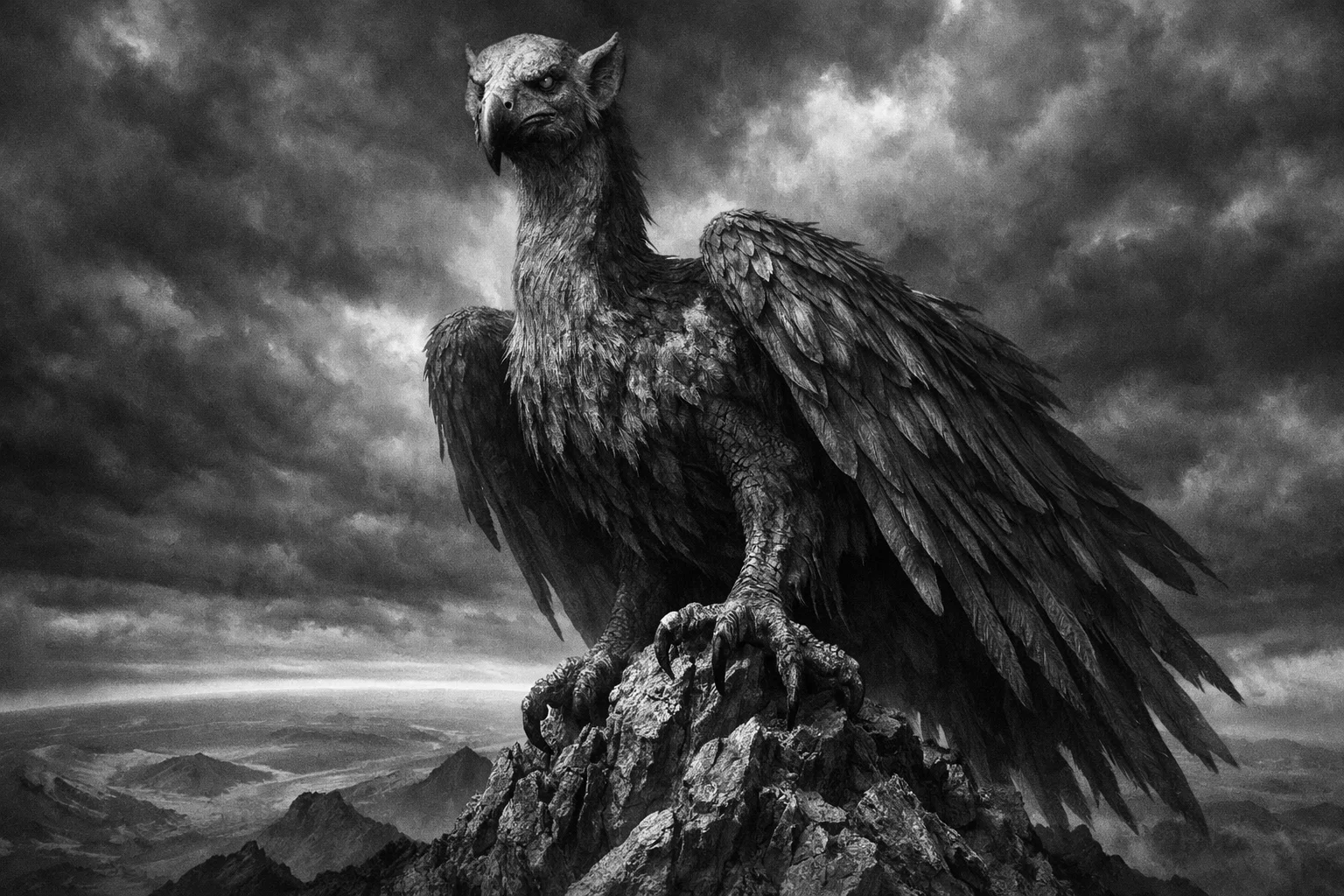

The Anqa is a giant bird of prey from Middle Eastern folklore, often linked to stories from before Islam and later Arabic literature. According to lore, the creature is extremely rare and ancient, usually living on distant mountain peaks or far-off islands.
Many stories portray it as a beautiful but troublesome creature, created by the divine and later banished or destroyed for its predatory habits.
Summary
Overview
| Attribute | Details |
| Name | Anqa |
| Alternative Names | Anqa al-Mughrib, Anqa Mughrib, Angha, Anka, Akka |
| Similar Monsters | Simurgh, Roc, Phoenix, Garuda, Thunderbird, Ziz, Gryphon, Fenghuang, Huma, Karura, Shangyang, Yatagarasu, Bennu, Cinomolgus, Peryton, Impundulu, Pamola, Minokawa |
| Etymology | Arabic: ‘anqa’ meaning ‘long-necked’ or ‘possessing a long neck’ |
| Gender | Female |
| Classification | Mythical Beast |
| Species | Hybrid / Avian |
| Origin / Culture | Arabian (Middle East) |
| First Recorded | c. 6th Century CE – Pre-Islamic Arabian Poetry |
| Active Period | Always active |
| Size | Wingspan of several kilometers; capable of carrying elephants |
| Lifespan | 1,700 to 2,000 years |
| Diet | Elephants, large whales, and humans |
| Habitat | Mount Qaf or distant, uninhabited islands |
| Powers & Abilities | • Immense physical strength • Longevity • Flight at extreme altitudes |
| Weaknesses | • Divine intervention • Vulnerability to prayer or curses |
| Reproduction / Creation | Directly created by God during the time of the prophets |
| Behavior | Solitary apex predator |
| Pop Culture | Final Fantasy XI / Dungeons & Dragons (various supplements) / The 1001 Nights / Age of Mythology |
Description
The Anqa is a legendary bird in Arabic tradition, known for its huge size and rarity. People once believed it lived in the world, but now it is thought to be extinct or hidden somewhere humans cannot reach. Its name is often combined with “Mughrib,” a word that means strange, distant, or setting like the sun, which adds to its image as a creature from faraway places.
Historically and in religious stories, the Anqa is often a symbol for something that exists only in name or is impossible to find. Unlike ordinary birds of prey, it was seen as a unique, divinely made creature, not a species with many members.
It is linked to the time of the “People of the Rass,” a group from religious texts. It is a warning about what happens when a creature’s hunger becomes too great for its surroundings.
The Mythical Creatures Bible. Flash Sale – Up to 23% OFF!
This beautifully designed paperback is the ultimate reference to legendary beings across history and cultures: From Biblical leviathans and behemoths to Asian kitsune, European fae, African tricksters, and ancient chimeras. Alphabetical entries with vivid illustrations, cultural context, and fascinating facts – essential for witchy libraries, ritual symbolism, or creature design inspiration.
Etymology
The name Anqa comes from the Arabic root ‘a-n-q, which means neck. It translates to “long-necked” or “having a long neck,” highlighting one of the bird’s main features. Adding “Mughrib” or “al-Mughrib” to its name gives it extra meaning, as these words in Arabic can mean “strange,” “mysterious,” or “distant.”
The name is also related to the word for “sunset” or “the West,” hinting that the bird lives where the sun goes down. In many stories, “Anqa al-Mughrib” became a saying for something people talk about but never see. It stands for the idea of something impossible to get, like the English phrases “hen’s teeth” or “a blue moon,” but with a more grand and mythical feel.
How to Pronounce “Anqa” in English
In English, the name is usually pronounced AHN-kuh. The first part sounds like the “a” in “father,” and the second part is a short, soft sound. Some people try to copy the Arabic “q” sound, which is made deep in the throat, but AHN-kuh is the common English way to say it.
Appearance
The Anqa is described as a huge bird with features from different animals. Its most noticeable trait is its very long neck, which is where its name comes from. While it looks mostly like a bird, its face is often described to human-like. Some stories say it has the beak of an eagle and the ears of a mammal, like a horse or a dog.
Its feathers are said to be very bright and colorful. Some stories say it has four wings, while others say it has two huge wings. The Anqa’s size is its most famous feature; it is described as being as big as a mountain or a large cloud.
When it flies, its wings can block out the sun and cover whole cities in shadow. Its claws are just as large and are said to be strong enough to grab and lift the biggest land animals easily.
Powers & Weaknesses
Powers
The Anqa’s main power is its huge size and strength. It can fly so high that people cannot see it, coming down only to hunt. It is strong enough to carry away animals as big as elephants or rhinos to feed its young. The Anqa is also said to live for almost two thousand years.
Some stories say the Anqa can speak or communicate with prophets. It is also thought to have great wisdom or ancient knowledge, but it is still mostly seen as a predator. Just seeing the Anqa is said to frighten all other living things, since it is at the very top of the mythical food chain.
Bulfinch’s Mythology Leather-Bound Classics Edition – Up to 43% OFF!
Own the timeless masterpiece in luxurious flexi leather-bound format from Canterbury Classics. Thomas Bulfinch’s complete compilation: The Age of Fable (Greek/Roman gods & heroes), The Age of Chivalry (King Arthur & knights), and Legends of Charlemagne – over 800 pages of elegantly retold ancient myths, Norse lore, and medieval romances. Gilded edges, ribbon marker, and premium binding make this a stunning heirloom for occult libraries or dark academia shelves.
Weaknesses
The Anqa has very few natural weaknesses. People cannot hunt or kill it with normal weapons because it is so big and lives so high up. Its main weakness is that it can be defeated by a divine command. In stories, the Anqa’s downfall happened because it could not control its hunger.
When the Anqa started attacking too many children and livestock, prophets had to step in. Only the prayers or curses of a holy person were believed to stop the creature.
Some stories say the Anqa could be forced to the ground or made unable to have young as a form of divine punishment, which led to its extinction. Its solitary life and slow breeding also made it easy for the species to die out.
Myths, Legends & Stories
The story of the Anqa starts with its creation as a perfect and beautiful creature. Tradition says God made the Anqa during the time of the prophet Moses or, in some stories, during the time of Khalid bin Sinan.
At first, the bird was meant to show divine power and beauty. It lived in a faraway place, sometimes called the “Land of the East” or an island in the ocean, where it peacefully ate wild animals for centuries.
Over time, the Anqa’s numbers and hunger grew along with its size. The wild lands could no longer feed it and its young. The bird started leaving its remote mountains and entered places where people lived. This change from a distant marvel to a local threat is a key part of its legend.
The People of the Rass
The most famous story about the Anqa is about the People of the Rass. They lived in a rich land, but the giant bird became a problem for them. The Anqa would come down from the clouds and take children to its nest on a high mountain. The people could not stop it; their arrows could not reach, and they could not climb the steep cliffs where it lived.
Desperate, the people asked their prophet, Khalid bin Sinan, for help. They pleaded with him to save them from the “long-necked” monster. The prophet prayed to God to remove the bird from the world, and as a result, disaster struck the Anqa.
In some stories, lightning hit the nests, destroying the birds and their eggs. In other versions, the Anqa lost its ability to have young, and the remaining birds were forced to the farthest parts of the earth, away from people.
The Exile to Mount Qaf
After it conflicts with people, the Anqa is said to have gone to Mount Qaf, a mystical mountain range in Islamic stories that circles the world. There, the Anqa became a lonely monster, no longer a common predator but a legend. During this exile, its long life was set: it would live for 1,700 years, then either renew itself or disappear, leaving only its name.
The Comparison to the Simurgh
In later stories, the Anqa is often mixed up with the Persian Simurgh. The Simurgh is usually portrayed as kind and wise, while the Anqa is often depicted as mysterious or even dangerous. In Attar’s Conference of the Birds, the Anqa is described as a kingly bird that remains hidden.
This story shows the Anqa as a symbol of the Divine, something that exists but is far beyond what people can understand. Searching for it is seen as the highest spiritual quest. Even in these deep stories, the Anqa is still the “Hidden One,” a creature that has taken itself out of the world’s history.
Ultimate Family Co-op Adventure – Horrified: Universal Monsters
Ravensburger’s acclaimed co-op Horrified Board Game masterpiece: Defend against Dracula, The Mummy, Invisible Man, and other icons in a beautifully themed village. Tactical pick-up-and-deliver gameplay, escalating tension, and endless variety. Ideal gateway game for families & friends, 1-5 players, 10+, with 4.8/5 star rave reviews.

Symbolism
The Anqa is a strong symbol of something that exists only in name, not in reality. It stands for things we can describe but cannot find in the real world. It is the ultimate example of something impossible to reach or already gone.
In philosophy, the Anqa shows the limits of what people can know and how much of the world is hidden from us. In some stories, it also symbolizes divine anger and the consequences of greed, since its fall stemmed from its endless hunger.
Since the Anqa was once a “perfect” bird that turned into a “monster,” it warns us that beauty and power can lead to ruin if not controlled.
Can Anqa Be Defeated?
You cannot defeat an Anqa with weapons, since it is too big for swords or arrows to harm it. People traditionally protected themselves through spiritual and group efforts.
In stories, the main way to defend against the Anqa was to call on divine names or ask a prophet for help. Communities would gather to say special prayers (dua) to create a spiritual shield or ask for the bird to be moved away.
Besides prayer, some stories mention using fire and smoke to block the bird’s view, so it cannot see the children from above. Some old texts say that the smell of burning sulfur or certain bitter herbs might drive the Anqa away, but these methods are seen as less powerful than a curse or a divine command.
Since the Anqa is a creature of the “unseen” and the “faraway,” people believed the best protection was to exile it. Once God sent it to Mount Qaf, the danger was gone as long as people stayed faithful.
Tags:
Related Monsters…
Ammit (Egyptian Soul Devourer Demon)
December 8, 2025
Aqrabuamelu (Mesopotamian Scorpion-Man Beast)
February 9, 2026
Azazel (Fallen Angel Turned Demon)
January 15, 2026
February 17, 2026
