
The Ape Man is a key monster in both evolutionary biology and folklore around the world. Often seen as a missing link between early primates and modern humans, it represents the connection between the wild and the civilized.
While some accounts treat the Ape Man as a biological relic of the prehistoric past, others regard it as a reclusive, sentient inhabitant of the world’s most inaccessible wildernesses.
Summary
Overview
| Attribute | Details |
| Name | Ape Man |
| Alternative Names | Pithecanthropus, Anthropoid, Missing Link, Wild Man, Hominid, Primates humanoid, Forest Man |
| Similar Monsters | Bigfoot, Sasquatch, Yeti, Yeren, Yowie, Hibagon, Almas, Barmanou, Orang Pendek, Mapinguari, Skunk Ape, Enkidu, Woodwose |
| Etymology | English: ‘Ape’ (Old English ‘apa’) and ‘Man’ (Old English ‘mann’). Refers to a creature possessing both simian and human characteristics. |
| Gender | Male, Female |
| Classification | Cryptid |
| Species | Humanoid / Beast |
| Origin / Culture | Global (primarily Western scientific and folklore traditions) |
| First Recorded | 1863 – Evidence as to Man’s Place in Nature (Thomas Henry Huxley) |
| Active Period | Always active |
| Size | 1.5–2.5 m tall |
| Diet | Omnivorous (roots, berries, small game, and occasionally livestock) |
| Habitat | Dense forests, mountain ranges, and remote caves |
| Powers & Abilities | • Enhanced olfactory tracking • Night vision • Supernatural physical endurance |
| Weaknesses | • Modern firearms • Loss of natural habitat • Traps and snares |
| Reproduction / Creation | Natural biological reproduction within a reclusive population |
| Behavior | Solitary ambush predator or shy, reclusive wanderer |
| Modern Sightings | 19th century–present, Worldwide |
| Pop Culture | Tarzan of the Apes (1912) / King Kong (1933) / Planet of the Apes (1968) |
Description
The Ape Man has a mix of human and non-human primate features. It is usually seen as a hominid that either did not follow the usual path of human evolution or belongs to a branch once thought extinct.
Unlike regular apes, this creature often shows signs of intelligence, can solve problems, and has a basic understanding of tools or social groups, even though it does not use formal language.
In modern cryptid studies, the Ape Man is seen as a real animal, not a supernatural being. Some think it could be a surviving Gigantopithecus or Paranthropus. The creature is known to be very shy and has avoided capture by scientists, despite numerous sightings.
However, because there is no solid physical evidence, many scientists remain skeptical. Critics say that without clear proof, the Ape Man is still just a topic for folklore and speculation, not real science. This debate keeps people thinking and talking about whether such creatures could exist outside of myths.
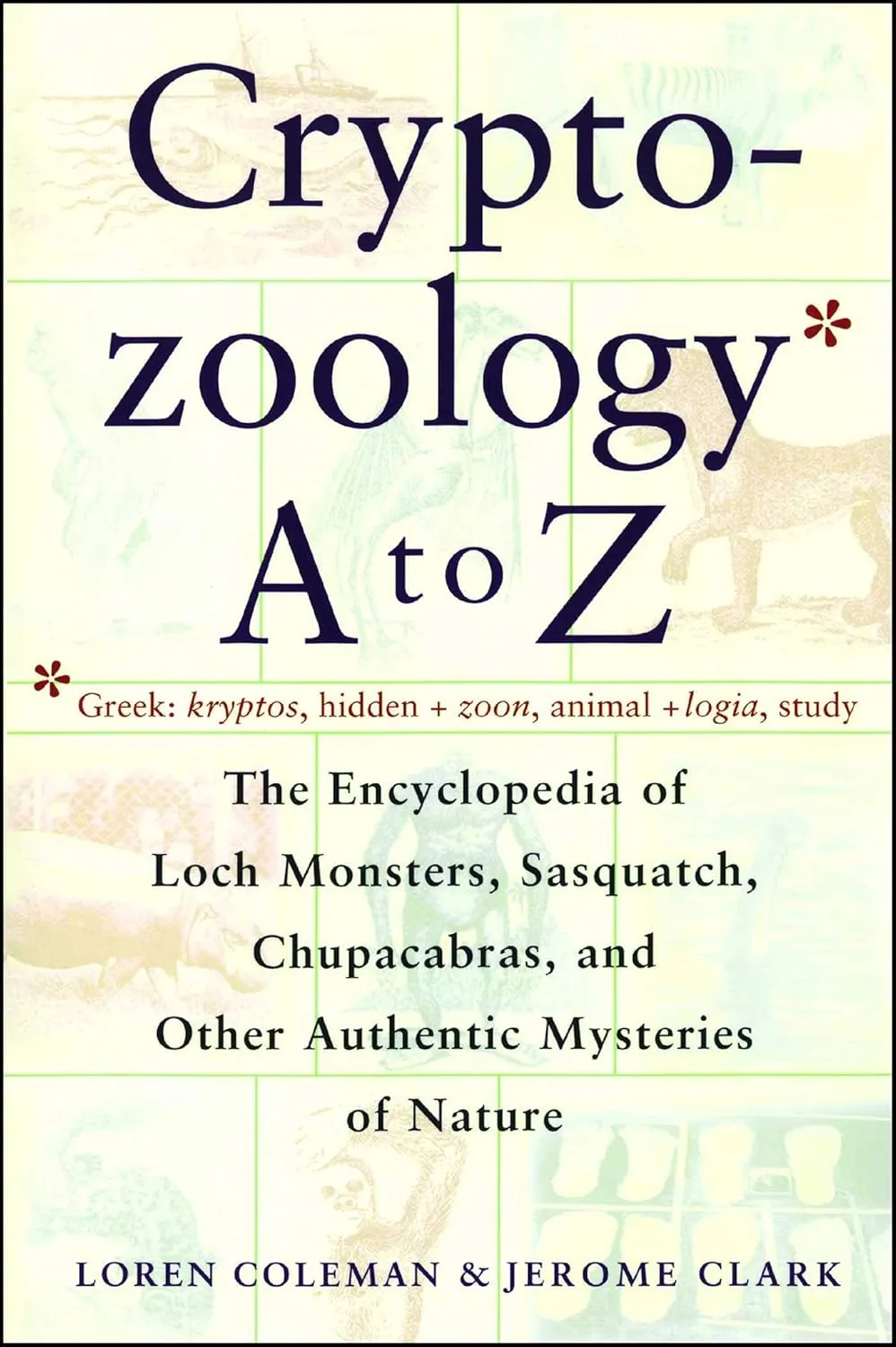
Loren Coleman Cryptozoology A to Z – Up to 46% OFF!
This authoritative encyclopedia catalogs hundreds of mysterious creatures in accessible A-to-Z format, authored by leading experts Loren Coleman and Jerome Clark. From classic Sasquatch sightings to exotic global cryptids, with cross-references, bibliography, and evocative illustrations – ideal for dark curiosity cabinets, paranormal studies, or sparking hunts for the world’s hidden beasts.
Etymology
The term “Ape Man” comes from Middle and Old English. “Ape” comes from the Old English word apa, which meant any non-human primate, especially those without tails. “Man” comes from the Old English mann, meaning a human being.
The term became popular during the 19th-century debates about evolution. Scientists and the public used it to describe a possible “missing link” (Pithecanthropus), a creature thought to be between great apes and modern humans.
Over time, the name changed from a scientific idea to a general term for any hairy, human-like creature that walks on two legs and has ape-like facial features.
Appearance
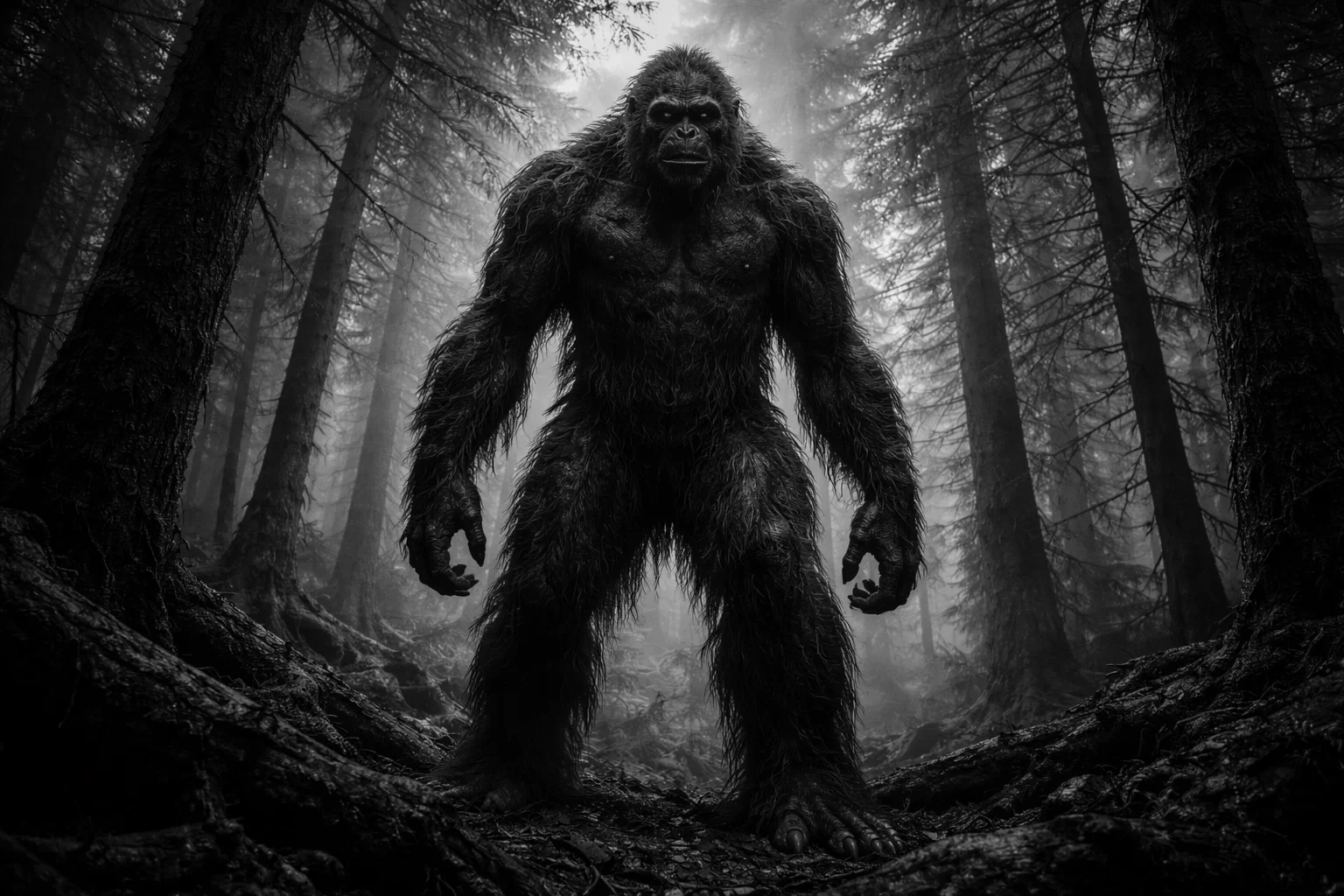
The creature is usually described as very large and muscular, walking on two legs. It is much taller and broader than most people, with long arms that can reach below its knees. Its body is covered in thick, rough hair, except for the palms, soles, and parts of the face. The hair can be dark brown, black, reddish-orange, or silver-grey.
The Ape Man’s face combines features like a heavy brow, flat nose, and strong jaw with big teeth. Its eyes are often said to look very human, showing signs of awareness. Its feet are large and flat, leaving tracks with five toes but no arch, unlike human footprints.
Geographic Distribution and Sightings
Stories about this mysterious cryptid are found all over the world, in many mountain ranges and forests. In North America, these tales are most common in the Pacific Northwest, from British Columbia to Northern California, where thick forests offer plenty of hiding places.
In Asia, the legend is strongest in the Himalayas and the remote forests of China and Indonesia. In Africa, stories of mysterious, human-like creatures appear in many regions, especially in jungles and savannahs. In South America, tales of hidden ape-like beings are common in the Amazon rainforest and are part of local traditions.
Oceania, too, has its share of cryptic sightings on the islands, where oral traditions recount encounters with entities that walk the line between human and beast.
Old reports also mention these creatures in the Caucasus Mountains of Central Asia and the large forests of Siberia. The names vary across places, like Almas in Mongolia or Yeren in Hubei province. Still, the main features in the stories are very similar.
As people build more roads and towns in wild areas, reports of the Ape Man have moved to deeper parts of national parks or high mountains where few people go.
Sightings Table
| Region | Primary Location | Reported Frequency | Notable Case Details |
| North America | Pacific Northwest (USA & Canada) | High; thousands of documented footprints. | 1967 – Patterson-Gimlin film: 59 seconds of footage showing a bipedal female hominid in Bluff Creek, CA. |
| Himalayas | Nepal, Tibet, and Bhutan | Moderate; near the snow line. | 1951 – Eric Shipton: Photographed a 33 cm long footprint with a distinct thumb-like toe on the Menlung Glacier. |
| Central Asia | Caucasus Mountains | Low; described as relict Neanderthals. | 1941 – Lt. Col. Vargen Karapetyan: Captured a “wild man” in Daghestan who appeared human but was covered in dark fur. |
| Southeast Asia | Sumatra (Indonesia) | Moderate; “Orang Pendek” (short person). | 1923 – Van Herwaarden: Encountered a bipedal, non-apelike hairy creature with long scalp hair while surveying land. |
| East Asia | Shennongjia (China) | Moderate; “Yeren” (wild man). | 1976 – Six forest committee members nearly struck a red-haired upright creature with their vehicle near the forest edge. |
| Australia | Blue Mountains & NSW | Moderate; “Yowie”. | 1912 – Charles Harper: Observed a large man-like animal thumping its chest near a campfire in the Bombala district. |
| South America | Amazon Basin | Low; “Mapinguari”. | Ongoing – Indigenous accounts: Describe a giant sloth-like creature with a secondary mouth on its abdomen. |
| Siberia | Kemerovo Region (Russia) | Increasing. | 2011 – International Expedition: Reported finding “twisted branches” and footprints in the Azasskaya Cave. |
Powers & Weaknesses
Powers
The Ape Man has physical capabilities that far exceed those of a standard human. Its primary power is its immense physical strength, allowing it to uproot small trees, move heavy boulders, and overpower large predators. This strength is coupled with an extraordinary level of agility; despite its size, the creature can get through steep, rocky terrain and dense undergrowth at great speed and in silence.
The creature also exhibits advanced sensory perceptions, particularly a heightened sense of smell and acute hearing, which allow it to detect human presence long before it is seen. What’s more, it has an innate mastery of camouflage, using the natural environment to remain invisible even at close range.
Ultimate Family Co-op Adventure – Horrified: Universal Monsters
Ravensburger’s acclaimed co-op Horrified Board Game masterpiece: Defend against Dracula, The Mummy, Invisible Man, and other icons in a beautifully themed village. Tactical pick-up-and-deliver gameplay, escalating tension, and endless variety. Ideal gateway game for families & friends, 1-5 players, 10+, with 4.8/5 star rave reviews.

Weaknesses
Even though the Ape Man is strong, it has weaknesses. It can be harmed by weapons or environment dangers. Its small numbers and need for special habitats make it at risk, especially when forests are destroyed or people move into its territory.
The creature also appears to have a strong aversion to bright, artificial lights and loud, mechanical noises, which often cause it to retreat deep into the wilderness. Its reliance on seasonal food sources means it can be weakened by harsh winters or droughts that deplete its foraging grounds.
Myths, Legends & Stories
The Wild Man of the Woods
Before the term “Ape Man” became common in Victorian times, European stories featured the “Wild Man” or “Woodwose.” These were people who had gone back to a wild state, covered in thick hair and carrying clubs.
In medieval art and symbols, the Woodwose showed the line between the order of towns and the wildness of the forest. Stories often told of hunters who went too far into the woods and met hairy giants, said to be strong enough to fight bears.
While the Woodwose was sometimes seen as a lost human, many tales treated it as a distinct race of beings that lived in the shadows of the mountains, predating the arrival of man.
Enkidu and the Wild Hominid
One of the first stories about an Ape Man-like creature is in the Epic of Gilgamesh. In this tale, the gods made Enkidu from clay and saliva to be both a rival and a friend to King Gilgamesh.
At first, Enkidu lived in the wild, covered in hair, eating grass with gazelles and drinking at water holes with animals. He was completely natural and knew nothing of people or cities. The story tells how he became “civilized” after meeting humans, losing his great speed, and his bond with animals.
This story is one of the oldest examples of the change from a wild, ape-like life to a human one. It shows the Ape Man as both an animal and a close relative of humans.
The Search for the Missing Link
In the late 1800s and early 1900s, the idea of the “Ape Man” shifted from myth to science. People began searching for the “Missing Link.” During this time, stories about Pithecanthropus erectus, or Java Man, became popular.
Exploring the jungles of Indonesia, researchers sought a creature that would prove the evolutionary connection between apes and humans. This quest sparked a global fascination with the idea that Ape Men might still live in the unexplored corners of the world.
Stories about the “Orang Pendek” in Sumatra or the “Yeti” in the Himalayas were no longer just campfire tales. People began to see them as possible real creatures, leading to expeditions that continue to this day.
Tarzan and the Lord of the Jungle
The most famous modern version of the Ape Man is in Edgar Rice Burroughs’s stories. Tarzan, a human raised by great apes in Africa, changed how people saw the “Ape Man” in the 20th century.
Unlike the monstrous cryptids of folklore, this narrative presented a monster who combined the physical power and instincts of the ape with the moral and intellectual capacity of the human. Tarzan became a bridge between two worlds, defending the natural kingdom from the corruption of the “civilized” world.
This story changed how people saw the Ape Man, turning it from a frightening monster into a noble, wild hero. This new image has shaped how the creature appears in many movies and books.
Symbolism
The Ape Man stands for the two sides of human nature, showing the struggle between our basic animal instincts and our advanced thinking. This idea connects with many theories in anthropology and psychology.
For example, in Jungian psychology, the Ape Man can be seen as a symbol of the ‘shadow,’ showing the parts of ourselves we often hide. In structuralism, the Ape Man is the opposite of civilized society, pointing out the differences and links in human culture. These ideas remind us of our roots and how close we are to the wild.
In many cultures, the Ape Man is seen as a ‘guardian of the threshold,’ showing up to people who go too far from society. It also stands for the wild world and the mysteries that persist, even amid modern technology and exploration.
Tags:
Related Monsters…
Hitotsume kozō (Japanese One-eyed Boy)
March 9, 2026
February 4, 2026
Akaname (Japanese Filth-Licking Yokai)
January 5, 2026
Black Annis (Blue Hag of Leicestershire)
February 18, 2026
Aspidochelone (Giant Sea Beast)
February 6, 2026
