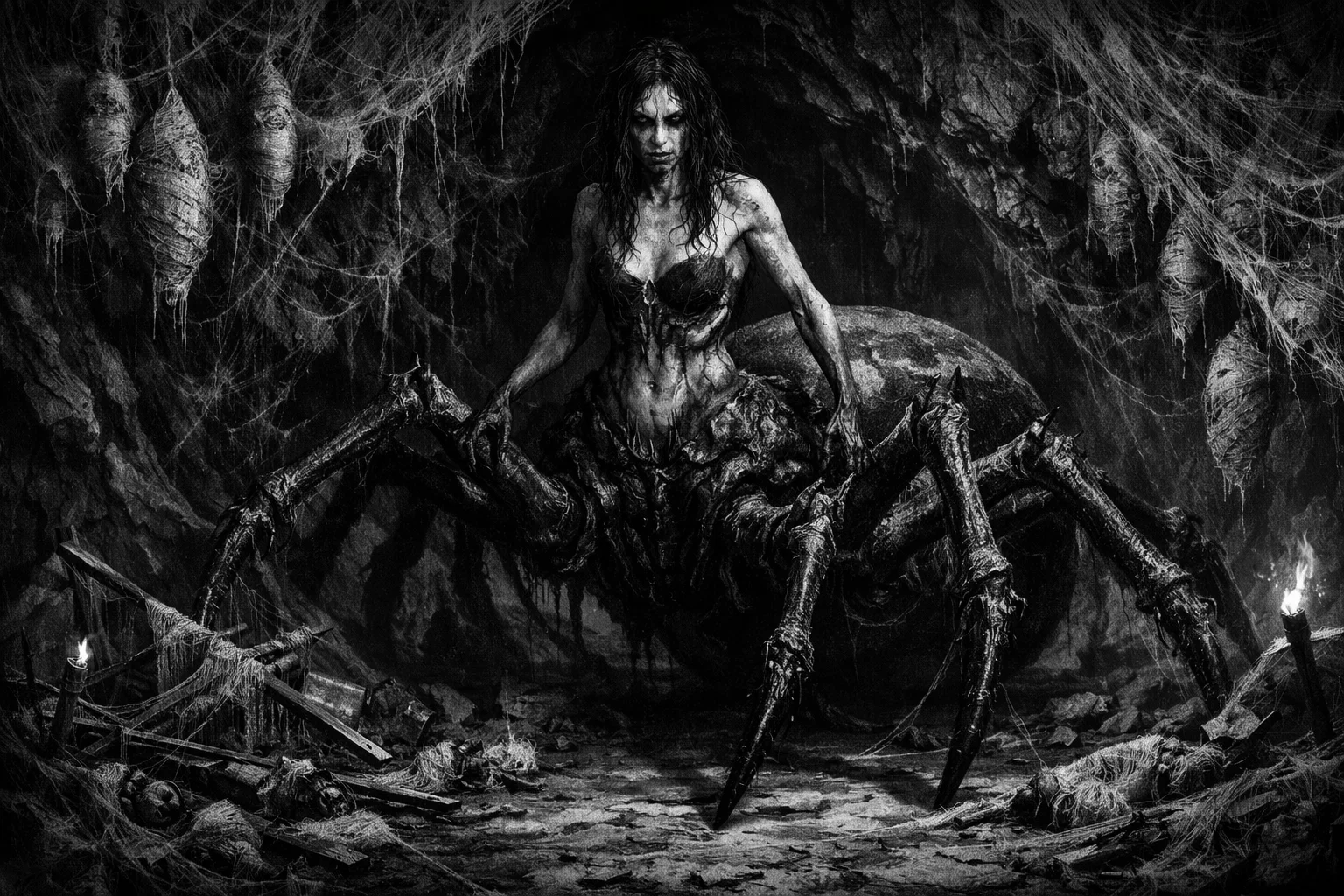

Arachne is a creature from classical mythology who is best known for being turned from a mortal woman into a spider. Her story warns of the dangers of excessive pride and of defying the gods. She starts as a human but ends up as a monstrous hybrid.
Summary
Overview
| Attribute | Details |
| Name | Arachne |
| Alternative Names | Arachnē, Aragne |
| Similar Monsters | Jorōgumo, Tsuchigumo, Anansi, Iktomi, Neith, Uttu, Spider Grandmother, Apanuugak, Qiligel, Biliku, Teratoma, Drider, Lolth, Shelob, Ungoliant, Aragog, Raknar |
| Etymology | From Ancient Greek “aráchnē” = spider |
| Gender | Female |
| Classification | Divine Punishment / Hybrid |
| Species | Hybrid |
| Origin / Culture | Greek (Lydia) |
| First Recorded | c. 8 CE – Ovid’s Metamorphoses |
| Active Period | Always active |
| Lifespan | Immortal (in spider form) |
| Diet | Insects (as a spider) |
| Habitat | Caves, dark corners, and web-covered structures |
| Powers & Abilities | • Perfect silk production • Supernatural weaving speed • Climbing vertical surfaces |
| Weaknesses | • Physical crushing • Divine intervention |
| Reproduction / Creation | Transformed from a human by the goddess Athena |
| Behavior | Solitary weaver |
| Pop Culture | D&D Monster Manual (Drider influence) / “Hercules: The Legendary Journeys” / “Percy Jackson” series / “Soul Eater” (Manga/Anime) |
Description
Arachne is known for changing from a skilled mortal weaver into a hybrid creature. She lived in Hypaepa, Lydia, and was famous for her weaving and embroidery skills. Many believed Athena taught her, but Arachne insisted her talent was her own.
After competing with a goddess, Arachne was physically transformed. She kept some human traits but gained the body and instincts of a spider.
As a monster, Arachne loses her humanity and is forced into a life of endless, instinctive labor. She weaves constantly, but now her weaving is for survival, not beauty.
Bulfinch’s Mythology Leather-Bound Classics Edition – Up to 43% OFF!
Own the timeless masterpiece in luxurious flexi leather-bound format from Canterbury Classics. Thomas Bulfinch’s complete compilation: The Age of Fable (Greek/Roman gods & heroes), The Age of Chivalry (King Arthur & knights), and Legends of Charlemagne – over 800 pages of elegantly retold ancient myths, Norse lore, and medieval romances. Gilded edges, ribbon marker, and premium binding make this a stunning heirloom for occult libraries or dark academia shelves.
Etymology
The name “Arachne” comes from the Ancient Greek word aráchnē (ἀράχνη), which means “spider” or “spider’s web.” This word is also the root for the term “arachnid,” used for spiders and similar creatures.
In the myth, Arachne’s name explains the origin of the species. The Greek word is related to other words for spinning or weaving, like the Latin aranea. Unlike other mythological names, hers directly describes what she becomes and what she does.
How to Pronounce “Arachne” in English
In English, “Arachne” is pronounced as uh-RAK-nee, with the main stress on the second syllable. The “ch” is a hard “k” sound. In the International Phonetic Alphabet, it is /əˈrækni/.
Appearance
In her monster form, Arachne is shown as part woman and part spider. Most stories describe her with a human upper body joined at the waist to a large spider’s body, complete with eight legs.
The human part of her body usually keeps her original features, though she may look pale from living in darkness. The spider part is often shown with dark, hard plating and sensory hairs.
In some versions, like Ovid’s, Arachne loses almost all human features. She becomes small, with a tiny head and fingers that turn into legs, showing how much of her beauty and humanity is gone.
Powers & Weaknesses
Powers
Arachne has supernatural skill in making and using silk. She can spin strong webs faster and more skillfully than any spider or human. Her silk is used not just for catching prey but also for weaving detailed tapestries.
Her hybrid form lets her move easily on any surface, even up walls and across ceilings, thanks to special features on her spider legs.
Arachne isn’t as physically powerful as some other Greek monsters. Still, she is precise and can trap enemies in nearly unbreakable threads. Some stories say she is still very intelligent and can set clever traps.
Weaknesses
Arachne’s main weakness is that her spider body is soft and can be hurt by crushing or piercing, just like other arthropods. She doesn’t have the tough skin or magical protection of monsters like the Nemean Lion or Hydra.
Arachne is also limited by her transformation. She is driven by pride and obsession, and she can’t resist the urge to weave, which makes her easy to distract or trap. Her biggest weakness was always her inability to submit to the gods.
Because she was cursed, Arachne is still under the control of the Olympian gods, especially Athena. In many stories, her real weakness was her pride, which led to her downfall even before she became a monster.
Enchant Your Space with Witchy Gothic Posters – Up to 40% OFF!
Transform your bedroom into a creepy dark sanctuary with this vintage gothic wall art set from 97 Decor. Unframed prints featuring spooky witch pictures, horror goth aesthetics, Halloween motifs, and moody occult vibes. Premium quality posters perfect for creating a haunting witchy room decor gallery – ideal for empaths, goths, and Halloween lovers.
Myths, Legends & Stories
The Weaver of Lydia
Arachne was born in Lydia, a region in western Asia Minor known for its textiles and for inventing coins. Her father, Idmon of Colophon, was famous for dyeing wool with expensive “Tyrian purple.” Arachne wasn’t from a noble family; her reputation came from her skill. She lived in Hypaepa, near Mount Tmolus, and became well known far beyond her hometown.
People saw Arachne’s weaving as more than just a craft—it was a spectacle. Nymphs from nearby vineyards and rivers would leave their tasks to watch her work. Crowds were drawn not only by her finished pieces but also by the skill and grace she showed while working. All this praise led to her growing pride.
When people said Athena must have taught her, Arachne was offended. She believed her talent was her own and challenged the goddess to a contest, risking her life on the result.
The Crone
Before things got out of hand, Athena came to Lydia disguised as an old woman. She warned Arachne to be content with fame among mortals and to respect the gods. The old woman said a simple prayer for forgiveness would clear Arachne of her pride.
Arachne reacted angrily. She stopped weaving, mocked the old woman’s age, and said her advice was better suited for her own family or servants. Arachne repeated her challenge, thinking Athena’s absence meant she was afraid.
Then Athena revealed herself in her true, shining form and armor. The nymphs and Lydian women bowed in fear, but Arachne stayed defiant and got ready for the contest.
The Competitive Tapestries
The contest began with both Arachne and Athena working quickly and silently at separate looms. Their tapestries showed two sides of the Greek world: order versus chaos, and the power of the gods versus human defiance.
The Tapestry of Athena
The goddess wove a central scene depicting the Foundation of Athens. It depicted the twelve Olympian gods seated on high thrones, with Zeus in the center. The narrative focus was her victory over Poseidon; she depicted herself striking the earth with her spear to produce the olive tree, while Poseidon struck the rock with his trident to create a salt spring.
To provide a clear warning to Arachne, Athena added four scenes in the corners of the tapestry, each depicting the “Victory of the Gods” over insolent mortals:
- Haemus and Rhodope: A Thracian king and queen who called themselves Zeus and Hera and were transformed into cold mountains.
- The Pygmy Queen: Gerana, who challenged Hera and was turned into a crane, was forced to wage eternal war against her own people.
- Antigone of Troy: A woman who claimed her hair was more beautiful than Hera’s and was transformed into a stork.
- The Cinyras’ Daughters: Women who were turned into stone on temple steps for their pride.
The Tapestry of Arachne
Arachne’s tapestry was a bold critique of the gods. She ignored their glory and instead showed their many deceptions and affairs, especially those of the Olympians.
Her tapestry featured twenty-one distinct scenes of divine misconduct, including:
- Zeus: Depicted in his many animalistic and elemental disguises used to seduce mortal women, such as the bull (Europa), the eagle (Ganymede), the swan (Leda), and the golden rain (Danaë).
- Poseidon: Shown as a bull, the river god Enipeus, and a ram, pursuing various nymphs and mortals.
- Apollo: Depicted in the guise of a rustic shepherd or a hawk to deceive his targets.
- Dionysus: Shown deceiving Erigone with a crown of false grapes.
Arachne’s tapestry was bordered with ivy and flowers and was even more skillful than Athena’s. When Athena looked at it, she found no flaws at all.
The myth ends with Athena unable to outdo Arachne’s work, which made her furious. Insulted by the perfect tapestry that showed the gods’ faults, Athena tore it up. She hit Arachne with her shuttle, stripping her of her dignity.
Desperate and unable to escape Athena’s anger, Arachne tried to hang herself. As she did, Athena decided to let her live, but only to hang forever. Athena sprinkled her with the juice of poisonous aconite or Hecate’s herbs.
Arachne’s body changed right away: her hair fell out, her limbs shrank and moved to her sides, and her belly grew large. She became the first spider, doomed to spin threads forever and keep weaving as she always had.
Cultural Variations and Later Interpretations
Ovid’s Metamorphoses gives the most detailed version of the story, but other sources tell it differently. Some older versions say the contest was only about wool quality, not the gods’ actions. Later Roman stories credit Arachne’s son, Closter, with inventing the spindle, and her grandson with inventing hunting nets, linking her legacy to human inventions.
Some Hellenistic versions treat Arachne’s change as a simple explanation for why spiders weave webs and live in dark corners, rather than as a tragedy. Still, Ovid’s version is the most famous, making Arachne the eternal victim of divine jealousy and the patron monster of weavers.
Ultimate Family Co-op Adventure – Horrified: Universal Monsters
Ravensburger’s acclaimed co-op Horrified Board Game masterpiece: Defend against Dracula, The Mummy, Invisible Man, and other icons in a beautifully themed village. Tactical pick-up-and-deliver gameplay, escalating tension, and endless variety. Ideal gateway game for families & friends, 1-5 players, 10+, with 4.8/5 star rave reviews.

Symbolism
Arachne is a central symbol of hubris, or the pride that leads someone to think they are equal to the gods. Her change into a spider shows how pride can bring someone down, turning a famous woman into a small, disliked creature working in the dark.
Arachne also stands for the obsessive side of art. Weaving, once her pride and joy, became something she had to do over and over. More broadly, she represents using art to challenge those in power, as she did by showing the gods’ faults in her tapestry, even at great cost.
Can Arachne Be Defeated?
Although the myth ends with Arachne’s transformation, later stories say she can be defeated. This usually involves using chemicals, rituals, and keeping order. Unlike monsters you can fight with weapons, Arachne’s weaknesses are tied to her curse and obsession.
Chemical and Botanical Neutralization
The main way to stop Arachne is to use the same substances that changed her in the first place. Since she was made with the “Herbs of Hecate,” she is still sensitive to their chemicals.
The chemicals in monkshood and henbane can both trigger and stop Arachne’s powers. Aconitine, a poison in these plants, harms her body and can cause her cells to break down.
In ancient times, people believed that the smell of dried aconite or its oils would keep Arachne away, since crossing it would cause her pain. Cedar and citrus oils were also used to break down her silk, making her main weapon useless.
Rituals and Symbolic Wards
In Hypaepa and Colophon, people created special rituals to keep away weaving spirits like Arachne.
One common ritual was the Purification of the Warp, where weavers passed a torch of sulfur or bay laurel through the loom to clear away bad energy. Another was the Offering of the First Thread, where the first bit of wool was burned as a sacrifice to Athena to avoid pride.
If a weaver found an unexpected knot, called “Arachne’s Tangle,” they would break and bury their tools in a Ritual of the Broken Needle to get rid of bad energy and avoid becoming obsessed.
Environmental and Divine Defeat
Arachne thrives in places that are neglected, dark, and quiet. So, keeping a space busy and well-lit was thought to weaken her, since she is connected to shadows.
The steady sound of a working loom, called the Rhythm of the Batten, was believed to keep Arachne away. In the end, the surest way to defeat her was to ask the gods for help.
Because Arachne’s fate was decided by Athena, only a direct prayer or offering to the goddess could truly break her influence. Traditionally, this was done through the Trial of the Shuttle, in which a weaver dedicated their work to Athena to show humility and to ask for protection.
Tags:
Related Monsters…
February 4, 2026
January 28, 2026
Argus Panoptes (Hundred-Eyed Giant)
January 13, 2026
Amphiptere (Ancient Winged Serpent Dragon)
December 9, 2025
Basilisk (European Reptilian Beast)
February 11, 2026
February 3, 2026
