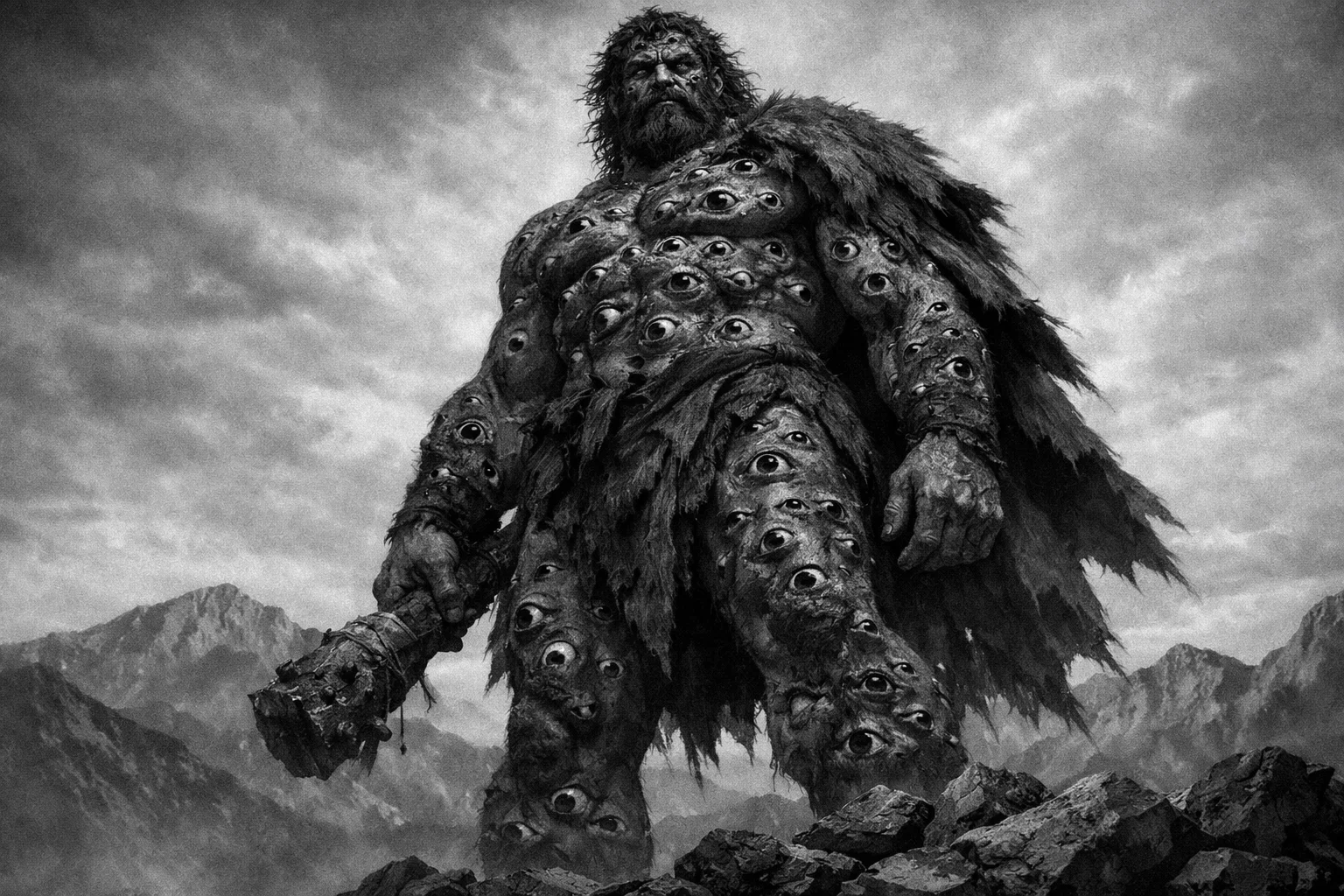

Argus Panoptes is an ancient monster from Greek mythology known for his ability to watch over everything. He is usually described as a giant with great strength, but what sets him apart is his body covered in many eyes, which means he never really sleeps.
Because of this unusual feature, he became the perfect guardian for the Olympian gods, especially Hera. Stories about him introduce the idea of total watchfulness and show that even the most careful guard can eventually fail.
Summary
Overview
| Attribute | Details |
| Name | Argus Panoptes |
| Alternative Names | Argos, Panoptes, Argos Panoptes, Argus the All-Seeing |
| Similar Monsters | Azhi Dahaka, Beholder, Hundun, Ophanim, Typhon, Geryon, Kumbhakarna, Talos, Polyphemus, Briareus |
| Etymology | From Greek ‘Argos’ (bright/swift) and ‘Panoptes’ (all-seeing) |
| Gender | Male |
| Classification | Giant |
| Species | Humanoid |
| Origin / Culture | Greek (Peloponnese, Greece) |
| First Recorded | c. 700 BCE – Hesiod (Aegimius) |
| Active Period | Always active |
| Size | Giant-sized (remarkable height) |
| Lifespan | Immortal (until slain) |
| Diet | Unknown |
| Habitat | Argolis (pastures and mountains) |
| Powers & Abilities | • Absolute surveillance • Simultaneous sleep/wake cycles • Immense physical strength |
| Weaknesses | • Music and storytelling (induction of sleep) • Decapitation • Sensory overload |
| Reproduction / Creation | Born of Arestor, Gaia, or Agenor (sources vary) |
| Behavior | Incorruptible and vigilant guardian |
| Pop Culture | Percy Jackson & The Olympians / God of War / Shin Megami Tensei |
Description
Argus Panoptes stands out in Greek mythology as an especially useful giant. Unlike other giants known for causing chaos or fighting the gods, he served the gods and kept order. He is seen as the perfect guard, built so he never tires or loses focus.
He is best known as Hera’s servant, the queen of the gods. In most stories, his main job is to guard and watch over things the gods want to keep safe or secret. He is known for being very loyal and strong in battle against monsters. Instead of hunting, he stays in one place and deals with intruders quickly and forcefully.
Etymology
The name Argus (or Argos) comes from the Ancient Greek word argos, which means “bright,” “shining,” or “swift.” This word is often linked to clear vision or bright eyes. The title Panoptes combines two Greek words: Pan, meaning “all,” and optes, which comes from the word for “seeing” or “eyes.” So, his full name means “The All-Seeing Bright One.”
The suffix was added to his name to set him apart from other characters named Argus in Greek stories, like the builder of the ship Argo or Odysseus’s loyal dog. Over time, Panoptes became closely linked to him and was even used to describe anything that keeps watch over everything.
Appearance
Argus Panoptes is a huge giant with a strong, muscular body. What makes him unique is that he has many eyes all over his body. Some old pictures show him with two faces or eyes on both sides of his head, but most stories say he has one hundred eyes.
These eyes are not localized to his face; they are scattered across his limbs, torso, and back. This distribution ensures that he has no blind spots.
A key physiological detail is that these eyes operate on a rotating schedule. When some of his eyes close to rest, others remain open and alert. His skin is often depicted as rugged, and he is frequently shown wearing the hide of a bull, a trophy from one of his earlier labors.
Powers & Weaknesses
Powers
Argus Panoptes’s main power is his ability to see everything. Since only some of his hundred eyes sleep at a time, he is always awake and aware of what is happening around him. He cannot be surprised or snuck up on, because he can see in every direction at once.
Besides his special vision, he also has the strength and toughness of the giants. He could beat strong enemies like the monster Echidna in a fight. Just being near him was enough to scare others, as he could spot movement over a wide area, making it almost impossible for people or animals to get away.
Bulfinch’s Mythology Leather-Bound Classics Edition – Up to 43% OFF!
Own the timeless masterpiece in luxurious flexi leather-bound format from Canterbury Classics. Thomas Bulfinch’s complete compilation: The Age of Fable (Greek/Roman gods & heroes), The Age of Chivalry (King Arthur & knights), and Legends of Charlemagne – over 800 pages of elegantly retold ancient myths, Norse lore, and medieval romances. Gilded edges, ribbon marker, and premium binding make this a stunning heirloom for occult libraries or dark academia shelves.
Weaknesses
Even though he is always alert, Argus Panoptes can be tricked by sound. Since he relies on his eyes, his mind can be put to sleep if all his eyes close at the same time. This does not happen on its own, but magical music or stories can make it happen by tiring out his mind.
Argus Panoptes is not immortal like the Olympian gods, so he can be killed by certain means, such as being beheaded. If he falls asleep, he has no magic to protect him from being attacked.
Because he depends so much on his eyes, a strong enough distraction can leave him open to a quick attack.
Myths, Legends & Stories
Argus Panoptes’s story goes from being a hero who protected the Peloponnese to a tragic servant of the gods.
Unlike most giants who fought against the gods, Argus started out as a defender of order. He is often said to have come from Gaia, the ancient earth goddess, who made him strong and useful. At first, he was a wandering hero.
People in Arcadia and Argos saw him as a hero because he used his many eyes and great strength to get rid of dangerous creatures. His greatest achievement was finding and killing Echidna, the “Mother of All Monsters,” while she slept in her cave, showing that no threat could escape him.
The Vigil of the White Heifer
The most long-lasting narrative involving Argus Panoptes begins with a conflict of divine infidelity. Zeus had become enamored with Io, a priestess of Hera. When Hera nearly caught them together, Zeus transformed Io into a snow-white heifer to hide her identity.
Hera, seeing through the deception, requested the cow as a gift. To ensure Zeus could not reclaim his lover, she placed Io under the absolute custody of Argus Panoptes.
Argus took his job very seriously. He led the cow to the fields of Mycenae and then to Mount Nemea. Thanks to his many eyes, he could always watch over her—even when some eyes rested, the others stayed open and focused on Io. She had to eat bitter plants and drink from muddy water, always watched by Argus.
Io’s father, the river god Inachus, and her sisters sometimes saw her in the fields, but Argus was such a strong and constant guard that they could never get close or realize that Io was trapped inside the animal.
NECA 8″ Clothed Sam Action Figure – Up to 24% OFF!
NECA’s meticulously crafted 8-inch clothed figure of Sam, the sinister spirit from Trick ‘r Treat. Fabric orange pajamas, removable burlap mask revealing his demonic face, lollipop weapon, bitten pumpkin accessory, and extra hands for poses. Fully articulated with real cloth clothing – the perfect eerie guardian for horror collections and year-round spookiness.
The Deception of Hermes
Io was freed not by force, but by turning Argus’s main strength against him. Zeus, feeling sorry for Io, sent Hermes, the god of thieves and clever speech, to kill Argus. Hermes came down to earth near Argus, pretending to be a shepherd with a flock of stolen goats. He started playing reed pipes, and the music caught Argus’s attention.
Argus, who lived a lonely and dull life, asked Hermes to sit with him. Hermes played music for hours and told long, rhythmic stories, including how the reed pipes were made and how Pan chased the nymph Syrinx. This was all part of a plan to make all of Argus’s eyes fall asleep at the same time.
Slowly, Argus’s eyes grew heavy and started to close. He tried to keep some of them open, but Hermes’s magical music was too strong. For the first time ever, all of Argus’s eyes shut at once, leaving him in complete darkness.
The Death and the Peacock
As soon as the last eye closed, Hermes stopped playing and took out a curved sword, or, in some stories, used a big stone. With one quick move, he cut off Argus’s head. Argus’s body fell down the cliffs, and Io was finally able to escape, though she stayed a cow for a long time after.
When Hera discovered the remains of her most faithful servant, she did not allow his unique gift to perish with him. She descended to the site of his death and gathered the hundred eyes that had once covered his skin. In a gesture of immortalization, she set them into the tail of her sacred bird, the peacock.
By doing this, Hera made sure that even though Argus Panoptes was gone, his “all-seeing” nature would live on in the peacock’s feathers. The bird became a lasting symbol of his watchfulness and of Hermes’s trick, which earned Hermes the name “Argeiphontes” or “Slayer of Argus.”
Symbolism
Argus Panoptes is a central symbol of watchfulness and vigilance. His hundred eyes stand for the idea of the “perfect watchman” who never misses anything and never sleeps.
More broadly, he shows that even the most powerful can fail—he had every advantage, but was defeated by a simple trick. This reminds us that even the best security can be undone if we let our guard down.
Also, by becoming part of the peacock’s tail, Argus stands for the idea that someone’s spirit and service can live on even after they are gone.
Tags:
Related Monsters…
Azhi Dahaka (Persian Three-Headed Dragon)
January 19, 2026
Argus Panoptes (Hundred-Eyed Giant)
January 13, 2026
Black Shuck (Ghost Dog from East Anglia)
January 26, 2026
Black Annis (Blue Hag of Leicestershire)
February 18, 2026
Amphisbaena (Greek Two-Headed Serpent)
January 20, 2026
