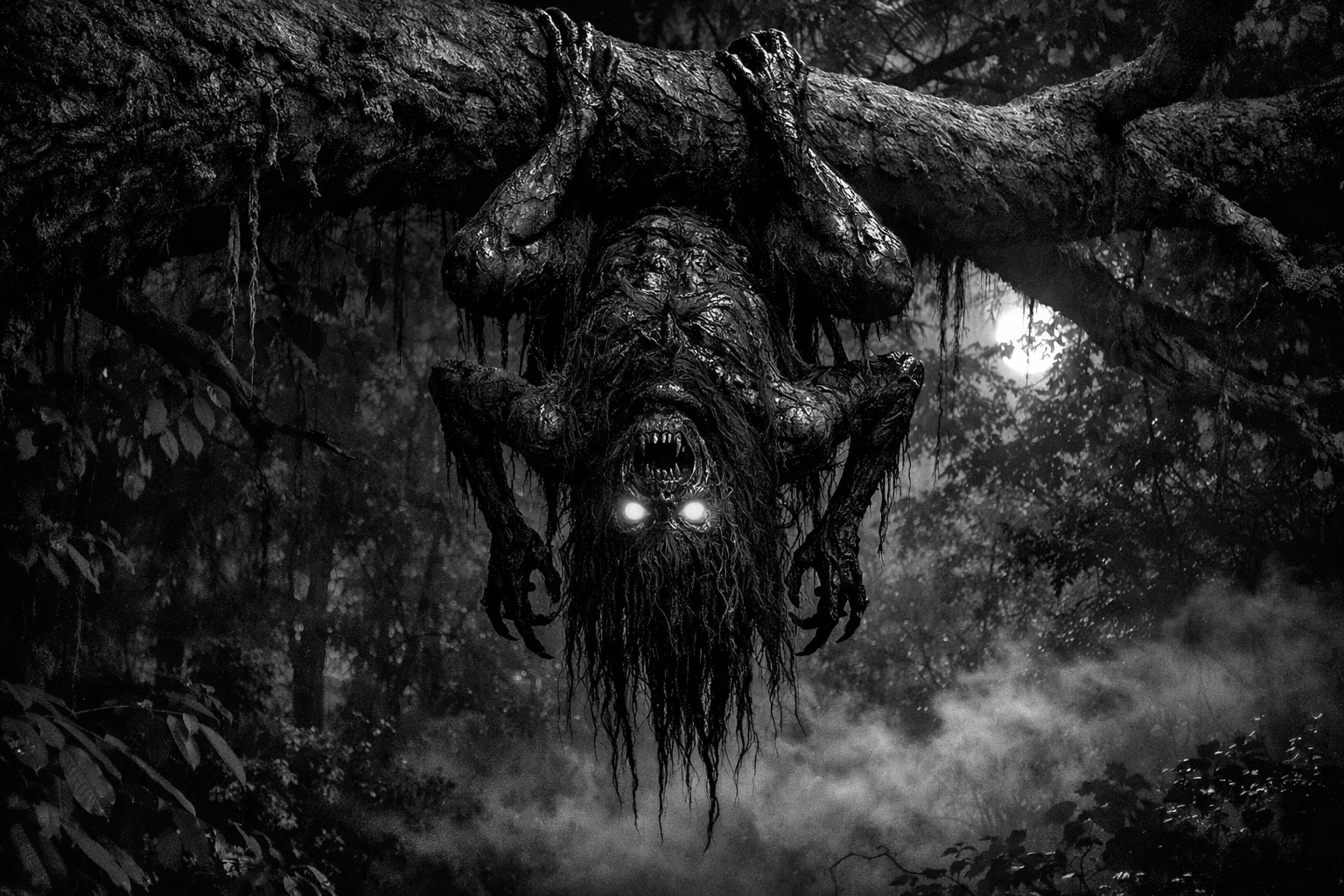

Asanbosam is a predator from Akan folklore. It lives in the forest and is known for ambushing travelers and hunters from the treetops. Unlike many West African spirits, it has a physical body with iron-like features and special adaptations for hunting in trees. People in Ghana, the Ivory Coast, and Togo still consider it one of the most feared creatures.
Summary
Overview
| Attribute | Details |
| Name | Asanbosam |
| Alternative Names | Sasabonsam, Asasabonsam, Sasabonsum |
| Similar Monsters | Yara-ma-yha-who, Eloko, Agogwe, Kapre, Drop Bear, Tikoloshe, Orang Pendek, Mapinguari, Hibagon, Barmanou, Basajaun, Leshy, Woodwose, Skunk Ape, Yowie, Chuchunya, Almas, Batibat, Kikiyaon |
| Etymology | Akan (Twi): ‘Asase’ (earth/ground) + ‘abonsam’ (demon/evil spirit); often interpreted as “earth demon.” |
| Gender | Male, Female |
| Classification | Demonic Entity |
| Species | Humanoid |
| Origin / Culture | Akan (Ghana and Ivory Coast) |
| First Recorded | Oral tradition; documented in 19th-century ethnological records. |
| Active Period | Nocturnal |
| Size | Human-sized |
| Diet | Human flesh and blood |
| Habitat | Dense tropical rainforests, specifically silk cotton trees (Onyina). |
| Powers & Abilities | • Iron-like skin durability • Tree-clinging suspension • Enhanced arboreal mobility |
| Weaknesses | • Iron weapons • Fire • Spiritual intervention by a fetish priest (Okomfo) |
| Reproduction / Creation | Born as a distinct demonic species or created through powerful dark sorcery. |
| Behavior | Solitary ambush predator |
| Pop Culture | D&D 5e (as Sasabonsam) / “The Girl Who Married a Ghost” (Folklore Anthology) / Vampire: The Masquerade (Laibon) |
Description
Asanbosam is an evil, human-like creature important in Akan beliefs. It is a predator that lives deep in the West African rainforest. Instead of moving through the forest floor, it stays high up in the silk cotton tree’s branches, which locals see as sacred and sometimes haunted.
This creature is extremely hostile to humans, especially those who enter the forest alone, such as hunters or woodcutters. It is not a ghost but a real being that needs to eat, mainly feeding on human flesh. People often see it as the opposite of kinder forest spirits, showing the wild and dangerous side of nature.
Etymology
The name Asanbosam comes from Twi, the language of the Akan people in Ghana and the Ivory Coast. It combines “Asase,” meaning “earth” or “ground,” with “abonsam,” which means “demon,” “devil,” or “evil spirit.” While “abonsam” is a general word for an evil spirit, the prefix connects this creature to the earth, setting it apart from spirits of the sky or ghosts.
In some dialects, the name is said as Sasabonsam. Here, “Sasa” means a vengeful or strong spirit of a dead animal or person. So, the name suggests a powerful, earth-based demon that controls a certain part of the forest.
How to Pronounce “Asanbosam” in English
In English, Asanbosam is usually pronounced ah-SAHN-bo-sahm. The first part is a soft “ah,” then “SAHN” (like “gone”), “bo” (as in “bone”), and “sahm” (like “palm”).
Appearance
Asanbosam looks mostly human but has some monstrous features. Its legs end in hook-shaped feet instead of normal toes, and these hooks are said to be as hard as iron or flint. This lets the creature hang upside down from tree branches for a long time without getting tired.
Its skin is said to be very tough, like tree bark or metal, and it protects it from ordinary weapons. It has long, strong arms and sharp, iron-like teeth. Its eyes are usually shown as big and glowing, helping it hunt at night. Its hair is wild and tangled, often reddish or dark, blending in with the shadows of the silk cotton tree.
Powers & Weaknesses
Powers
Asanbosam has supernatural strength and is a very effective predator. Its body is as hard as iron, and its teeth and hook-shaped feet can bite through bone and tough skin. The hooks let it hang still from branches, making it almost impossible to spot from below.
It also has great upper-body strength, so it can lift an adult human into the trees in one move. People believe it can wait for days in one spot for prey to walk by. Its thick skin makes it immune to most minor injuries, unlike normal animals.
The Mythical Creatures Bible. Flash Sale – Up to 23% OFF!
This beautifully designed paperback is the ultimate reference to legendary beings across history and cultures: From Biblical leviathans and behemoths to Asian kitsune, European fae, African tricksters, and ancient chimeras. Alphabetical entries with vivid illustrations, cultural context, and fascinating facts – essential for witchy libraries, ritual symbolism, or creature design inspiration.
Weaknesses
Even though Asanbosam is very strong, it can be hurt. Iron weapons can pierce its tough skin, and fire scares it away. Hunters often carry torches because the creature likes the dark, high up in the trees.
Many stories say the creature must follow the forest’s spiritual rules. It cannot enter holy ground or villages protected by strong charms called “suman.” The best way to defend against Asanbosam is to ask an Okomfo, a traditional priest, to perform rituals or give amulets that make a person invisible or unappealing to the monster.
Myths, Legends & Stories
Asanbosam has been part of Akan stories for centuries, seen as both a real threat and a warning. The legends are closely tied to the West African rainforest, especially the huge silk cotton trees found there.
The Origin of the Forest Demon
In the earliest oral accounts, Asanbosam was not always a solitary monster. Some traditions suggest that these creatures were once a tribe of beings that chose to reject the laws of the Supreme Being, Nyame. By retreating into the deepest parts of the forest and refusing to participate in the order of human society, they were transformed.
Their bodies changed to fit the forest. Their feet became hooks so they would never walk on ‘civilized’ ground again, and their hearts turned to iron, just as their skin and teeth had. They became the symbol of the wild, always opposing the village and the farm.
The Hunter and the Hooked Feet
A well-known folk tale tells of a skilled hunter who went too far into the forest during a drought. He sat under a big Onyina tree to rest, not knowing an Asanbosam was hanging above him. The story says the creature does not jump down but lowers its hooked feet slowly and quietly.
In this story, the hunter noticed a strange shadow that did not move with the sun. Looking up, he saw the iron hooks descending toward his shoulders. Because he was a man of great spiritual preparation, he did not panic. He placed his iron machete across his lap.
When the Asanbosam’s hooks hit the machete instead of the hunter, sparks flew and blinded the creature. This let the hunter escape. People tell this story to teach children to be alert and to always carry iron tools in the forest.
The Marriage to a Spirit
In a darker narrative, a woman from a remote village refused all local suitors, claiming she would only marry a man of perfect beauty. A Sasabonsam, hearing of this, used a common folkloric ability to briefly disguise its monstrous features. It entered the village as a tall, handsome stranger. The woman married him and followed him into the forest.
As they went deeper into the forest, the stranger gave back the parts of his beauty to the trees and animals he had taken them from. When they reached the silk cotton tree, he was back in his real form, with hooked feet and iron teeth. The woman was trapped in the high branches. This story warns against vanity and the risks of leaving the community’s safety.
The Pact with Sorcerers
In later stories, especially those about witchcraft, Asanbosam is portrayed as an ally to evil sorcerers. People believe a witch can meet Asanbosam at the base of the silk cotton tree to trade forest secrets for the blood of victims.
These stories transformed Asanbosam from a mere wild predator to a member of a larger, dark spiritual world. This shows how the creature came to be seen as both a forest monster and a demon of the spirit world.
Ultimate Family Co-op Adventure – Horrified: Universal Monsters
Ravensburger’s acclaimed co-op Horrified Board Game masterpiece: Defend against Dracula, The Mummy, Invisible Man, and other icons in a beautifully themed village. Tactical pick-up-and-deliver gameplay, escalating tension, and endless variety. Ideal gateway game for families & friends, 1-5 players, 10+, with 4.8/5 star rave reviews.

Symbolism
Asanbosam stands for the dangers and strangeness of the wild forest. In Akan culture, the forest offers both resources and great risks. The creature marks the line where human control stops and nature’s raw power starts. Its iron-like body shows the harshness of a world without rules.
The way Asanbosam attacks from above is a symbol for sudden problems in life that people do not expect. It acts as a guardian of the deep forest, reminding people that they are only visitors in nature and should always be ready for its dangers.
Can Asanbosam Be Defeated?
To defeat Asanbosam, people use both weapons and spiritual protection. The main defense is iron, since only iron can cut through its tough, iron-like body. Hunters often coat their iron tools with special herbs to make them work better against the creature.
People also use ‘suman,’ which are talismans or amulets made by an Okomfo. These often include sacred soil, certain leaves, and iron filings. The amulets hide a person’s scent or create a spiritual shield that Asanbosam cannot cross.
Another way to stay safe is to make loud noises and use bright lights. Because Asanbosam hunts alone and depends on silence and darkness, moving in big, noisy groups with torches makes an attack much less likely.
If someone is caught, their best chance is to hit the creature’s sensitive eyes or use a heavy iron blade to cut off its hooked feet. This makes it fall from the trees, where it moves slowly and can be finished off with fire.
Tags:
Related Monsters…
Aqrabuamelu (Mesopotamian Scorpion-Man Beast)
February 9, 2026
Alkonost (Russian Half-Bird, Half-Woman)
December 8, 2025
February 26, 2026
Argus Panoptes (Hundred-Eyed Giant)
January 13, 2026
Aspidochelone (Giant Sea Beast)
February 6, 2026
