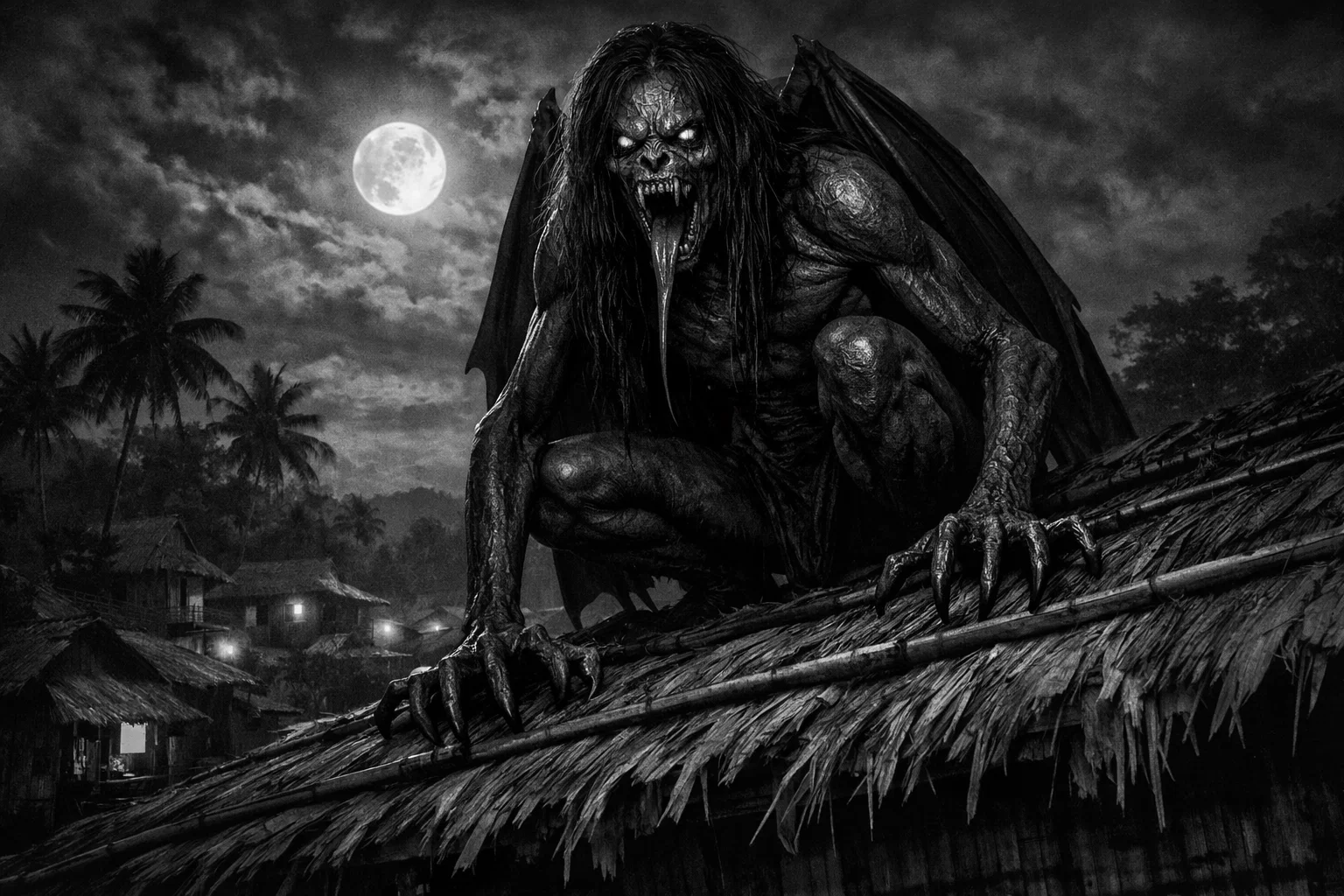

The Aswang is one of the most feared creatures in Philippine folklore. It is a broad term for different evil, shapeshifting beings. The Aswang is seen as a living symbol of social taboos, haunting rural areas and targeting those who are most vulnerable.
The Aswang is known for blending in with people during the day and turning into a predator at night. This hidden danger has remained a part of local stories, shaping traditions and inspiring modern horror.
Summary
Overview
| Attribute | Details |
| Name | Aswang |
| Alternative Names | Asuwang, Osuwang, Yuswang, Soccoro, Tik-tik, Wak-wak, Ek-ek |
| Similar Monsters | Vampire, Werewolf, Ghoul, Manananggal, Rakshasa, Penanggalan, Krasue, Leyak, Strigoi, Vetala, Soucouyant, Chonchon |
| Etymology | From Sanskrit ‘Asura’ meaning demon or ‘Asu’ meaning life/breath. |
| Gender | Male, Female |
| Classification | Demonic Entity |
| Species | Hybrid |
| Origin / Culture | Filipino (primarily Visayan and Tagalog regions) |
| First Recorded | 1589 – Juan de Plasencia, ‘Relacion de las Costumbres de los Tagalos’ |
| Active Period | Nocturnal |
| Diet | Human blood, hearts, livers, and fetuses |
| Habitat | Rural villages, forests, and rooftops |
| Powers & Abilities | • Shapeshifting into animals • Detaching upper torso (Manananggal variant) • Creating dopplegangers of victims • Superhuman speed • Silent movement |
| Weaknesses | • Salt • Garlic • Holy water • Stingray tails (Buntot Pagi) • Calamansi • Copper or bronze weapons |
| Reproduction / Creation | Passing a black chick or stone from a dying Aswang’s mouth to a successor |
| Behavior | Solitary ambush predator |
| Pop Culture | ‘Trese’ (Netflix series) / ‘The Aswang Phenomenon’ (Documentary) / ‘Grimm’ (TV Series, Season 3) |
Description
In the Philippines, ‘Aswang’ is a general term for many supernatural creatures that can change shape and hunt people. It does not refer to just one monster, but to a group that includes blood-suckers, organ-eaters, ghouls, and scavengers. By day, they look like quiet, ordinary people with regular jobs in the village. Many stories say they have bloodshot eyes from staying up all night.
At night, the Aswang changes form to hunt. It often goes after pregnant women, young children, or people who are very sick. The Aswang is very sneaky and sometimes hides its crimes by leaving behind fake bodies made from plants or wood.
Unlike many Western monsters, the Aswang is closely tied to Filipino fears and is often used to explain sudden illnesses or deaths in rural areas.
Etymology
Many linguists think the word ‘Aswang’ comes from the Sanskrit word ‘Asura,’ which means a type of powerful and often evil spirit or demon in Hindu stories. This shows the long history of trade and cultural exchange between Southeast Asia and India. In some local languages, the root ‘Asu’ means ‘life’ or ‘breath,’ hinting that the Aswang is a creature that takes the life force from others.
Different types of Aswang have names with their own origins. For example, ‘Tik-tik’ and ‘Wak-wak’ are named after the sounds they are said to make when flying. ‘Manananggal’ comes from the Tagalog word ‘tanggal,’ meaning ‘to remove’ or ‘to separate,’ which refers to how this creature can split its upper body from its lower half.
Appearance
When disguised as a human, an Aswang looks just like anyone else. Some stories say they do not have the groove under the nose, called a philtrum, or that your reflection in their eyes is upside down. They are often described as thin or tired-looking.
When the Aswang transforms, its appearance changes a lot depending on the type. Some become big black dogs, wild pigs, or huge birds. In a mixed form, they might have long, thin tongues that can reach through thatched roofs.
Their skin often turns tough and dark. Winged Aswangs have bat-like wings and long hair that help them sense their surroundings. Their claws and teeth become sharp, making it easier for them to eat flesh and organs.
Powers & Weaknesses
Powers
The main power of the Aswang is metamorphosis, which lets it sneak past people by looking like a common animal. It is also very strong and fast, able to climb walls and move over rooftops without making any noise.
A unique ability of the Aswang is its long, thin tongue, which it can stretch out to take blood or organs from sleeping people. Some types can also control shadows or make illusions to trick travelers. They can even make a magical copy of a victim that seems to die naturally, so the real body can be taken and eaten later.
Sketching from the Imagination: Creatures & Monsters Paperback – Up to 32% OFF!
Unleash your dark creativity with this 320-page paperback from 3dtotal Publishing, packed with hundreds of original creature and monster sketches from over 50 professional fantasy artists. Raw concept art, developmental drawings, and imaginative beasts ranging from dragons and demons to eldritch horrors – ideal for artists seeking inspiration for character design, RPG creatures, or spooky illustrations.
Weaknesses
There are many traditional ways to keep the Aswang away. Salt and garlic are the most common, and people often spread salt around their homes to stop Aswang from coming in. The ‘Buntot Pagi,’ which is a dried stingray tail, is used as a whip to hurt the creature.
Aswang are also driven away by bright lights and loud sounds. Since many people see them as evil or cursed, religious items like crucifixes or holy water work well in Catholic areas. There is also a special oil called lana, made by healers, that is said to bubble when an Aswang is nearby, warning people in advance.
Myths, Legends & Stories
Stories about the Aswang come from a mix of local beliefs, regional differences, and history. The term covers many monsters, but most tales focus on how close the human world is to the world of these predators. These stories often show the Aswang as a threat to trust in the community and as a danger to those who are most at risk.
Origins
In many local stories, the first Aswang was once a human who either wanted dark powers or was cursed through their family line. One common myth says the first Aswang was created by making a deal with evil spirits or old gods.
In this story, a person swallows a magical black chick or a ‘mutya,’ which is a stone-like charm that stays in their stomach. This object gives them a long life and the power to change shape, but it needs to feed on human life force. Before an Aswang dies, it must provide this object to a relative, either by choice or by tricking them, so the line of Aswang continues.
Another story from old Bikolano myths tells of a fight between the main god Gugurang and the evil god Asuang. Asuang wanted to steal Gugurang’s fire to become just as powerful. He lost and had to hide, but his followers on earth became the first Aswangs, cursed to always avoid sunlight and the fire they once wanted.
The Legend of Teniente Gimo
One of the most well-known urban legends in the Philippines is about Teniente Gimo, a leader from Dueñas, Iloilo. The story says Gimo was the head of an Aswang family. Two young women were invited by his daughter to stay at their house for a town festival. That night, one of the girls heard the family talking about which guest they would eat first.
Realizing she was in danger, the girl switched her bracelet or hair ribbon with Gimo’s daughter while she slept. In the dark, the family accidentally attacked and killed their own daughter.
The girl who survived escaped and told the authorities, which led to a lasting negative reputation for the area that still appears in jokes and stories today.
Creepy Gothic Horror Posters – Limited Deal Alert!
Elevate your witchy room with 97 Decor’s masterful unframed posters blending dark gothic aesthetics, horror elements, and creepy occult art. Rich, atmospheric designs with witches, macabre motifs, and vintage spookiness – essential for creating a captivating, moody atmosphere that draws in the shadows.
The Transformation of Maria Labo
A more recent legend that is well known across the Philippines is the story of Maria Labo. In this tale, Maria was a caring mother and domestic worker who went abroad to help her family. While she was away, she was said to have caught the Aswang curse from another worker or a demon.
When Maria came back to the Philippines, her husband found her in the kitchen with a boiling pot. He was horrified to see that she had killed and cooked their children. In anger, he hit her face with a large knife, leaving a scar that gave her the name ‘Labo,’ which means ‘gash.’ He then forced her to leave.
This story is often told to explain strange disappearances in different provinces, as people say Maria now roams the islands looking for her next victim.
The Manananggal’s Severed Half
The Manananggal is a type of Aswang known for being able to separate its upper body from its lower half.
In one common story, a traveler falls in love with a beautiful woman in a far-off village. He becomes suspicious of her nighttime habits and secretly watches her. He sees her rub a magical oil called lana on her skin, and then her body splits at the waist, and wings grow from her back.
Following a shaman’s advice, the traveler finds the lower half of her body in the bushes and puts salt, ash, or crushed garlic on the exposed flesh. When the upper body comes back at dawn, the pain stops it from rejoining with its legs. The creature cannot hide from the sunlight and is destroyed by the first light of day.
The Trickery of the Tik-tik and Wak-wak
The bird-like Aswangs, called Tik-tik and Wak-wak, appear in many warning stories about tricky sounds. Legends say these creatures are either scouts for bigger Aswangs or are the monsters themselves in bird form. One common myth says that if you hear the ‘tik-tik’ sound getting louder, the creature is actually far away and moving away from you.
But if the sound gets quieter and seems far away, it means the monster is actually right above your roof, using its long, thin tongue to reach a sleeping pregnant woman.
The Corpse-Stealing Bal-bal
In some northern areas, the Aswang appears as a scavenger called the Bal-bal. This creature is said to have a strong sense of smell for anything decaying. One well-known story is about a family holding a wake for their father.
Even with bright lights and many people around, the Bal-bal slips onto the roof and uses a strong spell to make everyone fall asleep. It then swaps the body in the coffin with a banana tree trunk shaped like the dead person. The real body is taken to the Bal-bal’s home to be eaten.
Symbolism
The Aswang is a strong symbol of social fear and the worry about outsiders hiding among us. In close Filipino communities, the monster stands for the danger from people who do not fit in or who keep to themselves. In the past, the story was also used to control people and even as a form of psychological warfare.
During colonial times and the mid-1900s, stories about Aswangs were sometimes spread to keep people inside at night or to harm the reputation of political rivals. The Aswang also stands for the dangers faced at home, especially during childbirth and when caring for babies.
Tags:
Related Monsters…
Akaname (Japanese Filth-Licking Yokai)
January 5, 2026
Ammit (Egyptian Soul Devourer Demon)
December 8, 2025
Azhi Dahaka (Persian Three-Headed Dragon)
January 19, 2026
Antaeus (Invincible Earth Giant)
January 5, 2026
