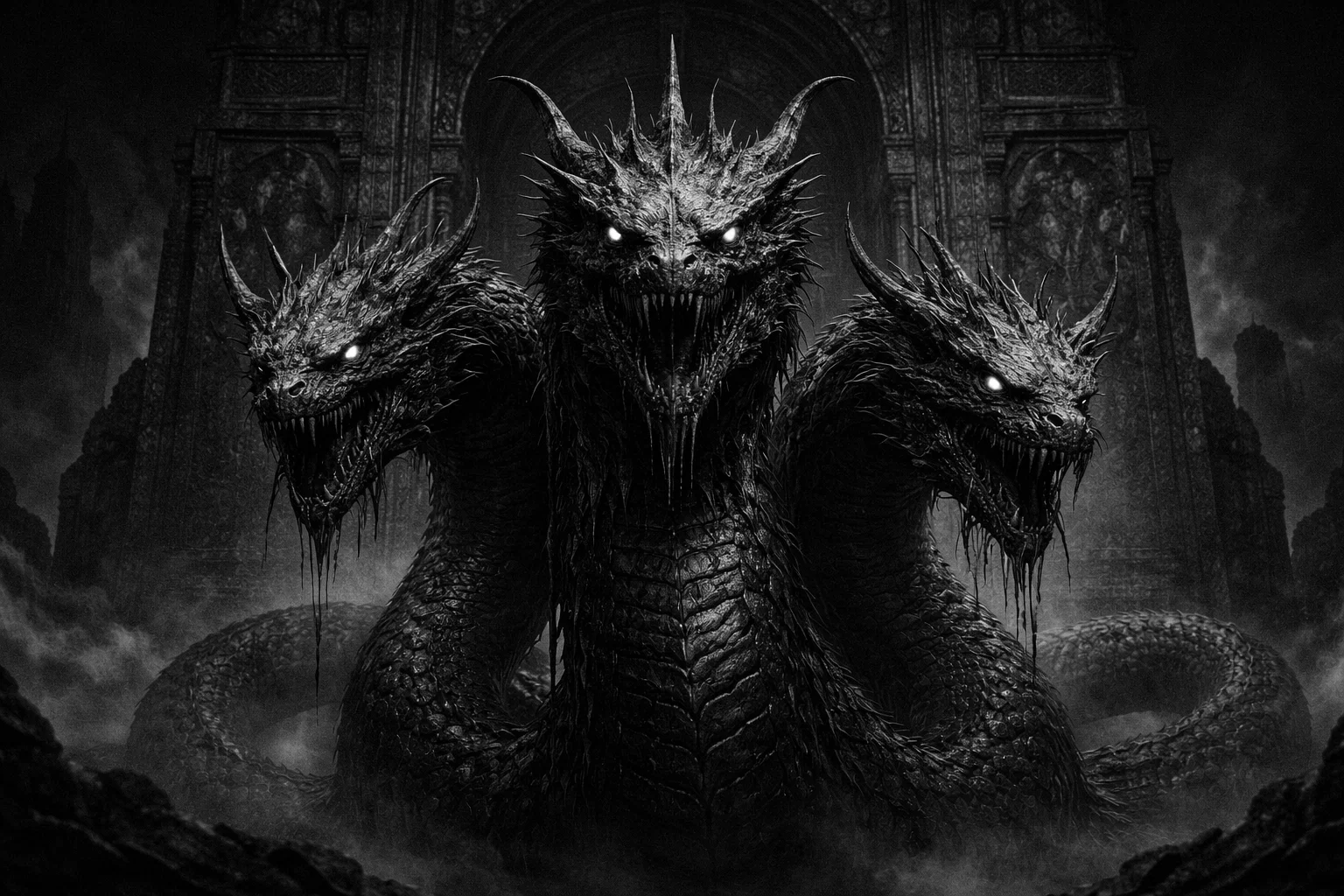

Azhi Dahaka is a well-known monster in Zoroastrian mythology and Persian folklore, seen as the embodiment of evil and chaos. Usually described as a huge serpent or dragon, it is the main enemy of light and order.
Ancient stories present it as a cosmic threat that only divine power can control. Even today, Azhi Dahaka is one of the most lasting symbols of evil in Middle Eastern myths.
Summary
Overview
| Attribute | Details |
| Name | Azhi Dahaka |
| Alternative Names | Aži Dahāka, Zahhak, Dahak, Zohak, Azdahak, Bevar-Asp |
| Similar Monsters | Typhon, Hydra, Vritra, Jörmungandr, Apep, Orochi, Tiamat, Ladon, Geryon, Nehebkau, Fafnir, Illuyanka, Lotan, Yam, Dahaka (Prince of Persia) |
| Etymology | Avestan: “Aži” (serpent/dragon) and “Dahāka” (stinging/burning or man-like) |
| Gender | Male |
| Classification | Demonic Entity |
| Species | Hybrid |
| Origin / Culture | Persian (Modern-day Iran) |
| First Recorded | c. 1000 BCE – The Avesta |
| Active Period | Always active |
| Size | Massive, often described as blocking the sun or stretching across horizons |
| Lifespan | Immortal (bound until the end of time) |
| Diet | Human brains, blood, and vital energy |
| Habitat | The fortress of Kuwirinta or Mount Damavand |
| Powers & Abilities | • Immortality • Command over thousand-fold deceits • Control over drought and storms • Blood turns to venomous vermin if spilled |
| Weaknesses | • Vulnerable to divine weapons • Cannot be slain without destroying the world • Imprisonment by holy metal |
| Reproduction / Creation | Created by Angra Mainyu (Ahriman) to destroy the world |
| Behavior | Malicious tyrant and deceiver |
| Pop Culture | Final Fantasy series / Prince of Persia: Warrior Within / High School DxD / Persona 2: Eternal Punishment |
Description
Azhi Dahaka is a primordial monster central to the dualistic cosmology of ancient Persia. It functions as a lieutenant of the supreme evil spirit, designed specifically to bring about the destruction of the material world and the purity of the righteous. It is not merely a beast but a sentient, cunning entity capable of speech, sorcery, and political manipulation.
Stories often show Azhi Dahaka as a king who became a monster through corruption. It stands for the worst kind of disorder, bringing famine, disease, and lies. Unlike monsters that hide, Azhi Dahaka tries to rule people through fear and by consuming them. Its defeat is seen as necessary for the world to be renewed.
The Mythical Creatures Bible. Flash Sale – Up to 23% OFF!
This beautifully designed paperback is the ultimate reference to legendary beings across history and cultures: From Biblical leviathans and behemoths to Asian kitsune, European fae, African tricksters, and ancient chimeras. Alphabetical entries with vivid illustrations, cultural context, and fascinating facts – essential for witchy libraries, ritual symbolism, or creature design inspiration.
Etymology
The name Azhi Dahaka comes from the Avestan language. ‘Aži’ means ‘serpent’ or ‘dragon,’ and is related to the Sanskrit word ‘Ahi.’ This shows its identity as a powerful, reptilian creature. The second part, ‘Dahāka,’ has different possible meanings. Some experts think it comes from a word meaning ‘to sting’ or ‘to burn,’ highlighting its dangerous side.
Some theories say the name means ‘ten-fold’ or ‘man-like,’ possibly because Azhi Dahaka could take human form or was seen as a corrupted ruler in later stories, such as the Shahnameh. Over time, the name changed to Dahak in Middle Persian and Zahhak in New Persian. In every version, it still means a ‘fiendish serpent’ that stands against the divine.
How to Pronounce “Azhi Dahaka” in English
In English, the name is typically pronounced as AH-zhee dah-HAH-kah. The first syllable of “Azhi” uses a soft “zh” sound, similar to the “s” in the word “measure” or “vision.”
The second word, “Dahaka,” places the primary emphasis on the second syllable. The “a” sounds throughout the name are generally open and back, as in the word “father,” rather than the flat “a” found in “apple.” Some speakers may use a harder “j” sound for the first part (AH-jee). However, the softer fricative is more linguistically accurate to its Persian roots.
Appearance
Azhi Dahaka is usually shown as a huge, three-headed dragon or serpent. It has six eyes and three mouths, so it can see everywhere and eat several victims at once. Its body is massive and covered in tough scales, often said to be the color of soot or dried blood. Some stories say it has human-like features, such as an upright torso, alongside its dragon form.
In later Persian stories, Azhi Dahaka is known for having two venomous snakes growing from its shoulders. These snakes act on their own and always need to be fed. Its blood is a thick, black liquid, not life-giving.
If this blood touches the ground, according to lore, it will turn into scorpions, lizards, and other poisonous creatures, making it impossible for heroes to simply cut the monster apart.
Powers & Weaknesses
Powers
Azhi Dahaka has great supernatural strength and is almost impossible for mortals to hurt. It is known for its skill in trickery, able to fool both humans and gods and spread lies and confusion. It can also control the weather, causing long droughts to weaken its enemies.
One of Azhi Dahaka’s most dangerous traits is its blood, which has the essence of all evil creatures, called ‘khrafstra.’ Just being near it poisons the land, and its breath brings disease. It is also nearly immortal; it can be hurt and feel pain, but killing it with ordinary or even divine weapons would unleash all the evil within, causing disaster.
NECA Collectible Texas Chainsaw Massacre Ultimate Leatherface
Horror masterpiece from NECA: 7” articulated Leatherface with swappable heads (terrifying masks and expressions), chainsaw with sound potential in pose, hammer, meat hook, and extra hands for dynamic displays. Authentic film-accurate detailing in a collector-friendly window box – perfect for witchy altars or creepy collections.

Weaknesses
Azhi Dahaka’s main weakness is that it cannot stand against certain holy objects and the power of Khvarenah, or Divine Glory. It is especially vulnerable to the ‘Mace of Victory’ (the Gurz), a weapon made for the hero Fereydun to defeat it.
Another weakness is its need to eat human brains. If the snakes on its shoulders are not fed, they become restless and may attack the main body. Most importantly, Azhi Dahaka is fated by divine will to be trapped in Mount Damavand. The mountain’s holiness and the chains keep it weak and in constant torment.
Myths, Legends & Stories
Azhi Dahaka did not appear by chance; it was created on purpose as an act of cosmic sabotage. Long ago, when the world was still balanced, the evil spirit Angra Mainyu wanted a weapon to frighten the good and upset the world. He used the darkness of many eclipses and the venom of all crawling creatures to make a being of pure destruction.
Once finished, the three-headed dragon was set loose on the world as a living form of the Great Lie. At first, it tried to swallow the sun and dry up the oceans, acting as a predator of the elements. The gods had to step in to stop the world from ending too soon.
The Pact of the Serpent-King
In the age when the world’s first kings ruled, there lived a man named Zahhak, a prince of great ambition but little wisdom. Angra Mainyu appeared to him in the guise of a wise counselor, whispering of the glory that could be his if he would only remove his father from the throne.
Tempted by this promise, Zahhak killed his own father. After becoming king, the evil spirit came back, this time disguised as a talented chef. He cooked delicious meat dishes, which were rare at the time, to win the king’s full trust.
As a reward for his cooking, the chef only asked to kiss the king’s bare shoulders. As soon as he did, the ground shook, and two hungry black snakes burst from Zahhak’s shoulders. The king screamed in pain and tried to cut them off, but the snakes grew back instantly, always hungry for more than normal food.
The Thousand-Year Mourning
The evil spirit, appearing one last time, informed the terrified Zahhak that the serpents could only be pacified by a constant offering of human brains. As a result, a millennium of darkness began. Zahhak moved his court to a towering fortress, and every day, two young men were led to the palace to be slaughtered so the snakes could feed. The land of Persia, once fertile and joyous, became a place of silence and shadows.
The dragon-king’s cruelty was not just about feeding the snakes. He tried to take away the world’s ‘Khvarenah,’ or divine glory, by making people give up the truth and believe his lies. Over time, he became a huge, three-headed monster, with his human side almost gone under scales and dark power.
Mothers hid their children in the mountains, and blacksmiths stopped working. People lived in constant sorrow, waiting for a savior who seemed unlikely to arrive.
Ultimate Family Co-op Adventure – Horrified: Universal Monsters
Ravensburger’s acclaimed co-op Horrified Board Game masterpiece: Defend against Dracula, The Mummy, Invisible Man, and other icons in a beautifully themed village. Tactical pick-up-and-deliver gameplay, escalating tension, and endless variety. Ideal gateway game for families & friends, 1-5 players, 10+, with 4.8/5 star rave reviews.

The Rise of the Iron Banner
The story changed in the workshop of a man named Kaveh. After losing almost all his sons to the palace sacrifices, Kaveh went to Zahhak’s court when his last son was called. In a bold act, he stood up to the serpent-king and demanded justice. When Zahhak tried to win him over by asking him to sign a paper saying the king was just, Kaveh ripped it up.
Kaveh left the palace, took off his heavy leather apron, and raised it on a spear. This simple tool became the Derafsh Kaviani, a symbol of freedom. He traveled across the land, gathering people who had suffered under the dragon’s rule, and looked for Fereydun, a young man from the ancient line of Jamshid who grew up in the wild, fed by a special cow.
The Iron Chains of Damavand
Fereydun, led by the divine messenger Sorush, marched to the capital with Kaveh’s army. He carried a huge mace shaped like an ox’s head, honoring the animal that fed him. At the palace, he found Azhi Dahaka in a room of horrors. Their fight shook the city. Fereydun hit the monster and broke its skull, but just as he was about to finish it, the angel Sorush stopped him.
The angel explained that killing the creature would release so many poisonous snakes and insects that they would cover the earth. So, instead, Fereydun chained the dragon-king with huge bands of holy metal and dragged the struggling beast to the top of Mount Damavand.
There, in the cold darkness of a deep cave, Fereydun nailed the monster to the rock. People say the sulfur smoke from the mountain today is the dragon’s heavy breath, as it waits for the end of the world to seek revenge.
The End of Days
Prophecy says Azhi Dahaka will not stay trapped forever. At the end of time, as the last battle between good and evil approaches, the dragon will break free. He will destroy a third of the world’s people and drink all the water in the rivers.
At the last moment, the hero Keresaspa will wake from his long sleep to fight the monster one final time. With one blow, he will kill the dragon, cleansing the world of its blood. This will allow the dead to return and a new age of peace to begin.
Symbolism
Azhi Dahaka is the ultimate symbol of unnatural tyranny and the corruption of leadership. In the Persian consciousness, he represents the “anti-king”—a ruler who consumes his people rather than protecting them.
He is also a manifestation of cosmic dualism, representing the inevitable presence of chaos and destruction that exists in opposition to order. The snakes on his shoulders symbolize insatiable greed and the heavy price of dealing with evil forces.
In the end, Azhi Dahaka’s imprisonment shows that restraint can win over destruction. It suggests that some evils are so deep they cannot be destroyed, only kept in check by constant watchfulness and divine law.
Can Azhi Dahaka Be Defeated?
Traditionally, defeating Azhi Dahaka completely is seen as something only divine beings or chosen heroes can do. While the creature was physically bound with a special mace, old stories say that ordinary people protected themselves through spiritual purity and rituals.
The main defense against the monster’s tricks was reciting the Ahuna Vairya, a sacred Zoroastrian prayer believed to keep away demons and protect the soul from the serpent-king’s corruption.
Besides prayers, people used symbols and natural items to protect themselves from the dragon’s evil. Burning white sandalwood and special resins in sacred fires was thought to clean the air of the beast’s harmful breath. Folk traditions also included wearing amulets with the ox-headed mace or the hero Fereydun to guard against illness and bad luck.
People also planted sacred herbs, such as the Haoma plant, to strengthen their homes spiritually. These methods were not meant to kill the monster, but to create a holy space where its chaos could not enter, helping good people survive until the final victory.
Tags:
Related Monsters…
Aqrabuamelu (Mesopotamian Scorpion-Man Beast)
February 9, 2026
January 28, 2026
Azhi Dahaka (Persian Three-Headed Dragon)
January 19, 2026
Black Annis (Blue Hag of Leicestershire)
February 18, 2026
December 3, 2025
