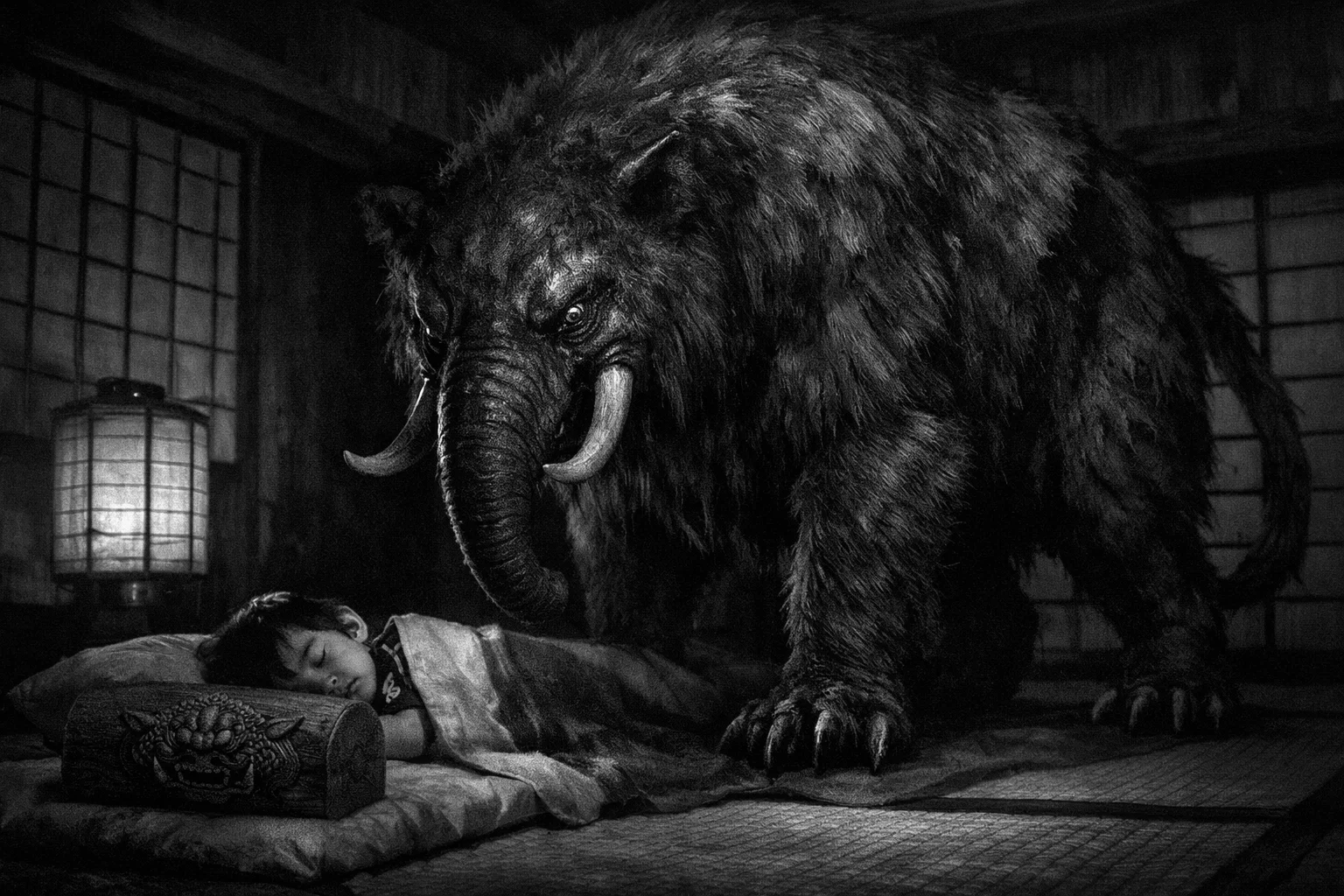

The Baku is a kind-hearted chimera from Japanese mythology, famous for eating nightmares. It first appeared in Chinese folklore before becoming a protective spirit in Japan. People usually call on the Baku after a bad dream to keep away any bad luck.
Although the Baku looks like a mix of different animals, its main role is to eat bad dreams and negative thoughts.
Summary
Overview
| Attribute | Details |
| Name | Baku |
| Alternative Names | Mo, Hakutaku (sometimes conflated), Dream-Eater |
| Similar Monsters | Nue, Kirin, Hakutaku, Qilin, Pixiu, Chimera, Manticore, Shachihoko, Amabie, Komainu, Kamaitachi, Raiju, Tanuki, Kitsune, Bakeneko, Nekomata, Yatagarasu, Inugami |
| Etymology | From Japanese “Baku,” referring to both the mythological creature and the tapir. |
| Gender | Male, Female |
| Classification | Spirit, Chimerical Entity |
| Species | Hybrid |
| Origin / Culture | Japanese (derived from Chinese folklore) |
| First Recorded | c. 14th Century – Muromachi period texts and art. |
| Active Period | Nocturnal |
| Diet | Nightmares and bad dreams |
| Habitat | Human settlements, bedrooms, the spiritual realm |
| Powers & Abilities | • Dream consumption • Warding off evil spirits • Transformation of bad luck into good fortune |
| Weaknesses | • Over-consumption (leading to starvation of hopes) • Specific verbal dismissals |
| Reproduction / Creation | Born from the leftover pieces of animals after the gods finished creating the world. |
| Behavior | Protective guardian |
| Pop Culture | Pokémon (Drowzee/Hypno), Digimon (Bakumon), Naruto, Touhou Project, Yo-kai Watch |
Description
The Baku is a supernatural creature that acts like a spiritual filter for the mind during sleep. It is seen as a holy being that brings good luck and protects the home. Unlike scary monsters, the Baku is considered a helpful, almost god-like entity that people want to welcome into their homes.
The creature works in the world of dreams, not in the real world. Many believe the gods made it from leftover parts after creating all other animals. Thanks to its unique origin and its role in eating nightmares, the entity is seen as a symbol of peace and health, especially for children who have bad dreams.
Yokai and Supernatural Beings Hardcover Book – Up to 28% OFF!
Explore 100 authentic illustrations of Japan’s most haunting creatures in this premium 240-page volume. From ape-like hihi kidnappers to smirking hannya and shape-shifting bakeneko, drawn from rare historical sources including first-time reproduced monster parade scrolls. Curated by a leading authority on Japanese prints – an indispensable guide to yokai horror and folklore for altars, shelves, or spooky reading.
Etymology
The word “Baku” is also the Japanese name for the tapir, a large plant-eating animal from Southeast Asia and South America. But the myth of the Baku existed in Japan before people there knew about the real tapir. The name is written with the kanji 獏.
The name comes from Chinese legends about a creature called the “Mo,” which was said to eat iron and copper. In Japan, this idea changed, and the Baku became known for eating dreams instead. Today, “Baku” can mean both the real tapir and the mythical spirit, probably because they look a bit alike.
How to Pronounce “Baku” in English
In English, “Baku” is pronounced BAH-koo. The first part sounds like “ba” in “father,” and the second part is like the “oo” in “too.” You can stress both syllables equally or put a little more emphasis on the first.
Appearance
The Baku has a unique body made from parts of different animals. It has an elephant’s trunk and tusks, which it uses to inhale dreams. Its eyes look like a rhinoceros’s, and its body is shaped like a bear’s.
Its legs look like a tiger’s, with strong paws and sharp claws, and its tail is like an ox’s. Even though it’s made from many animal parts, artists usually show the Baku as one complete creature. Often, its fur is spotted or looks like a patchwork quilt, showing that it was made from leftover parts.
Powers & Weaknesses
Powers
Baku’s main power is eating nightmares. This isn’t just a physical act—it’s like a spiritual cleaning. If someone wakes up from a bad dream, they can call the Baku, and it will come to eat the dream, so the person won’t be bothered by it anymore.
Besides eating dreams, the Baku can also keep away sickness and evil spirits. People believe that just having the Baku nearby can keep bad luck from entering the house. In the past, people used its image as a charm to protect against illness. The Baku is also said to turn a bad omen, like a nightmare, into something good or lucky for the person who called it.
NECA Collectible Texas Chainsaw Massacre Ultimate Leatherface
Horror masterpiece from NECA: 7” articulated Leatherface with swappable heads (terrifying masks and expressions), chainsaw with sound potential in pose, hammer, meat hook, and extra hands for dynamic displays. Authentic film-accurate detailing in a collector-friendly window box – perfect for witchy altars or creepy collections.
Weaknesses
Baku’s main weakness is that it is always hungry. Normally, it only eats bad dreams, but if it is called too often or still feels hungry, it might start eating a person’s hopes, wishes, and good dreams, too. This can leave someone feeling empty and without joy or ambition.
The creature can only help if someone invites it, usually through special rituals such as placing its picture under a pillow. If a person says they don’t need the Baku anymore, it will leave, since it needs an invitation to appear in the human world.
Myths, Legends & Stories
The monster actually comes from Chinese folklore and was brought to Japan during the Tang Dynasty. In China, it was called the Mo and was known for eating iron and copper, not dreams.
People believed the Mo would sneak into camps at night and lick metal off weapons and cooking tools. When the story reached Japan in the Muromachi period (14th–16th centuries), the creature’s taste changed from metal to nightmares.
According to Japanese tradition, the Baku was made from leftover parts after the gods finished creating all the other animals. This story explains why it appears to be a mix of creatures. Because of its special origin, the Baku is seen as a holy beast, like the Phoenix (Ho-oh) and the Kirin.
The Summoning Ritual of the Muromachi
In the Muromachi and Edo periods, people believed they could call the Baku for help if they had a bad dream. The ritual was to sit up in bed and say, “Baku-kurae!” (Baku, eat it!) or “I give this dream to the Baku” three times.
The legend says you have to do this before sunrise, or the nightmare might come true. When called, the Baku comes down from the spirit world and uses its trunk to inhale the bad dream.
The story says that the creature enjoys the taste of fear and anxiety. By eating the dream, it erases the memory from the person’s mind and removes any bad luck linked to it.
The Treasure Ship and the New Year’s Dream
One important story about this strange monster is connected to Hatsuyume, the first dream of the New Year. In Japan, people believe this dream sets the mood for the whole year. To bring good luck, a tradition began where people used the Takarabune, or “Treasure Ship,” which carries the Seven Lucky Gods.
According to legend, putting a woodblock print of the Takarabune under your pillow will help you have a lucky dream. The sail of this magical ship almost always has the kanji for “Baku” on it.
The story says the Baku acts like a guard. If a bad spirit tries to enter your New Year’s dream, the Baku on the sail will appear and eat it before it can reach you. This helped make the Baku known as a household protector, not a wild monster.
The Pestilence of the Edo Period
In the 18th and 19th centuries, people began to see Baku not just as a dream-eater but also as a protector against sickness. Stories from this time talk about “Baku-fuda,” or Baku charms, being used during outbreaks of smallpox and other diseases.
One well-known story tells of a village where people kept having nightmares about a skeleton coming into their homes. After these dreams, the villagers would become very sick.
A local monk told the survivors to carve pictures of the Baku into the wooden pillars of their homes and to sleep with “Baku-makura”—pillows made of wood or ceramic with the Baku’s image. The legend says the Baku stopped the “evil winds” that brought disease, treating the sickness like a nightmare to be eaten.
This started the tradition of carving Baku figures into the wooden supports, or kiban, of Buddhist temples and Shinto shrines. You can still see them today, acting as eternal guardians against both spiritual and physical harm.
Creepy Gothic Horror Posters – Limited Deal Alert!
Elevate your witchy room with 97 Decor’s masterful unframed posters blending dark gothic aesthetics, horror elements, and creepy occult art. Rich, atmospheric designs with witches, macabre motifs, and vintage spookiness – essential for creating a captivating, moody atmosphere that draws in the shadows.
The Warning of the Hollow Sleeper
Although Baku is usually seen as kind, there is a darker story about its endless hunger. In this tale, a nobleman was so anxious that he wanted to never feel fear again. He used a Baku charm every night and eventually asked the creature to eat even his smallest bad thoughts.
The legend says that after the Baku finished eating all the man’s nightmares, it was still hungry. Since the nobleman called on it so often, the Baku started to eat his good dreams too—his hopes, his love for his wife, and his happy memories. In the end, the man woke up healthy but felt empty inside, without any passion or desire.
This story explains why people need both good and bad experiences. It warns that if you never have nightmares, you lose something important about being human.
Symbolism
The Baku stands for protection, cleansing, and the victory of good over chaos. It shows that even scary things like nightmares and bad omens can be turned into something harmless or even helpful.
Since the Baku is made from many animals, it also stands for harmony and bringing different things together. At home, it’s a symbol of caring parents, because its image was often used to protect children from nightmares.
Can Baku Be Defeated?
Because the Baku is a kind spirit, people don’t usually fight it. Still, folklore warns of its potential downsides, such as accidentally eating good dreams. To control the creature, people used special charms. The most common was the “Takarabune” (Treasure Ship) paper, which often had the kanji for Baku on its sail. People put this under their pillows to make sure the Baku did only good things.
If someone thinks the Baku is staying too long and taking away their motivation, the usual solution is to tell it to leave. People also stop calling the Baku for a while, which makes it go away on its own.
Some stories say that burning incense made from certain mountain herbs can clear a room of the Baku. Unlike evil spirits, the Baku respond to people’s feelings. If a person is no longer afraid, the Baku will leave and look for someone else who needs it.
Tags:
Related Monsters…
February 5, 2026
Abominable Snowman (Himalayan Beast)
December 1, 2025
Akkorokamui (Ainu Monstrous Sea Kraken)
January 8, 2026
Behemoth (Middle Eastern Biblical Beast)
February 13, 2026
Azazel (Fallen Angel Turned Demon)
January 15, 2026
Black Annis (Blue Hag of Leicestershire)
February 18, 2026
