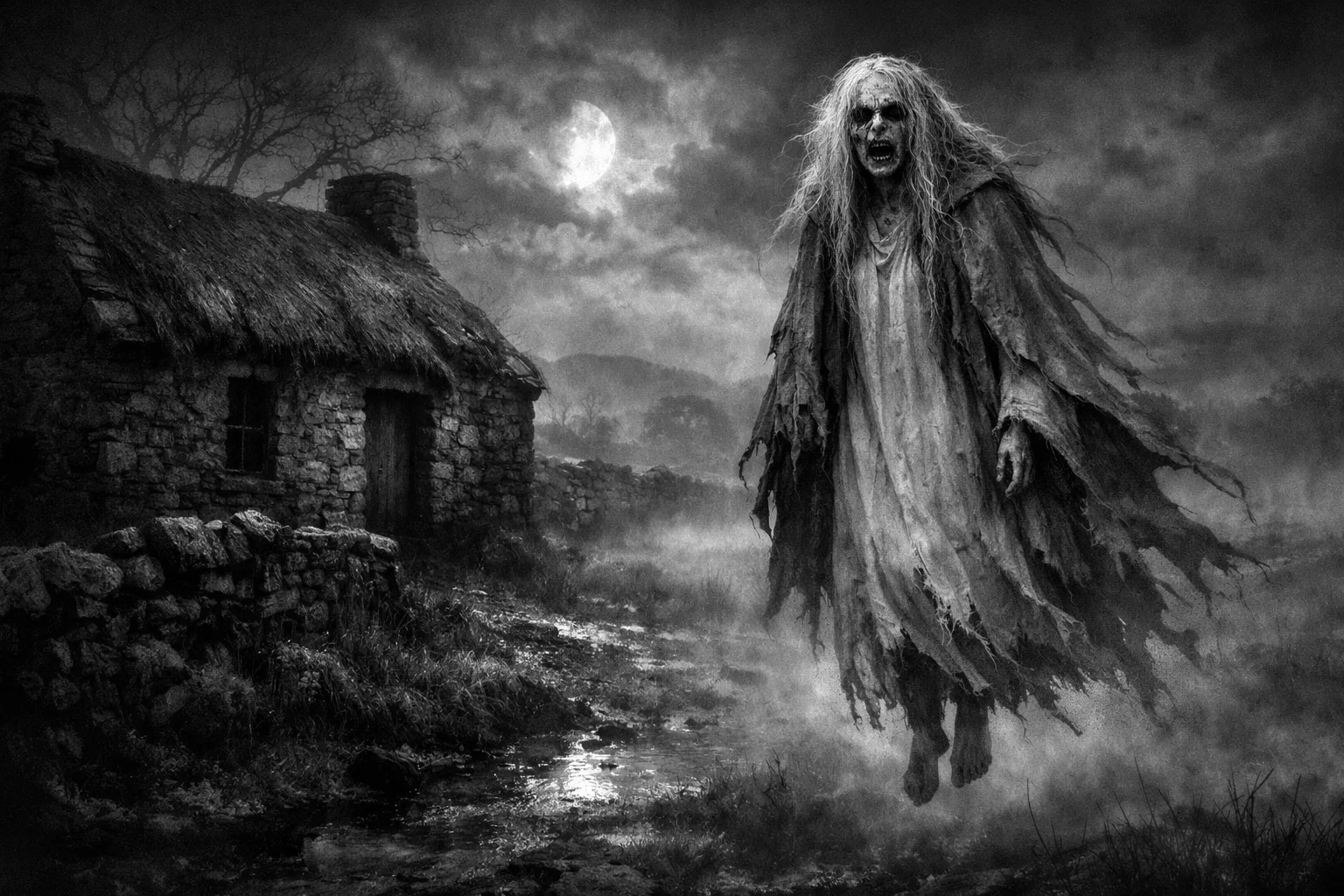

The banshee is a female spirit in Irish folklore who warns of a family member’s approaching death. Her piercing wail is a well-known part of Gaelic tradition. People fear her appearance because she is seen as an omen, not a cause of death. To understand the banshee, it helps to look at ancient Celtic society and Ireland’s supernatural history.
Summary
Overview
| Attribute | Details |
| Name | Banshee |
| Alternative Names | Bean Sídhe, Bean-Sìth, Bhean Cháinte, Badhb, Bean Nighe, Little Washer by the Ford, Cyhyraeth, Gwrach y Rhibyn, Hag of the Mist, White Lady of Sorrow |
| Similar Monsters | La Llorona, White Lady, Bean Nighe, Cyhyraeth, Gwrach y Rhibyn, Deer Woman, Huldra, Onryō, Succubus, Yuki-onna, Harpy, Siren, Empusa, Lamia, Pontianak, Manananggal, Mourning Woman, Black Annis, Kuchisake-onna, Medusa |
| Etymology | From Old Irish “ben síde” = woman of the fairy mound |
| Gender | Female |
| Classification | Spectral Entity |
| Species | Spectral |
| Origin / Culture | Irish (Ireland and Scotland) |
| First Recorded | c. 1350 – Cathreim Thoirdhealbhaigh (Triumphs of Turlogh) |
| Active Period | Night |
| Size | 1.5–1.7 m tall |
| Lifespan | Immortal |
| Diet | None |
| Habitat | Near water, fairy mounds, and ancestral homes |
| Powers & Abilities | • Keening (piercing wail) • Death omens • Intangibility • Levitation |
| Weaknesses | • Iron • Religious icons • Holy water • Salt • Silver |
| Reproduction / Creation | The ghost of a murdered woman or a deceased family keener |
| Behavior | Solitary harbinger |
| Pop Culture | D&D Monster Manual, X-Men (Banshee), Harry Potter and the Prisoner of Azkaban, Supernatural (TV Series), The Banshees of Inisherin, Darby O’Gill and the Little People |
Description
In Gaelic mythology, the banshee is a supernatural being who signals when someone is about to die. She is a solitary spirit, not part of a group. The banshee is closely tied to old Irish families, especially those with surnames starting with “O” or “Mac.” She does not cause death, but instead warns relatives that it is near.
The banshee is linked to the “Sídhe,” who were believed to be the last of the Tuatha Dé Danann living in Ireland’s ancient mounds. The banshee’s main role is to watch and wail. She is often seen near the homes of people who are about to die or by water. People both respect and fear her, since her presence means someone’s life is about to end.
The Mythical Creatures Bible. Flash Sale – Up to 23% OFF!
This beautifully designed paperback is the ultimate reference to legendary beings across history and cultures: From Biblical leviathans and behemoths to Asian kitsune, European fae, African tricksters, and ancient chimeras. Alphabetical entries with vivid illustrations, cultural context, and fascinating facts – essential for witchy libraries, ritual symbolism, or creature design inspiration.
Ethymology
The English word “banshee” comes from the Irish “bean sídhe.” “Bean” means “woman,” and “sídhe” refers to the hills or mounds where fairies were thought to live. So, the name literally means “woman of the fairy mound.”
In Scottish Gaelic, the word is “bean sìth,” which means the same thing. Older writings sometimes use “bhean cháinte,” which means “wailing woman.” The word changed over time as the language moved from Old Irish to Middle Irish and then to modern English.
The word “sídhe” comes from the Proto-Celtic word “sīdos,” meaning “settlement” or “mound.” This links the banshee to Ireland’s land and its old burial sites.
How to Pronounce “Banshee” in English
“Banshee” has two syllables. The first, “ban,” rhymes with “pan” or “can.” The second, “shee,” sounds like the word “she.” The stress is on the first syllable: BAN-shee. In the International Phonetic Alphabet, it is /ˈbænʃiː/.
Appearance
The banshee’s appearance changes depending on the story, but there are three main types. She may look like a young woman with pale skin and long hair that is white, silver, or red. Sometimes, she appears as a middle-aged woman. Most often, she is described as an old woman, or crone, with thin grey hair and red eyes from crying so much.
The banshee is usually seen in a long, loose dress or a burial shroud, often in green, grey, or white, and sometimes with a grey cloak. She is sometimes spotted brushing her hair with a silver or gold comb. No matter her age, she always looks ghostly and see-through, not solid like a living person.
Powers & Weaknesses
Powers
The banshee’s main power is her voice, called “keening.” This is a loud, high-pitched wail that can be heard far away. Some stories say it can even break glass, but its real purpose is to warn a family that someone is about to die. Only the right family members can hear it.
Besides her voice, the banshee can pass through walls and trees, float above the ground, and move without making a sound. She also knows when and where someone will die before it happens. The banshee can remain invisible to everyone except those she wants to warn.
Yokai and Supernatural Beings Hardcover Book – Up to 28% OFF!
Explore 100 authentic illustrations of Japan’s most haunting creatures in this premium 240-page volume. From ape-like hihi kidnappers to smirking hannya and shape-shifting bakeneko, drawn from rare historical sources including first-time reproduced monster parade scrolls. Curated by a leading authority on Japanese prints – an indispensable guide to yokai horror and folklore for altars, shelves, or spooky reading.
Weaknesses
According to Celtic folklore, the banshee can be kept away by certain objects. Cold iron is the most effective, so people place iron near doors or windows to keep her from coming too close. Some stories also say that silver can keep her or other spirits away.
Religious items and rituals are also used for protection. Holy water and making the sign of the cross are believed to drive the banshee away. Since she is linked to certain families, people outside those bloodlines are not at risk. Some also put salt on windowsills to keep her away.
Myths, Legends & Stories
The banshee’s origins are closely tied to old Gaelic mourning customs and the legends of the Tuatha Dé Danann. Before the banshee was seen as a lone spirit, Irish funerals featured the “keen,” a rhythmic, sung lament performed by women called mná caointe.
Some legends say the first banshees were the spirits of these professional mourners, especially those who were deeply loyal to noble families and kept serving them after death. Other stories claim the banshee appeared when Ireland’s ancient gods left for the hollow hills, leaving guardians to watch over their descendants.
Over time, these guardians changed from real mourners into ghostly spirits, forever connected to the families they promised to protect.
The First Keener
In the mist-shrouded era when the High Kings still sat at Tara, there lived a woman of unmatched vocal beauty who served the royal courts. She was the chief keener of her province, a woman whose life was dedicated to the art of the caoineadh. It was said that her voice possessed a resonance that could carry the weight of an entire clan’s sorrow, a sound so pure it could close the gap between the living and the dead.
When the last of her great patrons fell in a tragic battle that wiped out his entire line, she found herself with no one left to pay for her services. Driven by a deep sense of ancestral loyalty, she spent seven days and nights by the river’s edge, singing a lament so profound that the very stones of the valley were said to weep.
After her own death, the spirits of the mounds recognized her devotion. Instead of passing into the afterlife, she was granted a unique and eternal existence. She was transformed into a permanent sentinel for the noble bloodlines of Ireland. She became the first “woman of the mound,” manifesting not as a threat, but as a final mark of respect for those of high birth.
This story made the banshee a sign of high status. Only the oldest and most noble families—the “O’s” and “Macs”—were honored by having a spirit mark their passing. Hearing her meant your family was ancient and important in Ireland.
Aibeall and the King of Ireland
Perhaps the most famous individual banshee in history is Aibeall, who was the guardian of the Dalcassian sept and the O’Brien family. Her legend reached its peak in the year 1014, on the eve of the Battle of Clontarf.
King Brian Boru, the High King who sought to unite Ireland and drive out the Viking invaders, was resting in his tent when a woman of the sídhe visited him. Aibeall did not wail that night; instead, she appeared as a regal, though sorrowful, entity of light. She offered the king a grim and specific prophecy.
She informed Brian Boru that, while his forces would be victorious against the Vikings, his own life would be the required sacrifice. She detailed how the battle would unfold and warned him that he would not leave the field alive to see the final peace. This encounter is often cited as the moment the banshee transitioned from a generic folk myth into a documented historical omen.
Aibeall’s presence was so palpable that the King’s advisors noted his sudden shift toward a somber, prepared state of mind. After the king’s death, Aibeall was said to remain at Craig Liath, where her presence served as a constant reminder to the O’Brien lineage of their royal burden and the heavy price of their crown.
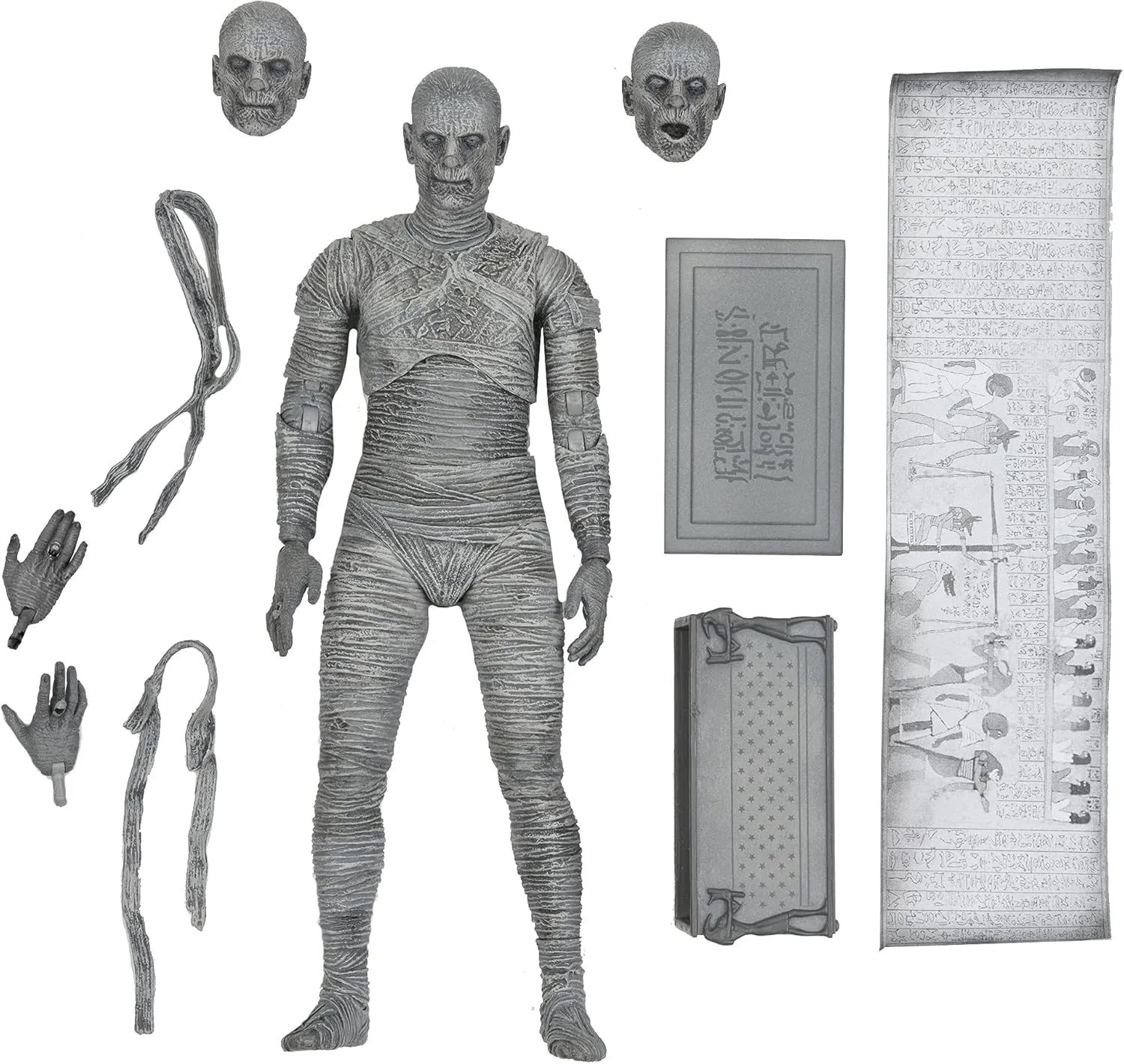
NECA Ultimate Mummy 7″ Black & White Action Figure – Boris Karloff Classic Deal!
Celebrate the 90th anniversary with NECA’s stunning black-and-white Ultimate Mummy, capturing Boris Karloff’s iconic wrapped horror in exquisite detail. 7-inch scale with interchangeable heads and hands, an opening Egyptian chest accessory, and highly articulated posing. Premium sculpt recreates the legendary makeup – essential for Universal Monsters collectors and dark displays.
The Thief of the Silver Comb
A common tale told across rural Ireland, particularly in the midland counties, involves a headstrong young man named Seamus who disregarded the warnings of his elders. Walking home near a stream at twilight, he spotted an entity sitting on a grey stone, her back turned to him. She was combing hair that shone like spun moonlight. As she shifted her position, a silver comb fell from her hair and landed in the tall grass.
Greedy and dismissive of “old wives’ tales,” the man waited for the spirit to vanish before snatching the comb and running home. He boasted to his mother of his find, claiming it was a treasure that would make them rich.
That night, the atmosphere around their cottage grew unnaturally heavy. The silence was broken by a sound like a thousand glass flutes shattering against the stone walls.
A pale, skeletal hand began to scratch at the windowpane, and a low, melodic moaning filled the yard. Recognizing the mortal peril, his mother grabbed the comb with a pair of long iron fireplace tongs. She thrust the tongs out the window, offering the comb back to the darkness so the spirit’s cold touch would not reach human skin.
The spirit grabbed the comb so forcefully that the iron tongs broke in two. The banshee disappeared at once, leaving the family in shocked silence. This story teaches that the banshee’s belongings are sacred and should never be touched by the living.
The Omen of the Bloodied Shroud
In the Highlands and Islands of Scotland, the myth takes the form of the Bean Nighe, or the Washer at the Ford. A group of seasoned warriors, returning from a successful cattle raid, once came across a woman kneeling by a fast-flowing river in the pre-dawn light. She was vigorously scrubbing clothes, but as the men drew closer, they saw the water running red. The warriors realized with a cold horror that the garments she washed were their own tunics and battle-shrouds.
One soldier, braver or more foolish than the rest, crept up behind her. According to the laws of the sídhe, if a mortal can catch the washer before she sees them, she is obligated to reveal the names of those destined to die and grant three wishes. The warrior caught her by her slender arm and demanded victory and a long, prosperous life for his kin.
The spirit looked at him with red eyes from years of crying and said that even though he caught her, no one could change what fate had already decided. The next morning, all the men in his group died in a surprise attack. The story of the “Washer” became a common superstition among soldiers, who would avoid crossing water if they saw a woman alone on the bank.
The Crossing of the Atlantic
As the Great Famine of the 1840s forced millions of Irish people to emigrate to America, Canada, and Australia, many believed they were leaving their ghosts behind. However, the legends followed the bloodlines across the sea.
One important account from the 1890s in New York describes an O’Grady family living in a crowded tenement building. Despite being thousands of miles from the green hills of their ancestors, the family was woken in the middle of the night by a rhythmic tapping on the glass and a low, melodic moaning that seemed to come from the very air of the room.
The patriarch of the family checked the fire escape and the street below, but both were empty, and the air was still. The sound was not a scream of terror, but a “keen” of deep, resonant sorrow. Hours later, a telegram arrived from County Clare: the family’s grandfather had passed away at the exact moment the sound was heard in the Manhattan apartment.
This story strengthened the belief that the banshee is connected to family bloodlines, not to a certain place. It showed Irish people abroad that the spirit’s watch lasts as long as the family name, and that their home link can never be broken.
The Lady of the Rosses
In the rugged, wind-swept region of Donegal, the Lady of the Rosses is a specific banshee said to inhabit the treacherous coastal cliffs. Unlike other spirits who wail for individuals within a house, she is said to appear before major maritime disasters that threaten the community. Local lore tells of a winter night when the entire village of Rosses heard a sound like a high-pitched storm whistle, yet the sea remained as calm as glass.
The Lady was seen by several witnesses walking atop the waves, her long white shroud trailing behind her like sea foam. The local fishermen, recognizing the omen, refused to launch their boats the following morning despite the perfect weather.
Their caution saved their lives, as a sudden rogue wave hit the coast that afternoon and would have sunk any boats at sea. In this story, the banshee protects the whole community, using her grief as a warning. She reminds people that the banshee is not just a sign of death, but also a guardian for those who respect the spirit world.
Symbolism
The banshee primarily symbolizes the certainty of death and the transition from life to the spirit world. She is a “memento mori,” reminding everyone that life ends. She also represents family loyalty and heritage, since she appears only to certain bloodlines, showing how important ancestry is in Gaelic culture.
Her red eyes and endless wailing show never-ending grief and the sadness that comes after losing someone. More broadly, the banshee is seen as the land itself mourning for its people.
Can Banshee Be Defeated?
A banshee cannot really be “defeated” or killed, since she is already a ghost and has no physical body. Still, people believed they could protect themselves from her presence. The most common way was to use iron. Blacksmiths were respected, and people would hang a horseshoe or put an iron poker across the doorway to keep her out.
People also used prayers and special chants to keep the banshee away from their homes. Saying the Rosary or Gaelic protective charms was thought to quiet her wail, which many believed was the most dangerous part. Some traditions warned not to look out the window if you heard her, since seeing her could bring bad luck.
People traveling at night in haunted areas often carried rowan wood charms or salt pouches for protection. The aim was not to destroy the banshee, but to keep a respectful distance from her warning.
Tags:
Related Monsters…
Amphisbaena (Greek Two-Headed Serpent)
January 20, 2026
January 12, 2026
February 17, 2026
February 5, 2026
Aspidochelone (Giant Sea Beast)
February 6, 2026
