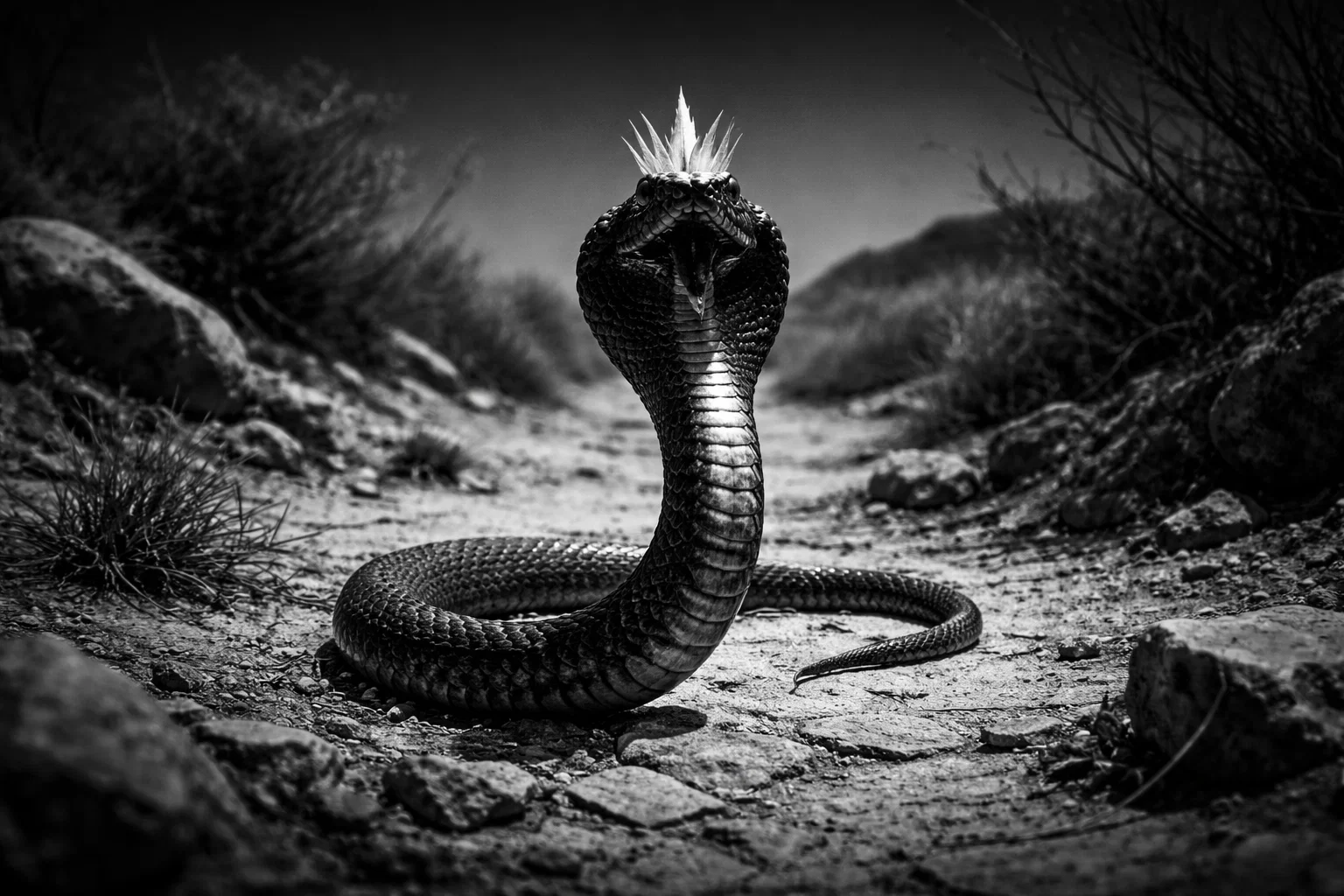

The Basilisk is a legendary creature known throughout European history as one of the deadliest beings ever imagined. Called the “King of Serpents,” it was said to kill with just a look or the strength of its breath.
The Basilisk first appeared in North African stories and later became a fixture in Medieval European bestiaries. It blended real animal traits with myth, lasting for centuries as a symbol of deadly poison and total power among reptiles.
Summary
Overview
| Attribute | Details |
| Name | Basilisk |
| Alternative Names | Basilic, Basilisco, Basiliscus, Regulus, Sibilus, Cockatrice |
| Similar Monsters | Cockatrice, Catoblepas, Medusa, Gorgon, Echidna, Amphisbaena, Cerastes, Scitalis, Jaculus, Dipsas, Seps, Prester, Haemorrhois, Aspis, Chelyder, Chersydrus, Elops, Dipsos, Tityos |
| Etymology | From Greek ‘basiliskos’ = little king |
| Gender | Male |
| Classification | Beast |
| Species | Hybrid |
| Origin / Culture | Greek and Roman (North Africa / Mediterranean) |
| First Recorded | c. 77–79 CE – Naturalis Historia by Pliny the Elder |
| Active Period | Always active |
| Size | 15–30 cm (Classical); up to several meters (Medieval/Modern) |
| Diet | Meat, life force, and toxic substances |
| Habitat | Arid deserts and rocky crevices |
| Powers & Abilities | • Lethal gaze (gaze of death) • Toxic breath • Corrosive venom • Plant-withering presence • Ability to kill at a distance via weapons |
| Weaknesses | • Odor of a weasel • Crowing of a rooster • Reflection in a mirror • Rue (herb) |
| Reproduction / Creation | A toad or snake hatching a yolkless egg laid by a seven-year-old rooster during Sirius’s ascent |
| Behavior | Solitary apex predator |
| Pop Culture | Harry Potter and the Chamber of Secrets / D&D Monster Manual / The Witcher series / Final Fantasy / God of War |
Description
The Basilisk stands out among mythical creatures because of its extreme deadliness. Unlike other monsters that use strength or speed, it destroys simply by being near. It is usually shown as the ruler of all snakes, marked by a crown-like spot on its head.
People once believed the Basilisk lived in the deserts of Cyrene, turning fertile land into wasteland wherever it went. Unlike most snakes, it moved with its middle raised off the ground. It lived alone and was so feared that other venomous animals would run away at the sound of its hiss.
The Basilisk’s legend continued through the Middle Ages, when people often confused it with the Cockatrice, another strange creature said to be born in unusual ways.
The Mythical Creatures Bible. Flash Sale – Up to 23% OFF!
This beautifully designed paperback is the ultimate reference to legendary beings across history and cultures: From Biblical leviathans and behemoths to Asian kitsune, European fae, African tricksters, and ancient chimeras. Alphabetical entries with vivid illustrations, cultural context, and fascinating facts – essential for witchy libraries, ritual symbolism, or creature design inspiration.
Etymology
The name “Basilisk” comes from the Ancient Greek word basiliskos, which means “little king.” This is a smaller form of basileus, or “king.” The name refers to a white spot or crest on the creature’s head, which early writers thought looked like a crown.
In Latin, the Basilisk was often called regulus, meaning “petty king” or “prince.” In the Middle Ages, the name changed to the Old French basilic. These names showed its reputation as the ruler of all reptiles, since no other snake could match its power.
Throughout history, the Basilisk’s name always highlighted its royal and powerful image in both natural history and folklore.
How to Pronounce “Basilisk” in English
The word is pronounced BAZ-uh-lisk. The first part is stressed and sounds like “apple,” followed by a soft “z.” The middle is a quick “uh,” and the last part, “lisk,” rhymes with “risk.”
Appearance
Descriptions of the Basilisk’s appearance have changed a lot over the past two thousand years. Early Roman writers described it as a small snake, usually less than a foot long.
Its most noticeable feature was a white mark on its head that looked like a crown. It also moved in a special way, holding its head and chest up instead of slithering flat like other snakes.
In the Middle Ages, people described the Basilisk in more detail, often as a mix of animals. It was shown with a rooster’s head, wings, and feet on a snake’s body with a pointed tail. Its scales were usually black or green, sometimes with yellow or red shades.
Later artists sometimes gave the Basilisk extra legs or dragon-like traits, but the crown-like mark was always included.
Powers & Weaknesses
Powers
The Basilisk has several supernatural powers that make it a top mythical threat. Its most famous ability is its deadly stare—anything that looks it in the eye dies instantly. Its breath is also so poisonous that it can kill plants and even crack stones.
Stories say the Basilisk’s venom is so strong that it can move through objects. According to legend, if someone on horseback stabbed a Basilisk with a spear, the poison would travel up the weapon and kill both the rider and the horse.
The Basilisk’s hiss is so frightening that all other snakes run away. It creates an area around itself where nothing else can survive.
Weaknesses
Even with all its power, the Basilisk has some unique weaknesses. Its main enemy is the weasel, which was believed to be able to kill the Basilisk, though it usually died afterward. The only plant that could survive near the Basilisk was rue, which weasels would eat to protect themselves from its poison.
A rooster’s crow is also deadly to the Basilisk. When it hears the sound, according to lore, the creature will die right away. The Basilisk can also be killed by its own reflection—if it looks into a mirror, its deadly stare turns back on itself and kills it instantly.
These weaknesses show that the Basilisk’s power is so great that it can’t survive its own abilities or some simple things in nature.
Bulfinch’s Mythology Leather-Bound Classics Edition – Up to 43% OFF!
Own the timeless masterpiece in luxurious flexi leather-bound format from Canterbury Classics. Thomas Bulfinch’s complete compilation: The Age of Fable (Greek/Roman gods & heroes), The Age of Chivalry (King Arthur & knights), and Legends of Charlemagne – over 800 pages of elegantly retold ancient myths, Norse lore, and medieval romances. Gilded edges, ribbon marker, and premium binding make this a stunning heirloom for occult libraries or dark academia shelves.
Myths, Legends & Stories
The Basilisk’s story has grown more deadly over time. It started as a strange animal in ancient times and became a top supernatural predator in the Middle Ages. Its origin story is among the best-known of mythical creatures, based on the idea of “Unnatural Incubation.”
According to medieval bestiaries and the later works of naturalists like Albertus Magnus, a Basilisk is brought into existence through a precise and grotesque sequence of events. A seven-year-old rooster must lay a yolkless, spherical egg into a dung heap during the celestial ascent of the dog star, Sirius. This egg must then be brooded by a toad or a serpent for a period of several weeks.
This mixed origin, combining a rooster with a toad or snake, was thought to create a creature with the worst traits of both: the pride and loud cry of a bird, and the poison and cold stare of a snake.
The Desolation of Cyrene
In ancient times, the Basilisk was closely tied to North Africa, especially the area of Cyrene. Writers like Pliny the Elder and Lucan described it as a real animal, not a ghost or demon, whose very existence could ruin the environment.
The myth says the Sahara wasn’t always a desert. The Basilisk’s presence was blamed for making the land barren. As it moved, it left dead ground behind. Birds flying over would drop from the sky, choked by its poisonous fumes. If it drank from a river, the water downstream would become deadly to animals.
The Peril of the Spear (The Soldier’s Death)
One of the most long-lasting anecdotal myths regarding the Basilisk’s potency is found in Lucan’s Pharsalia. The story tells of a Roman soldier traveling through the Libyan desert who encountered a Basilisk and managed to impale it with his spear.
But the victory was short-lived and deadly for the soldier. The story says the Basilisk’s venom was so strong that it traveled up the spear to the soldier’s hand before he could let go.
To try to save himself, the soldier had to cut off his arm, but the poison had already reached his horse, which died soon after.
The Basilisk of Vienna (1212 CE)
In Central Europe, the 1212 story of the Vienna Basilisk connects legend with local history. The tale says a servant went to get water from a well in Schönlaterngasse and noticed a bad smell and a strange light at the bottom.
The creature in the well was said to be a Basilisk, born from a rooster’s egg hatched by a toad. The town was terrified until a smart baker’s apprentice—or sometimes a prisoner—came up with a plan. He went down into the well with a big mirror. When the Basilisk saw its own reflection, it either died of fright or was turned to stone by its own gaze.
Today, a house in Vienna still has a stone carving of the Basilisk. Old records mention the well being closed because of “corrupt air,” showing how people used myths to explain the dangers of gases like methane in deep wells.
The Trial of the Rooster in Basel (1474 CE)
Perhaps the most peculiar historical intersection of the Basilisk myth happened in Basel, Switzerland. In 1474, a local rooster was put on formal trial after it was accused of laying an egg. In the legal framework of the time, this was viewed as a grave threat to public safety, as the egg could potentially hatch into a Basilisk.
The rooster was provided with a legal defense. Still, the court eventually found the bird guilty of performing an “unnatural act.” The rooster was sentenced to death and publicly burned at the stake, along with the “egg,” to prevent the manifestation of the monster.
This event shows how seriously people in Europe feared the Basilisk. The threat felt so real that it even led to court cases.
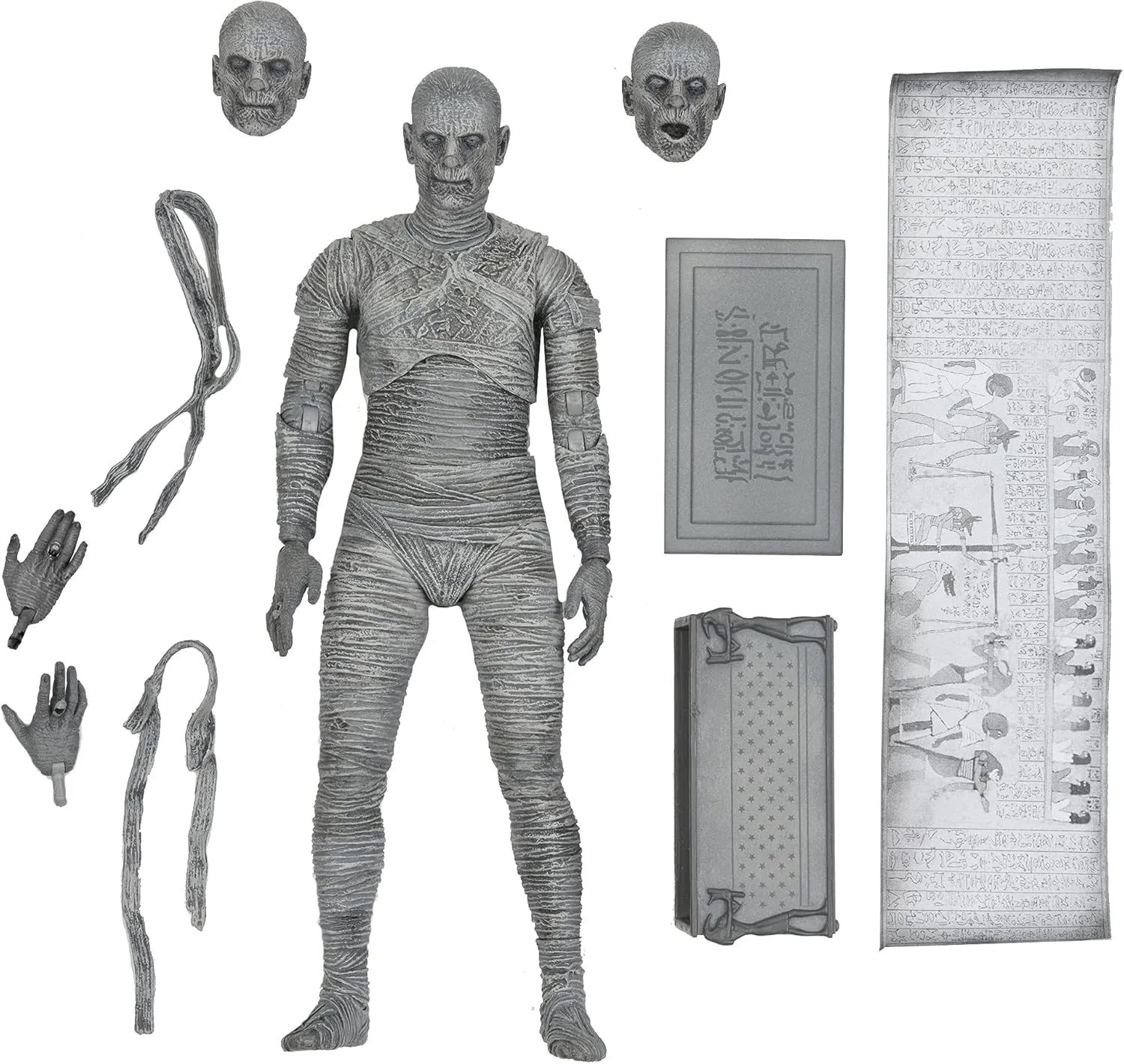
NECA Ultimate Mummy 7″ Black & White Action Figure – Boris Karloff Classic Deal!
Celebrate the 90th anniversary with NECA’s stunning black-and-white Ultimate Mummy, capturing Boris Karloff’s iconic wrapped horror in exquisite detail. 7-inch scale with interchangeable heads and hands, an opening Egyptian chest accessory, and highly articulated posing. Premium sculpt recreates the legendary makeup – essential for Universal Monsters collectors and dark displays.
The Warsaw Cellar and the Magister
In Warsaw’s Old Town, the Basilisk legend is set in the cellars of a house on Krzywe Koło Street. In the 16th century, people believed a Basilisk guarded treasures hidden in the underground vaults.
Many people went into the cellar and never came back. Their bodies were later found turned to stone or dead, with looks of terror. The story ends with a doctor named Benedict, who went in wearing a suit covered in mirrors.
The story highlights the danger of the descent, as Benedict had to look only at the floor to avoid the Basilisk’s gaze until he could face it with the mirrors.
The Medieval Cockatrice Synthesis
By the 14th century, people often mixed up the Basilisk with the Cockatrice, partly because of the Wycliffe Bible. At this time, the Basilisk was described as having wings and resembling a bird.
The “King of Serpents” changed from a small ground snake to a flying monster. Now, stories said it could hide in church rafters or on mountain cliffs.
Stories from this time often mention the “Sibilus” or “Hisser,” a type of Basilisk whose sound could paralyze people. Travelers were told to whistle or play loud music in mountain passes to avoid waking a sleeping Basilisk.
The Alchemical Basilisk
In the 16th and 17th centuries, the Basilisk became a symbol in spiritual and chemical traditions. Alchemists like Paracelsus wrote about the “Alchemy of the Basilisk,” saying its gaze stood for turning unstable substances into something fixed.
Some occult groups even shared “recipes” for making a Basilisk in a lab, hoping to use its ashes to turn copper into gold. This changed the Basilisk from a monster to something people wanted, as it became a symbol of the powerful force needed for the “Great Work” of making the Philosopher’s Stone.
The Modern Adaptation: The Chamber of Secrets
The most famous modern version of the Basilisk appears in the Harry Potter books. While made up, it borrows a lot from old legends. In these stories, the Basilisk is a giant snake that can live for almost a thousand years, created by a Dark Wizard using the old “toad-hatching-egg” method.
This modern story brought back the idea of the Basilisk’s deadly stare for people everywhere, and added the twist that seeing its reflection only freezes, not kills, the victim. It mixes the old Roman image of a giant snake with the Medieval story of its strange birth, keeping the Basilisk alive in today’s imagination.
The Survival of the Weasel Myth
Over the centuries, one part of the story stayed the same: the “Heroic Weasel.” From Pliny to Renaissance writers, people believed the weasel was the only animal that could kill a Basilisk.
The legend says the weasel would go into the Basilisk’s den and, even though it was smaller, would fight so fiercely that the Basilisk couldn’t survive. The weasel often died from the poison afterward, making it a symbol of brave self-sacrifice.
Some stories said the weasel would eat rue leaves first to protect itself for a short time. This myth showed that even the most frightening creature has a simple, natural enemy.
Ultimate Family Co-op Adventure – Horrified: Universal Monsters
Ravensburger’s acclaimed co-op Horrified Board Game masterpiece: Defend against Dracula, The Mummy, Invisible Man, and other icons in a beautifully themed village. Tactical pick-up-and-deliver gameplay, escalating tension, and endless variety. Ideal gateway game for families & friends, 1-5 players, 10+, with 4.8/5 star rave reviews.

Symbolism
The Basilisk is a strong symbol of deadly envy and the harm of the “Evil Eye.” In Christian art, it often stood for the Devil or for sins like pride or lust, which were thought to destroy the soul just as the Basilisk destroys the body.
As the “King of Serpents,” the Basilisk was seen as the opposite of the Lion, the king of beasts. While the lion stood for noble strength, the Basilisk stood for tyranny and secret evil. In alchemy, it symbolized the power of fire and the destructive stage needed to create the Philosopher’s Stone.
Can Basilisk Be Defeated?
To defeat a Basilisk, people believed you needed certain conditions and special items. The best protection was a rooster. Travelers in areas where Basilisks were rumored to live would carry a rooster in a cage, since its crowing was thought to kill the monster right away.
Other ways to protect yourself include using certain herbs and animals. Rue was thought to be the only plant that could resist the Basilisk’s poison, so people would carry it as a charm or eat it for some protection.
People also used glass or crystal. Some legends said that looking at a Basilisk through glass or crystal would weaken its deadly stare, but this was still very risky.
For fighting a Basilisk directly, using a mirror was the main tactic. In some stories, people used a clear container to get close to the creature without looking it in the eye.
People also believed that talismans made from weasel skin or with weasel scent would keep the Basilisk away, since the two were natural enemies.
Tags:
Related Monsters…
Black Shuck (Ghost Dog from East Anglia)
January 26, 2026
February 5, 2026
Aswang (Philippine Vampire Shapeshifter)
January 14, 2026
