
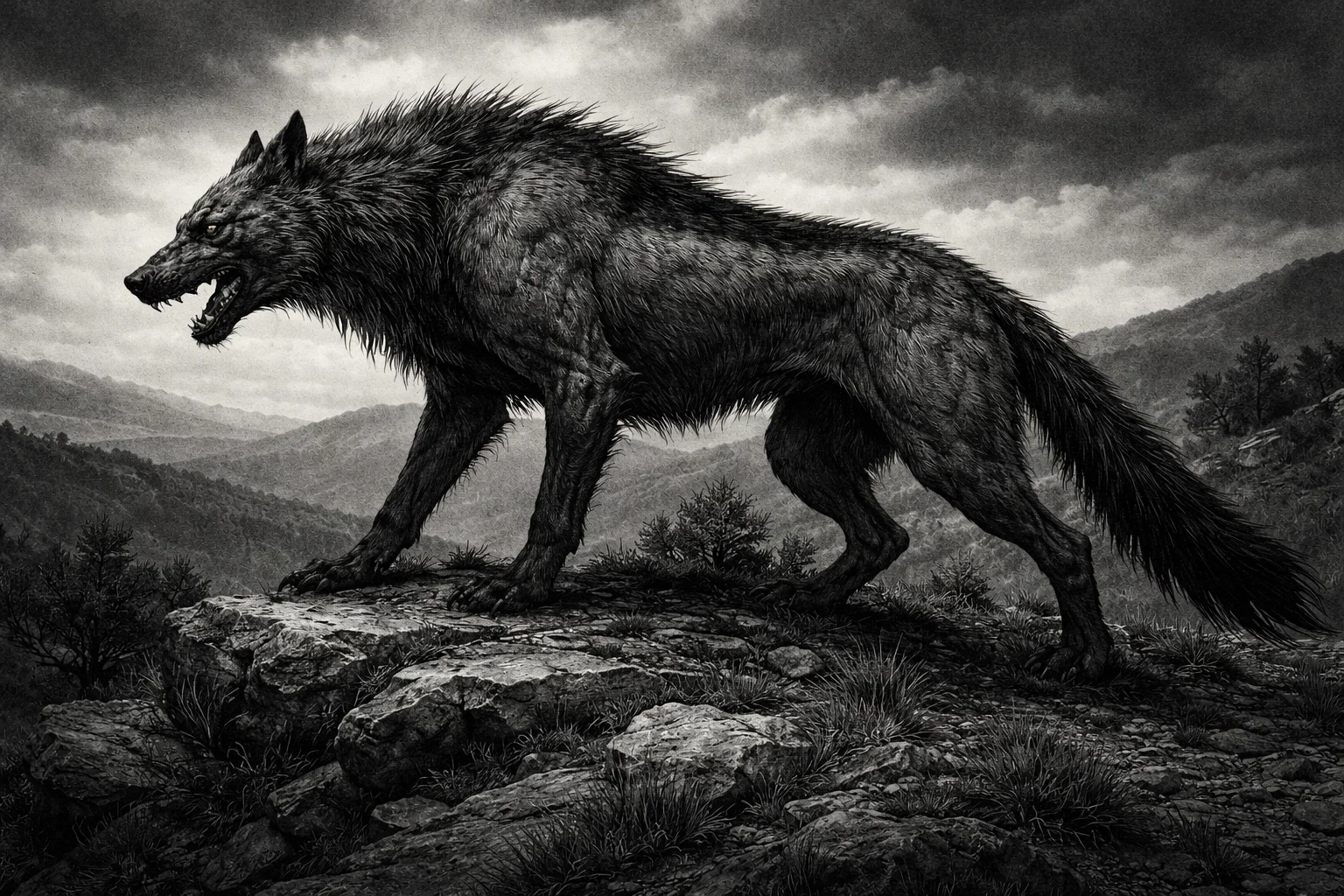

The Beast of Gévaudan was a real animal that attacked people in the old province of Gévaudan, France, from 1764 to 1767. During this time, dozens of people died, most of them women and children.
The attacks became so well known that King Louis XV sent hunters and soldiers to stop the Beast. Even today, experts still argue about what kind of animal it really was.
Summary
Overview
| Attribute | Details |
| Name | Beast of Gévaudan |
| Alternative Names | La Bête du Gévaudan, La Bête, Beast of Mende, Beast of the Lozère |
| Similar Monsters | Beast of Cinglais, Beast of Benais, Beast of Truimes, Wolf of Ansbach, Beast of Sarlat, Beast of Primarette, Beast of Orléans, Beast of Veyreau, Beast of Auxerre, Beast of Gard, Beast of Limousin, Hyena of Gevaudan, Werewolf, Shunka Warakin, Waheela, Amarok, Akhlut, Gevaudan Hound, Dire Wolf |
| Etymology | From French “Bête” meaning beast or animal, and “Gévaudan,” the historical mountainous region in south-central France (modern-day Lozère). |
| Gender | Male |
| Classification | Cryptid |
| Species | Beast |
| Origin / Culture | French (Province of Gévaudan) |
| First Recorded | June 1, 1764 – Death of Jeanne Boulet near Langogne |
| Active Period | Diurnal (primarily daylight hours) |
| Size | Length of a calf or large dog, approx. 1.2 to 1.5 meters |
| Diet | Human flesh |
| Habitat | Mountainous forests, rocky ravines, and marshlands |
| Powers & Abilities | • Immunity to standard ammunition • Extraordinary leaping distance • Supernatural intelligence/evasiveness |
| Weaknesses | • Silver bullets (blessed) • Large-scale military drives • Professional tracking |
| Reproduction / Creation | Unknown; historically speculated to be a hybrid offspring or a trained animal. |
| Behavior | Solitary ambush predator targeting human necks and heads. |
| Pop Culture | Brotherhood of the Wolf (2001) / Teen Wolf (TV series) / Bloodborne (Cleric Beast influence) / The Wolfman (2010) |
Description
Unlike most legendary monsters, the Beast of Gévaudan is backed by strong evidence and official records. Its existence is confirmed by 18th-century court documents, church death records, and letters between local officials and the royal court at Versailles.
The threat was so serious that it caused a national crisis. Many original records show the Beast was a real animal, not just a story or a shared illusion. Records from the time show just how deadly the Beast was. Researchers have counted about 210 attacks, with at least 113 people killed and 49 injured.
Some experts think the real number of deaths could be higher, since many victims were children in remote areas whose deaths may not have been recorded. This level of attacks is very unusual for any animal in European history.
However, even with all the records, the Beast is still a big mystery for researchers. Modern science has not been able to clearly identify the animal from the descriptions in the Marin Report, so the case remains unsolved.
Even today, centuries after the attacks, the Beast still sits at the crossroads of history and mystery. Researchers still debate whether it was a known animal, a rare mix, or something completely unknown to science.
Loren Coleman Cryptozoology A to Z – Up to 46% OFF!
This authoritative encyclopedia catalogs hundreds of mysterious creatures in accessible A-to-Z format, authored by leading experts Loren Coleman and Jerome Clark. From classic Sasquatch sightings to exotic global cryptids, with cross-references, bibliography, and evocative illustrations – ideal for dark curiosity cabinets, paranormal studies, or sparking hunts for the world’s hidden beasts.
Chronology of Recorded Attacks (1764–1767)
Records about the Beast of Gévaudan are very detailed because the French King became involved and because church records were carefully kept. Of more than 200 attacks, the most important are listed in the table below:
| Date | Location | Result / Victim Detail |
| Early June 1764 | Mercoire Forest | Unidentified woman attacked; saved by her cattle. |
| June 30, 1764 | Les Hubacs | Death of Jeanne Boulet (14); first official fatality. |
| August 8, 1764 | Masméjean | Death of a 15-year-old girl. |
| September 1764 | Various (Pradels/Chaulhac) | Deaths of a 15-year-old boy and a 12-year-old girl. |
| October 8, 1764 | Château de la Baume | Herdsman attacked; Beast survived musket fire from hunters. |
| November 25, 1764 | Buffeyrettes | Death of Catherine Vally (70); showed the Beast targeted all ages. |
| January 12, 1765 | Villaret | Jacques Portefaix (10) and seven children successfully fought off the Beast. |
| January 1765 | Various Parishes | 26 attacks recorded in this month alone; 11 fatalities. |
| March 1765 | St. Alban | A mother defended her three children; one child killed, others saved. |
| April 18, 1765 | Paulhac | Death of Martial Charrade (13); body found severely mutilated. |
| May 17, 1765 | Saugues | Death of a woman near the village; prompted more royal attention. |
| June 21, 1765 | Nozeyrolles | Death of a 17-year-old girl. |
| August 11, 1765 | River Desges | Marie-Jeanne Valet (20) wounded the Beast with a bayonet. |
| September 2, 1765 | Dièges | Attack on a 16-year-old girl; she survived with serious injuries. |
| September 20, 1765 | Bois de Pommier | François Antoine killed a massive wolf; attacks paused briefly. |
| December 2, 1765 | Besseyre-Saint-Mary | Attacks resumed; two young girls attacked near the village. |
| Throughout 1766 | Multiple Districts | 18 fatalities recorded as the Beast returned to full activity. |
| Early 1767 | Various (Auvers) | 21 fatalities recorded in the first six months of the year. |
| June 19, 1767 | Sogne d’Auvers | Jean Chastel killed the animal; all predatory attacks ceased. |
Etymology
The name “Beast of Gévaudan” refers to the area where the creature was found. In the 1700s, the word “Beast” (French: Bête) was used for any dangerous animal that people couldn’t easily identify, especially if it acted savagely or strangely.
“Gévaudan” is the name of the province in the Lozère mountains where the attacks happened. The region’s name comes from the Gabali, a Gallic tribe that lived there in Roman times. So, the name means “the predator of the land of the Gabali.” During the crisis, people often just called it La Bête.
How to Pronounce “Beast of Gévaudan” in English
In English, you say it as: Beest (like feast) ov Zheh-voh-dahn. The “G” sounds like the “s” in “measure.” The “voh” part rhymes with “go,” and “dahn” ends with a soft, French-style “n.”
Appearance
People at the time said the Beast was about as big as a calf or a very large dog. It had a broad chest and a long, flexible body. Its fur was reddish-brown or tawny, with a black stripe down its back. Its tail was much longer and thicker than a normal wolf’s, often ending in a tuft.
The Beast’s head was said to be large and long, with a pointed snout and small, straight ears. People noticed its huge jaws and big fangs, and its heavy-clawed feet. Some reports even said it could stand or move on its back legs for a short time, which made it look strange.
Powers & Weaknesses
Powers
Witnesses said the Beast could do things no normal wolf could. It could jump over walls and hedges more than ten feet high and was fast enough to outrun hunters on horseback, even over rough ground.
Some hunters said they shot the Beast at close range with muskets, but it ran away without being seriously hurt. This led people to think its skin was impossible to pierce or that it had supernatural strength.
The Beast also seemed very clever. It often avoided traps and large groups of armed people, choosing instead to attack people who were alone.
Weaknesses
Records show the Beast could be driven off by organized hunts and powerful weapons. Large groups of peasants and soldiers worked together to chase it out of hiding. At first, regular bullets didn’t work, but in the end, special ammunition was used to kill it.
Local stories say the Beast’s weakness was silver. Jean Chastel is said to have killed it with a silver bullet blessed by a priest. This shows people believed the Beast had a spiritual or magical weakness as well as a physical one.
Bulfinch’s Mythology Leather-Bound Classics Edition – Up to 43% OFF!
Own the timeless masterpiece in luxurious flexi leather-bound format from Canterbury Classics. Thomas Bulfinch’s complete compilation: The Age of Fable (Greek/Roman gods & heroes), The Age of Chivalry (King Arthur & knights), and Legends of Charlemagne – over 800 pages of elegantly retold ancient myths, Norse lore, and medieval romances. Gilded edges, ribbon marker, and premium binding make this a stunning heirloom for occult libraries or dark academia shelves.
Myths, Legends & Stories
The story of the Beast of Gévaudan comes from the tough, mountainous area of south-central France. The thick forests and isolation there helped the legend grow.
Today, scientists argue about what kind of animal the Beast was. But at the time, many people thought it was a “Scourge of God” or a “Divine Punishment.” Some locals even believed it was created by magic or bred by someone to hunt people.
The idea of a “trained monster” became popular because the Beast often ignored livestock and went after people instead, which was very unusual for a normal wolf.
The Initial Onslaught and Early Murders
The attacks started in early summer 1764. The first recorded case happened near Langogne, where a woman looking after cattle was approached by a huge, wolf-like animal. She survived because the bulls in her herd chased the Beast away.
Soon after, on June 1, 1764, the first death was recorded: fourteen-year-old Jeanne Boulet. By the end of the year, many more people had been killed. The Beast’s way of killing was especially shocking—it didn’t eat the whole body. Still, it often attacked the head and neck, sometimes even decapitating its victims.
This way of killing made people believe the Beast was a supernatural creature that fed on the life force or blood of innocent people.
The Combat of Portefaix
One of the most famous stories happened on January 12, 1765. A boy named Jacques Portefaix and seven friends were watching sheep when the Beast attacked them.
Instead of running away, the children stood together in a circle and pointed their homemade pikes—sticks with blades—at the Beast. Even though it tried to attack the smaller kids, they fought back so well that the animal finally ran off.
The story was published in the Gazette de France and caught the attention of King Louis XV. He rewarded Portefaix and his friends for their bravery and used the event to push for a bigger royal hunt.
The King’s Hunters and the Wolf of Chazes
The French government sent its best wolf hunters, Jean-Charles-Marc-Antoine Vaumesle d’Enneval and his son, to the region. They spent months trying to catch the Beast but failed, saying the locals were unhelpful and the land was too hard to search. The King then replaced them with his own top hunter, François Antoine.
In September 1765, Antoine trapped a huge wolf near the Abbey of Chazes and shot it. The animal was very large, weighing 130 pounds. Officials said this was the Beast of Gévaudan, and its body was shown at Versailles. For a short time, people thought the mystery was solved.
But the attacks started again in December 1765. Locals felt betrayed when they realized the real Beast was still out there.
The Defeat by Jean Chastel
The last part of the story happened on June 19, 1767. Jean Chastel, a local farmer and innkeeper, joined a hunt led by the Marquis d’Apchier. Stories say Chastel sat in the woods at Sogne d’Auvers and prayed. As he finished, the Beast came out of the bushes.
Chastel shot the Beast with a double-barreled shotgun loaded with large bullets. Stories say these bullets were silver or blessed by a priest. The Beast died instantly.
When people examined the animal, they found the remains of a small girl in its stomach, proving it was the real man-eater. After Chastel killed the Beast, the attacks in Gévaudan stopped for good, making this one of Europe’s most famous and mysterious monster hunts.
Creepy Gothic Horror Posters – Limited Deal Alert!
Elevate your witchy room with 97 Decor’s masterful unframed posters blending dark gothic aesthetics, horror elements, and creepy occult art. Rich, atmospheric designs with witches, macabre motifs, and vintage spookiness – essential for creating a captivating, moody atmosphere that draws in the shadows.
Theories Regarding the Beast’s True Identity
Even though the attacks stopped after the Beast was killed in 1767, the mystery remained. The animal’s body was poorly preserved and eventually lost, so historians and scientists have proposed many theories to explain what kind of creature it was.
The Large Wolf Theory
The most straightforward theory is that the Beast was just a very large Eurasian wolf (Canis lupus lupus). Supporters of this idea note that France had many wolves in the 1700s, and some did attack people.
Some think the Beast was a wolf with a genetic problem or one that had gotten used to eating people. The strange descriptions from witnesses may have been exaggerated because they were so scared.
The Sub-Saharan Hyena Theory
Some researchers, looking at the Marin Report’s details like reddish fur with black stripes, strong front legs, and powerful jaws, think the Beast was a Striped Hyena (Hyaena hyaena) or a Spotted Hyena (Crocuta crocuta).
In the 1700s, people sometimes kept exotic animals as pets. Some think a hyena escaped or was let loose in the French countryside. Hyenas are strong hunters and can decapitate their prey, which matches the injuries seen on many victims.
The Prehistoric Survival Theory
A more out-there theory says the Beast was a leftover from prehistoric times, like a Hyaenodon or a Mesonychid. People who support this idea point to its strange way of walking and tracks that looked split.
But there’s no fossil proof that these animals survived into modern times. This idea is mostly considered part of cryptozoology and tries to explain the strange features described by doctors in the 1700s.
The Human-Animal Hybrid or Trained Predator Theory
Another theory says the Beast was a mix between a big mastiff and a wolf, bred and trained by someone to attack people. Some historians think Jean Chastel or his son, Antoine, could have been behind it, since Antoine had traveled to Africa and knew about exotic animals.
This idea could explain why the Beast avoided hunters and soldiers so well. It might have been hidden in a kennel or barn during the day and let out at night by someone who knew when the authorities would be around.
The Lion or Sub-Adult Feline Theory
Some people think the Beast’s ability to jump far and its tufted tail sound more like a big cat than a dog.
A young male lion (Panthera leo) without a full mane would match the reddish-brown color and size described by people. Like the hyena theory, this idea depends on the animal escaping from a circus or a noble’s private collection.
The “stripe” people saw could have been a ridge of fur found on some lion subspecies, or they might have misunderstood the animal’s muscles.
The “Socio-Environmental Pressure” Study (2020)
Recent studies, especially by Meret Fehlmann, suggest the Beast was not just one animal but a sign of a bigger ecological problem.
In the 1760s, France had a huge number of wolves. Historian Jean-Marc Moriceau says there were about 3,000 deadly wolf attacks during that time. Researchers think the crisis in Gévaudan got worse because of poverty, few guns among peasants, and wolves getting used to eating human bodies after wars and famines.
The “Immature Male Lion” Hypothesis
Biologist Karl-Hans Taake recently used modern forensic methods to look at old reports of the Beast’s attacks. He found that the way the Beast attacked the head and neck and jumped long distances matches what a young male lion would do.
Taake also says a lion’s territory, about 50 miles wide, matches the area where the attacks happened. His research suggests the Beast was an escaped exotic animal that survived in the French mountains until Jean Chastel killed it.
Ultimate Family Co-op Adventure – Horrified: Universal Monsters
Ravensburger’s acclaimed co-op Horrified Board Game masterpiece: Defend against Dracula, The Mummy, Invisible Man, and other icons in a beautifully themed village. Tactical pick-up-and-deliver gameplay, escalating tension, and endless variety. Ideal gateway game for families & friends, 1-5 players, 10+, with 4.8/5 star rave reviews.

Symbolism
The Beast of Gévaudan became a symbol of the clash between new scientific ideas and old rural beliefs. For the city elite in Paris, the story showed how superstitious the peasants were. For people in Gévaudan, the Beast was a real “Scourge of God,” sent as punishment for their sins.
More broadly, the Beast symbolizes the wild and frightening aspects of nature that people can’t easily explain or control. It is still a major figure in French folklore, showing how close history and myth can be.
Was the Beast of Gévaudan Truly Defeated?
Most historians agree that the Beast of Gévaudan was defeated by force. However, the methods used were unusual for the time. At first, people tried to protect themselves by working together.
Peasants were told not to watch livestock alone and to carry iron-tipped pikes or pitchforks. Some villagers used bells and loud noises to scare the Beast, but these didn’t work well once it had picked a target.
Spiritual protection was also important. Since many people thought the Beast was evil, they carried religious items like St. Benedict medals or used holy water to bless their homes and animals. In the end, it took skilled hunters and special weapons to defeat the Beast.
Modern studies suggest the Beast was probably a real animal, maybe a hybrid or an escaped exotic predator. Like any animal, it could be killed by blood loss or organ damage. So, the best defense was a rifle, as long as the shooter could hit such a fast-moving target.
Tags:
Related Monsters…
Black Shuck (Ghost Dog from East Anglia)
January 26, 2026
Arachne (Ancient Greek Half-Woman, Half-Spider Beast)
February 10, 2026
Akkorokamui (Ainu Monstrous Sea Kraken)
January 8, 2026
