
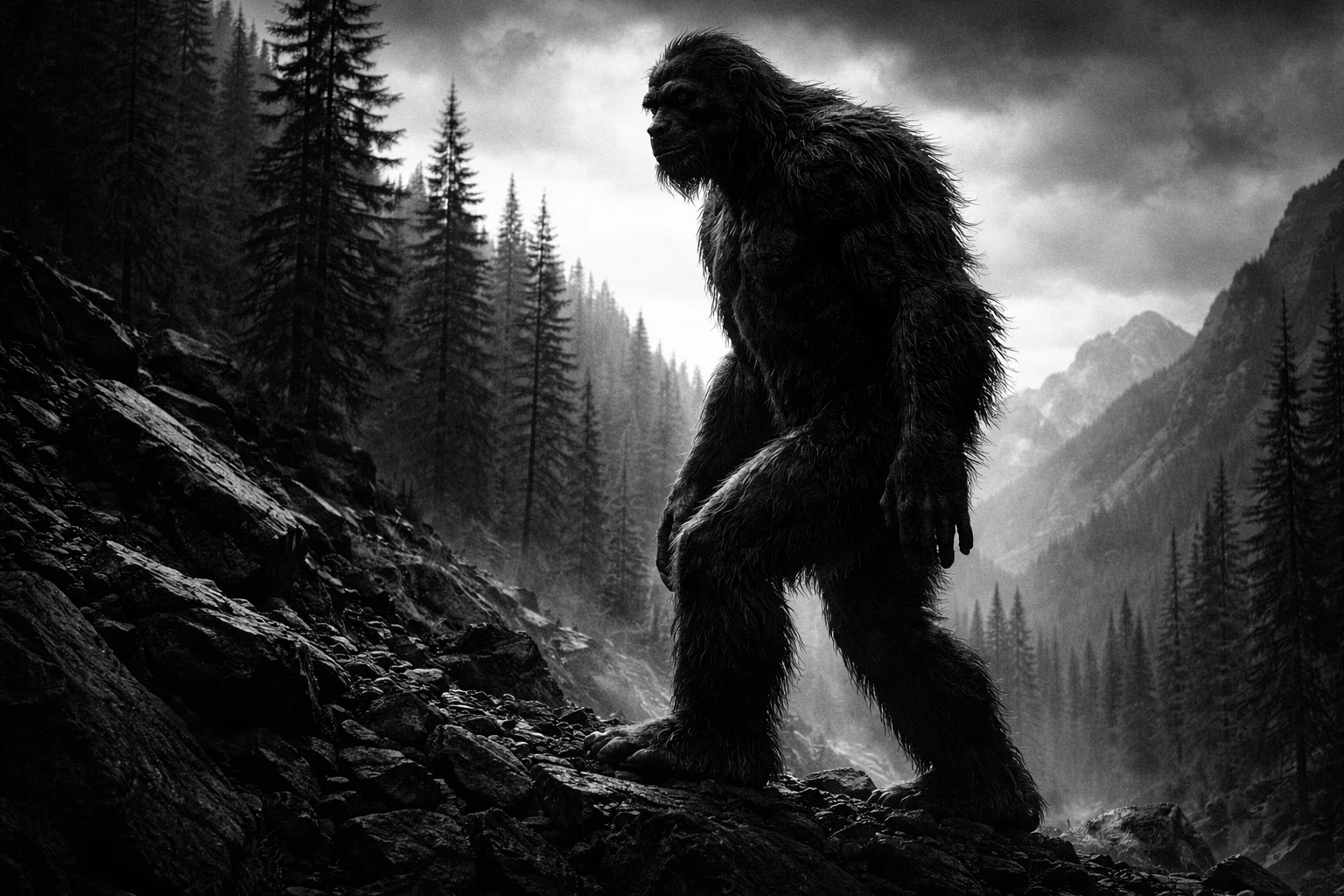

Bigfoot is, perhaps, the best-known cryptid in the world. The creature is mostly reported in the Pacific Northwest of North America. People often describe it as a huge, forest-dwelling creature that seems to fall somewhere between primates and humans.
Even though no physical specimen has been found, thousands of sightings and footprint discoveries keep both scientists and the public interested in whether a large, unknown animal might still live in the wild.
Summary
Overview
| Attribute | Details |
| Name | Bigfoot |
| Alternative Names | Sasquatch, Sásq’ets, Oh-Mah, Skookum, Bushman, Woodsman, Wildman, Momo, Grassman, Rugaru, Yahoo |
| Similar Monsters | Yeti, Almas, Yowie, Hibagon, Orang Pendek, Barmanou, Basajaun, Mapinguari, Amomongo, Fear liath, Nuk-luk, Sisimite, Ucumar, Xingu, Yeren, Agogwe |
| Etymology | English compound: “big” + “foot,” referring to the size of the tracks found in 1958. |
| Gender | Male, Female |
| Classification | Cryptid |
| Species | Humanoid |
| Origin / Culture | Native American (various nations), United States, Canada |
| First Recorded | 1811 – David Thompson’s journals (documented large footprints) |
| Active Period | Always active |
| Size | 2–3 m tall |
| Diet | Omnivorous (deer, berries, plants, fish) |
| Habitat | Boreal forests, temperate rainforests, and mountainous regions |
| Powers & Abilities | • Infrasound emission • Stealth and camouflage • Exceptional climbing |
| Weaknesses | • High-frequency noise • Bright lights • Strong chemical odors |
| Reproduction / Creation | Biological reproduction |
| Behavior | Solitary ambush predator |
| Modern Sightings | 1958–present, United States & Canada |
| Pop Culture | Harry and the Hendersons (1987), The Six Million Dollar Man, Expedition Bigfoot, Finding Bigfoot, The Patterson-Gimlin Film |
Description
Bigfoot is described as a shy, two-legged creature living in the thick forests of North America. Some researchers call it a “relict hominoid,” meaning it could be a surviving member of an extinct group of primates. People often note how well it avoids being seen, even in areas where humans are common.
Most reports describe Bigfoot as a real animal, not a supernatural being. People often link it to signs like tree knocks—rhythmic pounding on tree trunks—and branch structures made by twisting or weaving sticks together.
Bigfoot is often connected to Native American stories about ‘wild men of the woods.’ Today, most people think of it based on eyewitness reports describing a large, non-human primate moving quickly and skillfully through thick brush.
Loren Coleman Cryptozoology A to Z – Up to 46% OFF!
This authoritative encyclopedia catalogs hundreds of mysterious creatures in accessible A-to-Z format, authored by leading experts Loren Coleman and Jerome Clark. From classic Sasquatch sightings to exotic global cryptids, with cross-references, bibliography, and evocative illustrations – ideal for dark curiosity cabinets, paranormal studies, or sparking hunts for the world’s hidden beasts.

Etymology
The name ‘Bigfoot’ first appeared in 1958 after events in Bluff Creek, California. Gerald Crew, who operated a bulldozer for logging, found and cast large, human-like footprints at a construction site.
The Humboldt Times, a local newspaper, reported the story and used the term ‘Bigfoot’ for the mysterious track-maker. The name soon spread across the country and became the common English name for the creature.
Another name for Bigfoot is ‘Sasquatch,’ which comes from the Halkomelem word Sásq’ets. Halkomelem is spoken by several First Nations groups in the Pacific Northwest, such as the Coast Salish.
The word means ‘wild man’ or ‘hairy man.’ J.W. Burns, an Indian Agent in British Columbia, helped make the term popular in the 1920s by collecting local stories for Canadian newspapers.
How to Pronounce “Bigfoot” in English
In English, ‘Bigfoot’ is pronounced [BIGfoot]. The first part, ‘Big,’ has a short ‘i’ sound like in ‘pig’ or ‘dig,’ and ends with a hard ‘g.’ The second part, ‘foot,’ uses the same vowel sound as in ‘book‘ or ‘put,’ and ends with a clear ‘t.’ The stress is on the first syllable.
Appearance
Bigfoot is usually described as a huge, two-legged primate that stands between 2 and 3 meters tall. It has a strong, muscular body with very broad shoulders and almost no neck, making its head look set into its shoulders.
Its whole body, except for the face, palms, and soles of the feet, is covered in thick hair. The hair can be deep black, dark brown, reddish brown, or sometimes silver grey.
The face is said to look somewhere between a human and a gorilla, with a strong brow ridge, a flat nose with nostrils facing forward, and a heavy jaw. People often report that its eyes glow or reflect a dull red or yellow light in the dark.
The most unique feature is its foot, which is about 35 to 60 centimeters long. The feet are very wide and have a ‘mid-foot break,’ a flexible joint that modern humans lack but some great apes possess.
Powers & Weaknesses
Powers
Although Bigfoot is mostly seen as a real animal, some reports mention abilities that seem almost unbelievable. One of the most common is that it can produce infrasound, which is a low-frequency sound humans cannot hear.
People say that being exposed to these sounds can cause strong fear, nausea, or even paralysis, letting Bigfoot escape or stop threats without touching them.
Bigfoot is also said to be very good at blending into its surroundings and moving quietly. Even though it is very large, people claim it can move through thick brush without making a sound and vanish into the shadows right away.
Some stories say Bigfoot can blend in so well with the forest that it almost seems invisible. It is also said to be extremely strong, able to break large trees, move heavy stones, and throw big rocks accurately over long distances.
Creepy Gothic Horror Posters – Limited Deal Alert!
Elevate your witchy room with 97 Decor’s masterful unframed posters blending dark gothic aesthetics, horror elements, and creepy occult art. Rich, atmospheric designs with witches, macabre motifs, and vintage spookiness – essential for creating a captivating, moody atmosphere that draws in the shadows.

Weaknesses
Like any animal, Bigfoot can be hurt and is affected by things in its environment. It is especially sensitive to sudden, strong stimuli. Bright lights, like powerful flashlights or camera flashes, are said to confuse and scare it away, which suggests its eyes are made for seeing in the dark.
Loud, unnatural noises, especially high-pitched mechanical sounds or sirens, are also thought to keep Bigfoot away. People also say it has a very sensitive sense of smell. Hence, it avoids strong chemical odors like bleach, ammonia, or gasoline.
Since Bigfoot depends on staying hidden, open spaces or city areas where it cannot hide make it hard for the creature to move around safely.
Myths, Legends & Stories
Stories about Bigfoot go back much further than the 1958 newspaper articles that gave it its modern name.
Many indigenous cultures across North America have old stories about hairy, human-like giants living in the wild with their ancestors. These early tales often describe Bigfoot as a ‘Protector of the Forest’ or a ‘Wild Man’ who lived on the edge of human society.
Origins and Early Manifestations
In many Pacific Northwest traditions, Bigfoot was not seen as a monster to hunt, but rather as a distinct group of people who chose to live apart from others. The Coast Salish people talked about the Sásq’ets, powerful beings who could move between the physical and spiritual worlds. These beings were respected as ancient mountain dwellers.
In other places, like the Great Lakes region, similar beings appeared in stories as the ‘Big Man,’ who taught people to respect nature. When European settlers moved west, these native stories mixed with pioneer tales of ‘wild men,’ changing Bigfoot from a spiritual figure to a mysterious creature living in the forest.
The Jacko Incident
In 1884, the British Colonist newspaper in Victoria, British Columbia, published a story saying that a train crew near Yale had captured a ‘gorilla-like’ creature.
The creature, called ‘Jacko,’ was said to be smaller than most Sasquatch reports but still had the same hairy, human-like features. The story says the crew found it sleeping near the tracks and managed to catch it by cornering and subduing it.
Historians still argue about whether the story is true, with some saying it might have been a tall tale or a misidentified chimpanzee. Still, it is one of the earliest ‘capture’ stories in Bigfoot history.
The Ape Canyon Attack
One of the most famous stories happened in 1924 in what is now called Ape Canyon, near Mount St. Helens. Five miners said they were attacked in their cabin by a ‘gang of mountain devils.’
The miners said that after one of them shot at a hairy, human-like creature earlier that day, several of the creatures came back at night to get revenge. They reportedly threw large rocks at the cabin and tried to break in through the roof and door.
The miners made it through the night and left the mountain at sunrise. This story became an important part of local folklore, adding the idea that these creatures live in groups and can be aggressive if threatened.
The Patterson-Gimlin Incident
In October 1967, Roger Patterson and Robert Gimlin filmed a short clip of a hairy, two-legged figure walking along Bluff Creek in Northern California. This 53-second film became the most famous piece of evidence in Bigfoot’s history.
The story behind the film is that two men on horseback surprised the creature, which then walked away with a heavy, unique stride, turning its head toward the camera before disappearing into the trees.
The ‘Patty’ film, as it is known, turned Bigfoot from a local legend into a worldwide pop-culture icon and led to years of study by scientists, film experts, and skeptics.
Ultimate Family Co-op Adventure – Horrified: Universal Monsters
Ravensburger’s acclaimed co-op Horrified Board Game masterpiece: Defend against Dracula, The Mummy, Invisible Man, and other icons in a beautifully themed village. Tactical pick-up-and-deliver gameplay, escalating tension, and endless variety. Ideal gateway game for families & friends, 1-5 players, 10+, with 4.8/5 star rave reviews.

Symbolism
Bigfoot stands for the lasting mystery of wild places and the line between humans and animals.
Nowadays, where technology and cities are everywhere, Bigfoot represents the unknown that still hides in deep forests. It is also a symbol of environmentalism and is sometimes used to support the preservation of old forests that might shelter such a large animal.
Bigfoot also represents our wish to discover new things and the hope that nature still has secrets that science has not yet explained.
Can Bigfoot Be Defeated?
People usually talk about keeping Bigfoot away in terms of survival and deterrence, not in terms of fighting. Old stories and modern survival tips say the best way to stay safe is by changing the environment. Since Bigfoot is thought to depend on its sharp senses, the main way to protect yourself is to disrupt those senses.
Methods of protection include:
- Acoustic Deterrents: Using “bear bells” or playing loud, rhythmic music can prevent a surprise encounter, as the creature typically avoids human contact.
- Light Barriers: High-intensity strobe lights are believed to overwhelm its nocturnal vision, causing it to retreat.
- Olfactory Repellents: Some hunters suggest that carrying strong-smelling substances like pine oil or industrial-strength detergents can mask a human’s scent and make an area unappealing to the creature.
- Geographic Safety: Staying in open areas during daylight hours is considered the safest practice, as almost all aggressive encounters are reported at night or in dense cover.
Unlike supernatural creatures, Bigfoot is not scared off by religious symbols or silver. Instead, people protect themselves by using outdoor skills and modern tools to make the area too noisy or bright for a shy forest animal.
Tags:
Related Monsters…
Basilisk (European Reptilian Beast)
February 11, 2026
February 4, 2026
February 17, 2026
Amphisbaena (Greek Two-Headed Serpent)
January 20, 2026
Baku (Dream-Eating Japanese Monster)
February 24, 2026
