
Black Shuck is a black ghost dog said to roam the coasts and countryside of East Anglia, England. It plays a major role in local folklore, especially in Norfolk, Suffolk, Essex, and Cambridgeshire. People often describe it as a sign of bad luck or death, appearing to lone travelers on empty roads, in churchyards, and along the coast.
Summary
Overview
| Attribute | Details |
| Name | Black Shuck |
| Alternative Names | Old Shuck, Shuck, Shock, Snarleyow, Galleytrot, Hateful Thing, Old Scarf |
| Similar Monsters | Barghest, Gytrash, Gallytrot, Cu-Sith, Cadejo, Dip, Hellhound, Moddey Dhoo, Church Grim, Skriker, Padfoot, Gwyllgi, Freybug, Striker, Yeth Hound, Wish Hound, Shag, Trash |
| Etymology | Likely from Old English “scucca” = demon, devil, or spirit. |
| Gender | Male |
| Classification | Spectral Entity |
| Species | Spectral |
| Origin / Culture | English (East Anglian) |
| First Recorded | 1127 CE – Peterborough Chronicle |
| Active Period | Nocturnal / Stormy nights |
| Size | Large calf or pony-sized |
| Diet | None |
| Habitat | Churchyards, coastlines, fens, and dark lanes |
| Powers & Abilities | • Silent movement • Instant disappearance • Causation of illness or death through sight • Portent of doom |
| Weaknesses | • Avoiding eye contact • Holy ground • Prayer • Not looking back |
| Reproduction / Creation | Unknown / Ancient manifestation |
| Behavior | Solitary omen or aggressive phantom |
| Modern Sightings | 1577–present, Norfolk and Suffolk, England |
| Pop Culture | The Darkness – “Black Shuck” / Sherlock Holmes – “The Hound of the Baskervilles” / D&D Monster Manual / Hellboy: The Wild Hunt |
Description
Black Shuck is a famous ghostly dog in English folklore. It belongs to the group of “Black Dogs,” a type of spirit often mentioned in stories from the British Isles. Unlike real animals, Black Shuck is seen as a supernatural being that exists between the physical and spiritual worlds. People often link it to places like the fens of Cambridgeshire or the coasts of Norfolk and Suffolk.
Most people see Black Shuck as a threatening creature or a sign of bad things to come. According to tradition, seeing the creature means the witness or someone in their family will die within a year. Some local stories say the dog can protect travelers.
Still, in East Anglia, it is usually seen as a frightening and dangerous ghost. Stories and sightings of Black Shuck are still common in the UK.
The Mythical Creatures Bible. Flash Sale – Up to 23% OFF!
This beautifully designed paperback is the ultimate reference to legendary beings across history and cultures: From Biblical leviathans and behemoths to Asian kitsune, European fae, African tricksters, and ancient chimeras. Alphabetical entries with vivid illustrations, cultural context, and fascinating facts – essential for witchy libraries, ritual symbolism, or creature design inspiration.
Etymology
The name comes from the Old English word ‘scucca,’ which means ‘demon,’ ‘devil,’ or ‘evil spirit.’ This suggests people once saw Black Shuck as a kind of local demon, not just the ghost of a dead animal. In East Anglia, especially in Norfolk and Suffolk, the word became ‘Shuck.’
Some people think the name might also come from ‘shucky,’ a local term meaning ‘shaggy’ or ‘unkempt,’ which describes the dog’s fur. Still, most language experts believe the ‘demon’ origin is more likely, as it appears in Old English writings. The word ‘Black’ just refers to the color always given to the creature in stories.
How to Pronounce “Black Shuck” in English
In English, ‘Black Shuck’ is pronounced /blæk ʃʌk/. ‘Black’ rhymes with ‘back’ or ‘track,’ and ‘Shuck’ rhymes with ‘luck,’ ‘duck,’ or ‘truck.’ The ‘Sh’ is pronounced like the ‘sh’ in ‘shoe,’ and the ‘u’ is a short sound, as in ‘luck.’
Appearance
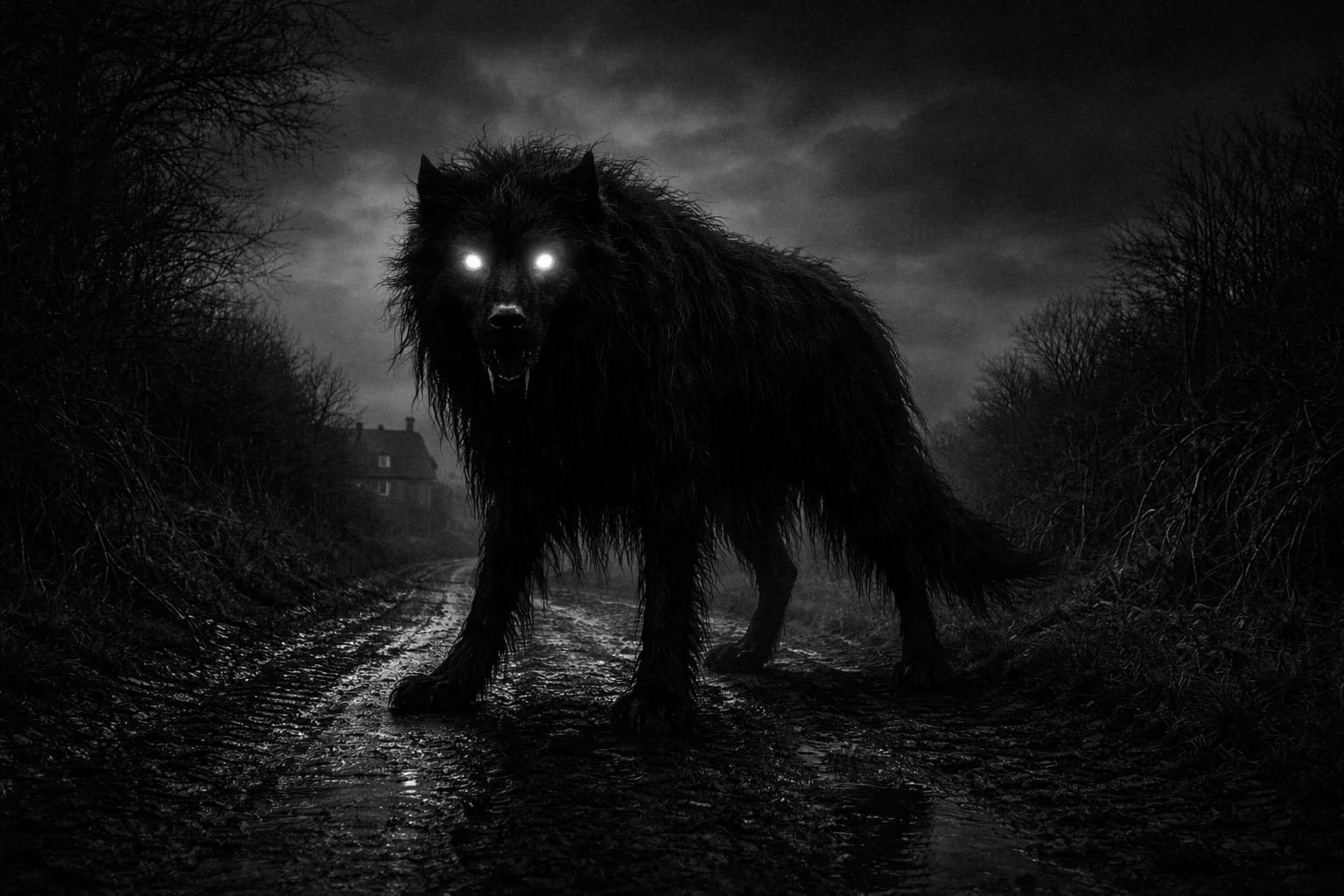
Those who claimed to have seen the monster usually describe it as a very large dog, sometimes as big as a calf or even a small horse. Its fur is matted, shaggy, and coal-black. The most remarkable feature is its eyes, which are often said to glow with a fiery red or yellow light.
Some stories from the Norfolk coast say Black Shuck has just one large eye in the middle of its forehead, like a cyclops. It often moves silently, even though it is huge, but some people report hearing heavy breathing or a clanking sound like chains. Many accounts also mention a sudden chill in the air or the smell of brimstone when the creature appears.
Powers & Weaknesses
Powers
Black Shuck has several supernatural powers that set it apart from normal animals. Its main ability is being a warning sign; just seeing it, according to lore, can bring a curse of bad luck or death. It can move completely silently, even over gravel or dry leaves. It can appear or disappear instantly, often showing up in front of travelers and vanishing before they can react.
Black Shuck is often said to pass through solid objects, such as gates or walls, but it can also use physical force. Some stories say it leaves burn marks on church doors or attacks people during storms. Its stare is said to paralyze people with fear if they look into its eyes.
Weaknesses
Black Shuck’s weaknesses come from old magical and religious beliefs. As a ghostly being, it is usually kept at bay by holy ground, prayers, or religious symbols such as a crucifix. Many stories say it cannot cross into a church unless it is invited or there is a storm.
One common weakness is that Black Shuck will not harm people who ignore it. Many legends say that if a traveler keeps walking without looking at the dog or turning back, the dog will disappear without causing harm. Not making eye contact is often said to help avoid its deadly curse.
Myths, Legends & Stories
Black Shuck’s roots go back to the old Norse and Anglo-Saxon history of East Anglia. Some local stories say it is a leftover from Odin’s hounds, left to wander the area after the Viking Age. In the 12th century, it was first described as part of the Wild Hunt, a group of ghostly riders, rather than a lone creature.
Over time, the monster changed from being part of a pack of gods’ animals to a lone creature haunting the English countryside. Its role shifted from a divine hunter to a local sign of death.
Sketching from the Imagination: Creatures & Monsters Paperback – Up to 32% OFF!
Unleash your dark creativity with this 320-page paperback from 3dtotal Publishing, packed with hundreds of original creature and monster sketches from over 50 professional fantasy artists. Raw concept art, developmental drawings, and imaginative beasts ranging from dragons and demons to eldritch horrors – ideal for artists seeking inspiration for character design, RPG creatures, or spooky illustrations.
The Terror of 1577: Bungay and Blythburgh
The most famous and well-recorded story about Black Shuck happened during a time of severe storms.
On August 4, 1577, a violent storm hit the village of Bungay. While people prayed in St. Mary’s Church, the sky turned pitch black. Suddenly, thunder crashed, the church doors flew open, and a huge black dog ran down the aisle.
The dog moved incredibly fast, and sparks seemed to fly from its fur. It ran between two people, who died instantly as if struck by lightning. A third man was grabbed by the neck; he survived but was said to have shriveled up ‘like a piece of drawn leather’ after being touched by the creature.
After leaving Bungay, the dog appeared at Holy Trinity Church in Blythburgh, a nearby village. It caused more chaos there, and as it ran through the frightened crowd, the church steeple crashed through the roof. Two men and a boy died. As the creature left, it pressed its paws against the north door.
Even now, the heavy oak door still has blackened marks that look like claw prints. Locals say these are the ‘Devil’s Fingerprints,’ burned into the wood by the creature as it passed.
The Guardian of the Dark Lane
Most stories describe Shuck as a monster, but a 19th-century tale from near Overstrand shows a different side. A local woman was walking home after dark along ‘Shuck’s Lane’ when she heard heavy breathing and the soft steps of large paws behind her.
She looked to her side and saw a huge, shaggy black dog with one glowing eye. Although she was terrified, the dog did not attack. Instead, it walked beside her, keeping her safe from the dark shadows along the road.
When she reached her cottage gate, the dog let out a low breath and disappeared into the mist. This story supports the local belief that Shuck only harms people with bad intentions or those who try to hurt him.
The Beeston Ghost Hole
In the Sheringham hills, legends mention a pit called the ‘Ghost Hole’ or ‘Shuck’s Hole,’ where the creature is said to hide during the day. One story tells of a farmer who, after drinking, went to the hole at midnight to prove the legends wrong. When he got there, he heard a noise like stones grinding together.
A huge black head rose from the pit, its eyes glowing like coals. The farmer ran away, but the dog did not follow. Instead, it howled so loudly that people in three villages heard it. The farmer made it home safely but lost his ability to speak and stayed mute until he died exactly one year later.
The Fisherman’s Omen
On the Norfolk coast, especially near Cromer, Black Shuck is linked to the sea. In one story, a group of fishermen were getting ready to go herring fishing at night. As they worked, a huge black dog appeared on the shore, barking at the waves. One young fisherman, scared of the ‘Hateful Thing,’ refused to get on his boat.
The others laughed at him and set out anyway. Within an hour, a sudden storm hit, sinking the boats and killing everyone who ignored the dog. The survivor said that as the ships sank, he saw Black Shuck standing on the cliffs, silently watching the sea before disappearing.
The Skeletal Remains of Leiston Abbey
In 2014, the legend gained a new twist when archaeologists at Leiston Abbey found a huge dog skeleton buried in a shallow grave at the ruins. The bones dated back to when the abbey was still in use.
The skeleton was much bigger than any normal dog from that time, so locals wondered if the monks had caught a ‘Shuck’ or something they thought was one. This discovery made the legend feel more real, suggesting the monster of the fens might have had a real-life version that people in Suffolk wanted to bury carefully.
Ultimate Family Co-op Adventure – Horrified: Universal Monsters
Ravensburger’s acclaimed co-op Horrified Board Game masterpiece: Defend against Dracula, The Mummy, Invisible Man, and other icons in a beautifully themed village. Tactical pick-up-and-deliver gameplay, escalating tension, and endless variety. Ideal gateway game for families & friends, 1-5 players, 10+, with 4.8/5 star rave reviews.

Symbolism
Black Shuck is a strong symbol of the ‘in-between’—the line between what we know and what we don’t, or between life and death. As a creature of wild places, it stands for the untamed and sometimes dangerous side of the English countryside.
In the past, the black dog was seen as the ‘Grim,’ a spirit that protected churchyards or carried out divine punishment. It also reflects people’s fears about sudden death and the unpredictable power of nature, especially the storms that often hit the East Anglian coast.
Can Black Shuck Be Defeated?
Folklore rarely suggests that Black Shuck can be defeated in a fight. Since it is a ghostly being, weapons like swords or guns do not work and usually pass right through it. Instead, people focus on ways to protect themselves rather than trying to fight it.
Traditionally, people used iron or salt to keep spirits away. Carrying a piece of cold iron or throwing salt across a doorway was believed to keep Black Shuck from entering. Another method, called the ‘Turned Coat,’ involved turning a piece of clothing inside out to confuse the spirit and hide from it.
In some coastal villages, people believed that church bells could drive Black Shuck away because the holy sound disturbed the spirit. Still, the best way to ‘defeat’ Black Shuck is just to survive the encounter—by not looking into its eyes or acknowledging it, you can break the curse it tries to bring.
Tags:
Related Monsters…
December 3, 2025
Aswang (Philippine Vampire Shapeshifter)
January 14, 2026
Antaeus (Invincible Earth Giant)
January 5, 2026
Baku (Dream-Eating Japanese Monster)
February 24, 2026
