
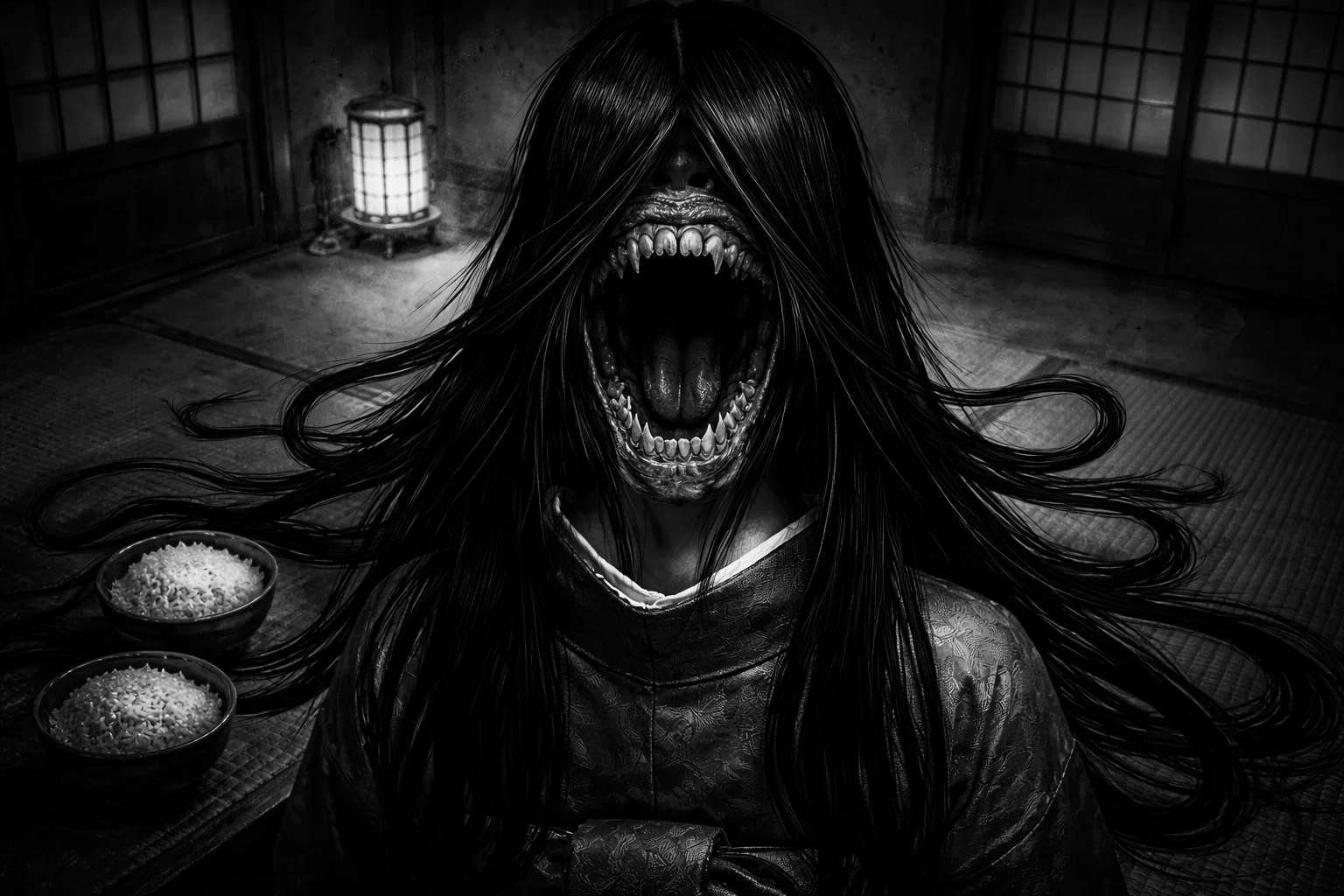

Futakuchi-onna is a unique monster from Japanese folklore, known as a yōkai or supernatural monster. She looks like an ordinary woman, but she hides a frightening secret: a second, hungry mouth on the back of her head, hidden under her hair.
Stories about her often serve as warnings about greed, mistreating others at home, and what can happen when people refuse to share food.
Summary
Overview
| Attribute | Details |
| Name | Futakuchi-onna |
| Alternative Names | Futakuchi-me, Two-mouthed woman |
| Similar Monsters | Rokurokubi, Kuchisake-onna, Ohaguro-bettari, Yama-uba, Harionago, Nure-onna, Ubume, Taka-onna, Kerakera-onna, Hone-onna, Yuki-onna, Kumo-onna, Hinoenma, Kiyohime, Hashihime, Gashadokuro, Akaname, Ittan-momen, Noppera-bō |
| Etymology | From Japanese “futa” (two), “kuchi” (mouth), and “onna” (woman). |
| Gender | Female |
| Classification | Yōkai |
| Species | Humanoid |
| Origin / Culture | Japanese (primarily Honshu and Kyushu) |
| First Recorded | c. 1776 – Gazu Hyakki Yagyō by Toriyama Sekien |
| Active Period | Always active (primarily during meals or at night) |
| Diet | Rice, standard human food, life force |
| Habitat | Human households, rural villages |
| Powers & Abilities | • Prehensile hair manipulation • Independent sentience of the second mouth • Infinite appetite • Telepathic whispering (to the host) |
| Weaknesses | • Feeding the second mouth • Direct observation of the transformation • Religious purification rituals |
| Reproduction / Creation | Cursed human transformation due to greed or neglect |
| Behavior | Solitary domestic infiltrator |
| Pop Culture | Pokémon (Mawile) / “Miss Hokusai” / “The Great Yokai War” / “Hellboy: Sword of Storms” / “Muramasa: The Demon Blade” |
Description
Futakuchi-onna is created when a regular person transforms, rather than being born a monster. She blends into society by appearing to be an ordinary housewife or village woman. Her main feature is a second working mouth on the back of her head that operates on its own, separate from her main mouth and awareness.
This creature is associated with the idea of “kuchi-busu,” or mouth-debt, which refers to a karmic debt incurred for not sharing. The woman might say she eats very little, but her second mouth secretly eats large amounts of food.
This situation creates a parasitic relationship. The woman is both the host and the victim, as the second mouth will find its own way to get food if it is not fed.
Yokai and Supernatural Beings Hardcover Book – Up to 28% OFF!
Explore 100 authentic illustrations of Japan’s most haunting creatures in this premium 240-page volume. From ape-like hihi kidnappers to smirking hannya and shape-shifting bakeneko, drawn from rare historical sources including first-time reproduced monster parade scrolls. Curated by a leading authority on Japanese prints – an indispensable guide to yokai horror and folklore for altars, shelves, or spooky reading.
Etymology
The name “Futakuchi-onna” comes from Japanese. It is made up of three kanji: “futa” (二) means “two,” “kuchi” (口) means “mouth,” and “onna” (女) means “woman.”
Put together, the name means “two-mouthed woman.” The term is meant to describe her appearance, not to be symbolic. In some regions or old texts, “-me” is used instead of “-onna” for woman, which can sound old-fashioned or even a bit negative.
This way of naming matches the simple style used in Edo-period yōkai encyclopedias, which often named monsters after their most obvious or surprising features.
How to Pronounce “Futakuchi-onna” in English
In English, you say it as foo-tah-koo-chee ohn-nah. “Fu” is like “foo” in “food,” “ta” is “tah,” “ku” is “koo,” and “chi” is “chee.” “Onna” has a short “o,” a clear “n,” and ends with a soft “ah.”
Appearance
Futakuchi-onna looks like a regular woman of any age and often wears traditional Japanese clothes like a kimono. From the front, she seems normal and may even look friendly or plain. But under her long black hair at the back of her head, there is a large, open mouth.
This second mouth has lips, teeth, and a tongue. The teeth are usually jagged or sharp, and the mouth can open much wider than a normal one. Most unusual is her hair, which moves like tentacles or extra arms around the second mouth.
Her hair can move on its own, twisting like ropes to grab food and feed the second mouth. When her hair is down, no one can see the mouth.
Powers & Weaknesses
Powers
Futakuchi-onna’s main power is that she can control her hair. It acts as an extra hand for the second mouth, strong enough to lift heavy bowls of rice or grab small items. The hair moves quickly and accurately, so she can eat fast while her main face stays still.
The second mouth also has its own mind and voice. It can whisper threats, rude words, or demands for food, either in the woman’s head or out loud when she is alone.
If the mouth is not fed, it can cause the woman a lot of pain, and she may scream loudly, though only she or people nearby can hear it. In some stories, the mouth can even control her actions to get food.
Sketching from the Imagination: Creatures & Monsters Paperback – Up to 32% OFF!
Unleash your dark creativity with this 320-page paperback from 3dtotal Publishing, packed with hundreds of original creature and monster sketches from over 50 professional fantasy artists. Raw concept art, developmental drawings, and imaginative beasts ranging from dragons and demons to eldritch horrors – ideal for artists seeking inspiration for character design, RPG creatures, or spooky illustrations.
Weaknesses
Futakuchi-onna’s main weakness is that the second mouth always needs to be fed. If it is full, it stays quiet and hidden. The best way to stop her is to discover her secret.
If someone sees the woman in her true form, the curse is often broken, or she has to run away, since her secret is what keeps her safe.
In traditional stories, religious help is another weakness. Priests can perform exorcisms or purification rituals to remove spirits or curses. Special charms or sutras placed on the back of the head are said to quiet the second mouth.
Also, since the creature comes from a curse or negative feelings, a real change in the family’s behavior, such as stopping stinginess, can sometimes make the mouth disappear.
Myths, Legends & Stories
The Origins of the Curse
Futakuchi-onna is rarely described as a natural creature. Instead, she usually appears after a moral mistake or a sad event. There are two main stories about how she is created.
In the first story, a cruel stepmother starves her stepchild but feeds her own children well. After the neglected child dies, their spirit attaches to the stepmother, becoming a second mouth that eats twice as much as the food she once withheld.
The second story is about a stingy husband and a wife who says she never needs to eat. The husband is happy to save money, but soon notices his food is disappearing much faster than expected.
In both stories, the monster shows what happens when greed is hidden or when someone owes a debt to another’s spirit.
The Miser and the Fasting Wife
In a famous folk tale from Fukushima, a stingy man lived alone and was obsessed with saving money. He wanted a wife but would not marry anyone who would eat his precious rice.
One day, a woman came to his door and said she could work all day without eating. The man thought this was perfect and married her right away. For weeks, she worked harder than anyone he knew and never ate in front of him.
But soon, he noticed his large rice supply was shrinking quickly. Growing suspicious, he pretended to leave for work one morning and hid in the rafters to watch his wife.
To his shock, he saw her let down her long hair and reveal a second, ugly mouth on the back of her head. Her hair moved like arms, grabbing rice and feeding it into her mouth. The man was so scared that he decided to divorce her right away.
The Escape and the Tub
After he found out, the husband tried to send his wife away. But she realized her secret was out. The second mouth started screaming, and her hair grabbed the husband, shoved him into a big wooden tub, and she carried him toward the mountains, planning to kill him.
The man escaped when the woman stopped near a swamp or a patch of lilies and bamboo. He hid in the thick plants, and because lilies are thought to be pure and protective, she could not find him.
She eventually gave up looking for him and disappeared into the wild. This story helped create the image of Futakuchi-onna as an old woman living in the mountains, much like the Yama-uba.
Undead Japanese Samurai Zombie – Limited Edition Resin Statue
Command attention with this intricately crafted Japanese-style Oni mask warrior sculpture from LOOYAR. Hand-painted resin/PU material captures the terrifying horns, fangs, and armored menace of the legendary demon guardian. Perfect for altars, shelves, desks, or gothic displays – a striking blend of folklore horror and samurai strength for home or office decor.
Symbolism
Futakuchi-onna is a strong symbol of the “hidden self” and the two sides of human nature. She shows that people cannot hide their true desires forever and that pretending to be something you are not has consequences.
In Japanese culture, people often separate their public face (tatemae) from their true feelings (honne). Futakuchi-onna is a real example of hidden desires that cannot be ignored. She also stands for the idea of a “karmic boomerang”—that being cruel or stingy will come back as a bigger problem for you.
Can Futakuchi-onna Be Defeated?
It is rare to defeat a Futakuchi-onna with fighting or weapons, since she is a cursed person, not a regular monster.
The best way to protect yourself is to avoid the behaviors that create her, like greed and neglect. Families often used home shrines and made offerings to the kami (gods) to ward off angry spirits.
If a Futakuchi-onna is already around, the most common way to protect yourself is with sacred plants. Many legends say she is driven away by the smell or presence of wild irises (shobu) and mugwort.
During the Dragon Boat Festival (Tango no Sekku), people would hang these plants from their houses to keep away evil spirits, including the two-mouthed woman. Some stories say that bathing in water with these herbs can remove the curse.
Also, if someone confronts and shames the creature, the evil spirit may leave, since the monster depends on keeping its secret.
Tags:
Related Monsters…
February 17, 2026
Aswang (Philippine Vampire Shapeshifter)
January 14, 2026
Rokurokubi (Japanese Long-Necked Woman)
March 3, 2026
Aqrabuamelu (Mesopotamian Scorpion-Man Beast)
February 9, 2026
Azazel (Fallen Angel Turned Demon)
January 15, 2026
