
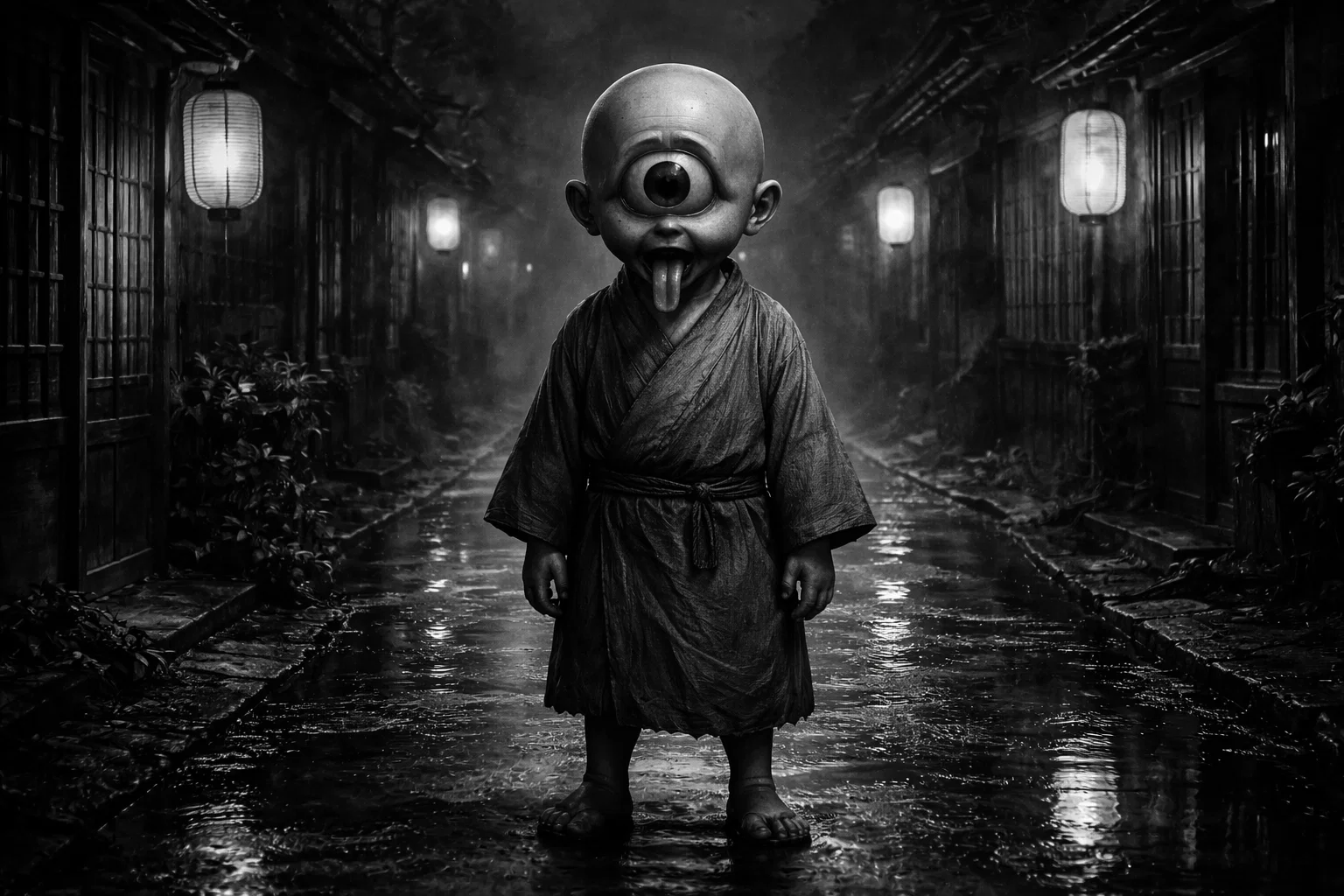

Hitotsume kozō is a well-known creature in Japanese folklore and is considered a type of yōkai. Unlike many spirits in Japanese tradition that are dangerous or threatening, this creature is mostly known as a harmless but surprising trickster. It often appears in urban legends from the Edo period. It remains a familiar part of supernatural stories in Japan today.
Even though Hitotsume kozō is small and appears childlike, it plays a special role in cultural rituals. It is one of the few yōkai linked to certain calendar dates and household protection customs.
Meeting one is rarely deadly, but its single eye has made it a lasting character in ghost stories and traditional art for centuries.
Summary
Overview
| Attribute | Details |
| Name | Hitotsume kozō |
| Alternative Names | Hitotsume kozō, Hitotsume, Ichigan-doji, Ennyūbo |
| Similar Monsters | Cyclops, Ippon-datara, Hitotsume nyūdō, Umibōzu, Kappa, Noppera-bō, Karasa-tengu, Zashiki-warashi, Abura-akago, Tofu-kozō, Akaname, Gaki, Baku, Nurarihyon, Wanyūdō, Mikoshi-nyūdō, Yuki-onna, Rokurokubi |
| Etymology | Japanese: “hitotsu” (one), “me” (eye), “kozō” (young priest or boy) |
| Gender | Male |
| Classification | Yōkai |
| Species | Humanoid |
| Origin / Culture | Japanese (Honshu, Shikoku, and Kyushu) |
| First Recorded | c. 1737 CE – Bakemono no e (Scroll of Monsters) |
| Active Period | Nocturnal / December 8th and February 8th |
| Size | Approximately 1 meter tall (size of a 10-year-old child) |
| Diet | Strictly non-predatory; occasionally associated with bean curd (tofu) |
| Habitat | Dark streets, abandoned temples, and residential doorsteps |
| Powers & Abilities | • Manifesting suddenly in the dark • Emitting a faint blue light • Observing humans from shadows |
| Weaknesses | • Bamboo woven baskets (zaru) • Needles • Holly leaves • Loud noises |
| Reproduction / Creation | Manifests as a spiritual entity; occasionally linked to the spirits of mistreated novices |
| Behavior | Mischievous trickster |
| Pop Culture | GeGeGe no Kitarō / Yo-kai Watch / Nioh / Shin Megami Tensei series |
Description
Hitotsume kozō is a supernatural monster found in both city and countryside stories in Japan. It is called a kozō, a term that once referred to young Buddhist monks in training, which explains its usual size and clothing. Unlike more dangerous spirits that haunt forests or seas, this creature is usually seen in towns, wandering quiet streets or showing up suddenly in homes.
It does not have a complex social life or a clear origin. Instead, it is seen as a symbol of the strange or uncanny. It is usually thought of as a low-ranking yōkai, so it does not have the great powers of major demons or gods.
In stories, its main role is to surprise people. It often looks like a normal child from the side or back, but when it turns around, its single eye is revealed. While seeing it can be a bad sign in some rituals, it does not hunt or harm people.
Yokai and Supernatural Beings Hardcover Book – Up to 28% OFF!
Explore 100 authentic illustrations of Japan’s most haunting creatures in this premium 240-page volume. From ape-like hihi kidnappers to smirking hannya and shape-shifting bakeneko, drawn from rare historical sources including first-time reproduced monster parade scrolls. Curated by a leading authority on Japanese prints – an indispensable guide to yokai horror and folklore for altars, shelves, or spooky reading.
Etymology
The name Hitotsume kozō comes from Japanese and shows the creature’s two main features. The word hitotsu (一つ) means “one,” and me (目) means “eye.” So, hitotsume (一つ目) means “one-eyed” or “cyclops.”
The second part, kozō (小僧), has two meanings. In the past, it meant “little priest” or a young monk who had not yet taken full vows. Later, especially in the Edo period, it came to be used as a common term for “boy” or “youngster.”
So, the name literally means “One-eyed Boy” or “One-eyed Young Priest.” In some places, like Okayama, it is called Ennyūbo, but most of Japan uses the same name.
How to Pronounce “Hitotsume kozō” in English
In English, you say the name as hee-to-tsu-meh ko-zoh. The “Hi” sounds like the start of “heat.” The “tsu” is like the end of “cats.” The “ko” is like “coat” without the ‘t’, and “zo” rhymes with “go,” but with a longer ‘o’ sound.
Appearance
Hitotsume kozō usually looks the same in old scrolls and modern pictures. It appears as a small boy, about the size of an eight- to ten-year-old child. Its most noticeable feature is a single, large eye in the middle of its forehead, like a cyclops.
Its head is usually shown as bald or shaved, matching the “priest” part of its name. It often wears traditional Japanese clothes, like a small kimono or monk’s robes. Sometimes, it is drawn with a wide-brimmed straw hat (kasa).
In many stories, the creature has a long tongue hanging from its mouth, which makes it look both strange and a bit funny. Even though it has a huge eye, its arms and body look like those of a normal child, so it can hide easily until someone sees its face.
Powers & Weaknesses
Powers
Hitotsume kozō does not have strong magic or great physical power. Its main ability is to appear suddenly and startle people. It can show up in places where someone feels uneasy, like a dark alley or near a flickering lantern. Some stories say it can glow with a pale light, making it visible even in complete darkness.
It is also said to be everywhere at once on certain ritual nights, such as Kotohajime (the start of things) and Koto-osame (the end of things). On these nights, people believe it travels from house to house, noting the actions of those inside to report to higher gods.
Weaknesses
Hitotsume kozō’s weaknesses are mostly symbolic and come from old household customs. The best-known way to scare it off is with a woven bamboo basket called a zaru.
If you put one on a pole outside or hang it over a door, the many holes are said to frighten the creature. Since it has only one eye, it cannot understand the “thousands of eyes” in the basket and will run away in fear.
Sharp or prickly things also keep it away. Holly leaves (hiiragi), and even sewing needles work well. In some traditions, people leave out a burnt sardine head due to its strong smell and ritual significance. Making loud noises or speaking firmly can also make the creature disappear.
Bulfinch’s Mythology Leather-Bound Classics Edition – Up to 43% OFF!
Own the timeless masterpiece in luxurious flexi leather-bound format from Canterbury Classics. Thomas Bulfinch’s complete compilation: The Age of Fable (Greek/Roman gods & heroes), The Age of Chivalry (King Arthur & knights), and Legends of Charlemagne – over 800 pages of elegantly retold ancient myths, Norse lore, and medieval romances. Gilded edges, ribbon marker, and premium binding make this a stunning heirloom for occult libraries or dark academia shelves.
Myths, Legends & Stories
The story of Hitotsume kozō shows a shift in Japanese spiritual history, moving from old mountain gods and drought spirits to more local urban yōkai during the Edo period.
In old mountain worship, the idea of “Ichigan Ikyaku” (one eye, one leg) was common for powerful gods who looked different from people. As these beliefs spread to busy cities like Tokyo and Kyoto, these gods became smaller and less scary, turning into the trickster figures we know today.
The Messenger of the Koto-yōka
The most significant legend involving Hitotsume kozō is his role as a supernatural census-taker during the Koto-yōka, a pair of festival days occurring on December 8th (Kotohajime) and February 8th (Koto-osame).
According to folklore throughout the Kantō region, the creature descends from the spirit world on these specific nights to inspect human households. He carries a small, leather-bound ledger known as a cho-men.
As he wanders from house to house, he peers through gaps in sliding doors or windows to observe the behavior of the inhabitants. He specifically looks for signs of “kegare” (spiritual impurity), such as unwashed dishes, dirty floors, or family members speaking unkindly to one another. He records every transgression in his book. Once his rounds are finished, he delivers the ledger to the Yakubyō-gami (Gods of Pestilence and Bad Luck).
These deities use the boy’s notes to decide which houses will be struck with illness or financial ruin in the coming year. To counter this, families developed the tradition of “Koto-yōka” protection, staying awake late into the night and hanging “me-kago” (many-eyed baskets) on high poles to distract the boy before he can make his entries.
The Encounter at Akasaka
A famous account from the Edo period involves a high-ranking samurai traveling through the Akasaka district of Tokyo at night. As he walked past a deserted area near a temple, he encountered a young boy who appeared to be lost and crying.
The boy was dressed in the simple, clean robes of a temple acolyte. Taking pity on the child, the samurai approached and asked what was wrong. The boy remained silent, covering his face with his wide sleeves.
When the samurai reached out to comfort him, the boy suddenly lowered his arms and turned his face upward. The samurai was horrified to see a single, massive, unblinking eye that occupied the entire center of the boy’s face, accompanied by a tongue that stretched down past his chin. The boy didn’t attack; he simply let out a high-pitched, childish giggle.
The samurai drew his sword, but the creature vanished into a cloud of pale blue mist before the blade could strike.
The Duel of the One-Eyed Shadows
In the annals of “kaidan” (ghost stories), there is a unique tale regarding a man who claimed he was not afraid of yōkai. He was visited one night in his home by a Hitotsume kozō.
The creature appeared in his guest room and sat cross-legged, staring at him. Instead of fleeing, the man stared back. After several minutes, the creature began to grow. Its single eye pulsed with a rhythmic light, and it began to mimic the man’s breathing.
Suddenly, a second yōkai, the Mikoshi-nyūdō (a towering, long-necked monk), appeared behind the boy. The two entities seemed to be working in tandem. At the same time, the Hitotsume kozō drew the man’s attention with its singular look; the larger monk grew taller and taller, attempting to make the man look up so it could bite his throat.
The man, realizing the trap, focused his eyes solely on the small boy and refused to acknowledge the giant. Frustrated by the man’s lack of fear and his refusal to look away from the boy’s single eye, both spirits dissolved into the floorboards as the sun began to rise.
Undead Japanese Samurai Zombie – Limited Edition Resin Statue
Command attention with this intricately crafted Japanese-style Oni mask warrior sculpture from LOOYAR. Hand-painted resin/PU material captures the terrifying horns, fangs, and armored menace of the legendary demon guardian. Perfect for altars, shelves, desks, or gothic displays – a striking blend of folklore horror and samurai strength for home or office decor.
The Legend of the Tofu-Kozō and the Rainy Night
In rural legends, particularly in the Okayama and Hyogo prefectures, the Hitotsume kozō is often linked to the appearance of Tofu-kozō. On rainy nights, a one-eyed boy is said to appear to travelers carrying a bamboo umbrella and a ceramic plate with a block of tofu. The tofu is inscribed with a red maple leaf or a specific seal.
The legend warns that if the traveler takes a bite of the tofu, a fungus will immediately begin to grow inside their body, leading to a slow and painful transformation into a yōkai themselves. In some versions of the story, the boy is not trying to poison the traveler. Still, he is simply a servant for a more powerful demon, tasked with delivering “spirit food.”
When the traveler refuses the gift, the boy often bursts into tears, his single eye shedding a massive, singular droplet of water, before fading into the rain.
The Gift of the Gold-Spitting Kozō
While most legends treat the Hitotsume kozō as a nuisance or an ill omen, a rare variation from the Tōhoku region portrays the creature as a bringer of wealth. In this myth, an elderly couple who lived in poverty found a small, one-eyed boy shivering in the snow outside their hut. Despite their lack of food, they brought him inside and shared their meager portion of rice.
The boy stayed with them for three days, never speaking. On the fourth morning, he stood in the center of the room and began to cough. Instead of breath, he spat out small gold coins (koban). He continued until the floor was covered in wealth, then bowed to the couple and walked out the door, vanishing into the winter air.
The Mononoke Roku and the Night Parade
In the famous Hyakki Yagyō (Night Parade of One Hundred Demons), the Hitotsume kozō is often described as one of the leaders of the smaller spirits.
He is depicted in the Mononoke Roku scrolls as the parade’s scout. Because of his keen, single eye, he is believed to be able to see through illusions and find humans who are hiding in the shadows to watch the parade—a forbidden act.
Legends say that if the boy spots a human watching the Night Parade, he will point his finger and lick his lips; the human will then be cursed with a fever that lasts for eight days, mirroring the number of the Koto-yōka festival.
Symbolism
Hitotsume kozō is a symbol that connects the sacred and everyday life. It first stood for the unusual forms of mountain gods, but later came to represent the idea of being watched at home.
Its job of recording bad behavior shows how important cleanliness and harmony are in Japanese culture. The fear of being “put in the book” made families keep their homes clean and act properly during special times of the year.
The creature also stands for the idea that the unknown can be harmless. Unlike Oni (demons), which mean destruction, Hitotsume kozō shows that the things that scare us in the dark are not truly dangerous, especially if we face them or use simple protections like a basket.
Can Hitotsume kozō Be Defeated?
You do not need fighting skills or holy weapons to deal with a Hitotsume kozō, since it is not a real physical threat. Instead, people use rituals and tricks to keep it away.
The main way to protect against it is with a Zaru (bamboo basket). In the past, families put a basket on a tall pole outside their house on the eighth day of the twelfth month. People believed the creature’s one eye would be confused by the many holes in the basket. Today, any object with lots of eye-like patterns can work the same way.
Other protective measures include:
- Holly Leaves and Sardines: Putting a branch of prickly holly (hiiragi) and a smelly sardine head (hiiragi iwashi) at your door is a traditional way to keep away yōkai, including the one-eyed boy.
- Incantations: In some areas, people believe that shouting certain words or clapping loudly can make the creature go away.
- Religious Amulets: Although not as common for this creature, general Ofuda (talismans) from a Shinto shrine or Buddhist temple are thought to offer spiritual protection and keep tricksters like this out of the home.
Tags:
Related Monsters…
Argus Panoptes (Hundred-Eyed Giant)
January 13, 2026
Abominable Snowman (Himalayan Beast)
December 1, 2025
