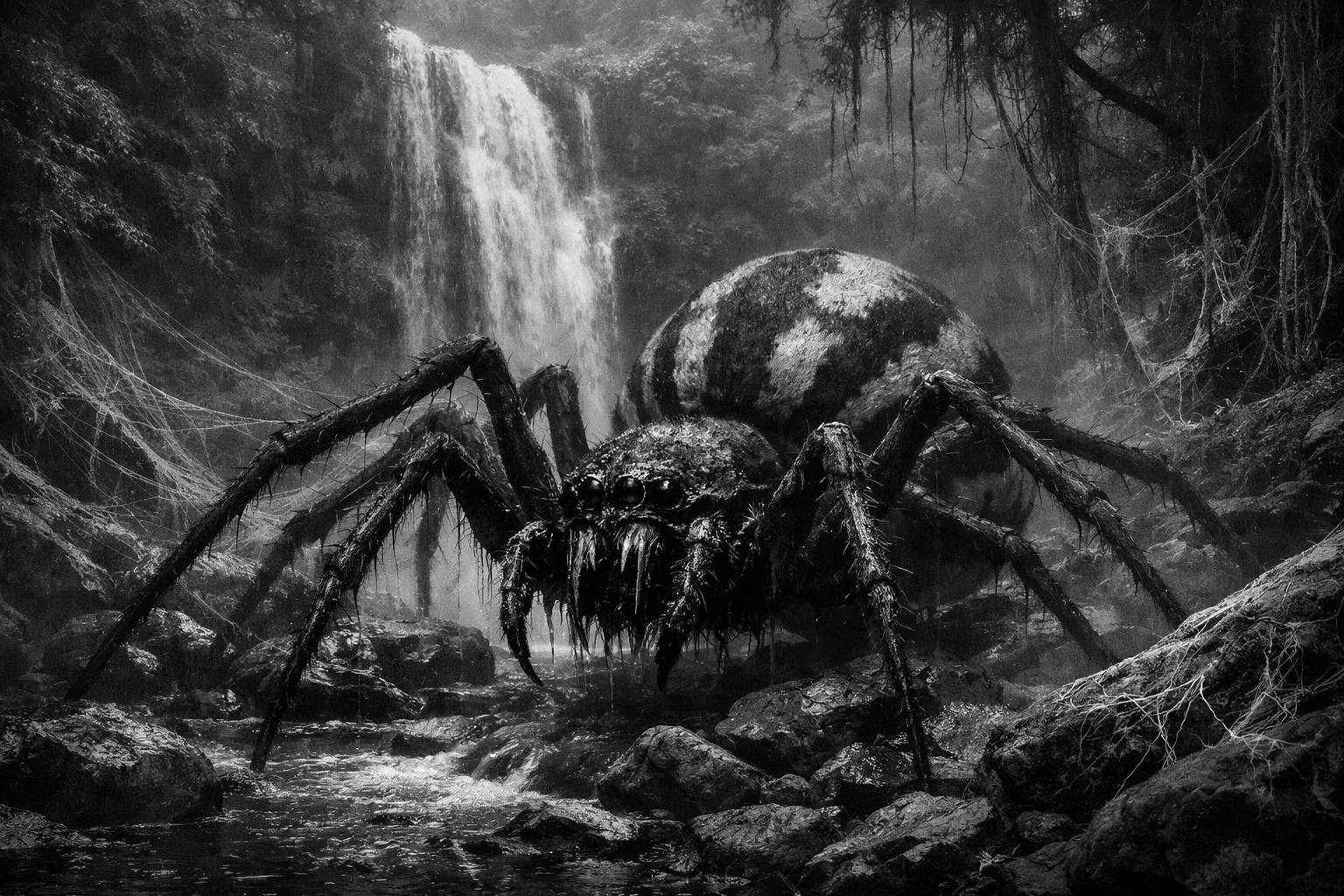

Jorōgumo is a well-known figure in Japanese folklore and is considered a type of yōkai, or supernatural monster. It is a giant orb-weaving spider that can transform into a beautiful woman to catch its victims.
The creature is often linked to places like waterfalls, bridges, and hidden homes. Stories about this dangerous mix of trickery and hunting instinct have been told for centuries.
Summary
Overview
| Attribute | Details |
| Name | Jorōgumo |
| Alternative Names | Jorō-gumo, Yorigumo, Madara-gumo, Woman-Spider, Entwining Bride |
| Similar Monsters | Tsuchigumo, Arachne, Chwidencha, Anansi, Qalicup, Nephilim Spider, Spider Grandmother, itsumade, Nure-onna, Kechibi, Ubume, Hone-onna, Yuki-onna, Kiyohime, Hannya, Futakuchi-onna, Kuchisake-onna, Rokurokubi, Kerakera-onna |
| Etymology | From Japanese “jorō” (prostitute or high-ranking courtesan) and “kumo” (spider). |
| Gender | Female |
| Classification | Yōkai |
| Species | Hybrid |
| Origin / Culture | Japanese (Honshu, Shikoku, and Kyushu) |
| First Recorded | Edo Period (1603–1867) – Taihei Hyakumonogatari |
| Active Period | Always active / Nocturnal preference |
| Size | In spider form, often described as 2–3 meters in length. |
| Lifespan | Transformed upon reaching 400 years of age. |
| Diet | Human flesh and blood. |
| Habitat | Waterfalls, caves, old temples, and abandoned houses. |
| Powers & Abilities | • Shapeshifting into a human woman • Silk generation and manipulation • Control over small fire-breathing spiders • Poison secretion • Illusion casting |
| Weaknesses | • Exposure of its true form in reflections • Physical destruction of its spider body • Holy sutras or charms |
| Reproduction / Creation | A Nephila clavata (Jō-gumo spider) that lives for 400 years develops supernatural powers. |
| Behavior | Solitary ambush predator |
| Pop Culture | Shin Megami Tensei series, Nioh, Grimm (TV series), Okami, Yu-Gi-Oh! (Card: Jogyo the Gracious), Dororo |
Description
Jorōgumo is a supernatural being known for its deadly tricks. Unlike ghosts or spirits in Western stories, it is a real spider that has gained spiritual power and lived for a long time. This change lets it move between the animal world and human society, so it can blend in and go unnoticed in homes or rural areas.
This creature hunts with patience, not strength. Instead of attacking directly, it exploits human feelings and desires. It often builds its nest in places where people pass by, like bridges or waterfalls, and pretends to be someone in need or a friendly companion.
Once its victim is caught in the web, both physically and emotionally, the Jorōgumo shows its true, dangerous side.
Yokai and Supernatural Beings Hardcover Book – Up to 28% OFF!
Explore 100 authentic illustrations of Japan’s most haunting creatures in this premium 240-page volume. From ape-like hihi kidnappers to smirking hannya and shape-shifting bakeneko, drawn from rare historical sources including first-time reproduced monster parade scrolls. Curated by a leading authority on Japanese prints – an indispensable guide to yokai horror and folklore for altars, shelves, or spooky reading.
Etymology
The name Jorōgumo comes from Japanese and has two meanings, depending on the kanji used. Today, it is usually written with characters that mean “prostitute spider” or “courtesan spider.” This name matches the stories where the Jorōgumo appears as a seductive woman who leads men to their doom.
In the past, the name was sometimes written to mean “entwining spider.” In Japanese zoology, Jō-gumo is the name for the East Asian orb-weaver spider Nephila clavata.
Over time, the word for the spider blended with terms for high-ranking women in pleasure districts, turning Jō-gumo (the animal) into Jorōgumo (the monster) in folklore.
How to Pronounce “Jorōgumo” in English
In English, Jorōgumo is usually pronounced as jo-roh-goo-moh. The “jo” sounds like “Joe,” “roh” is like “row,” “goo” is like the word for something sticky, and “moh” rhymes with “low.” Most people say each part evenly, but some may stress the second syllable a bit more.
Appearance
In its true form, the Jorōgumo is a huge spider, usually shown with the bright colors of the Nephila clavata species. It has a round abdomen with bold yellow, black, and red stripes. Its eight legs are long and thin, covered in tiny hairs that sense movement. Its jaws are strong enough to pierce human skin and inject a powerful venom that can sedate or paralyze.
When it changes shape, the Jorōgumo looks like a beautiful young woman. She is often described as wearing fancy silk kimonos made from her own webs. In some stories, the disguise is not perfect—her reflection in water or a mirror might still show a spider’s shadow or jaws.
In some versions of the story, she keeps the upper body of a woman, but her lower half is still a giant spider. She usually hides this form under her clothes or in her web-filled home.
Powers & Weaknesses
Powers
The Jorōgumo’s main power is its ability to change shape. It can copy the look, voice, and actions of a human woman. This trick is even stronger thanks to its silk, which is much tougher than normal spider webs. Its silk is so strong that it can tie up victims or even build houses that look like they are made of wood and paper, but are really made from silk.
Besides making silk, the Jorōgumo can control smaller spiders to help it. In some stories, it can even order fire-breathing spiders called hi-gumo to burn down the homes of its enemies. The Jorōgumo is also very clever and can play instruments like the biwa or koto to charm its victims.
Undead Japanese Samurai Zombie – Limited Edition Resin Statue
Command attention with this intricately crafted Japanese-style Oni mask warrior sculpture from LOOYAR. Hand-painted resin/PU material captures the terrifying horns, fangs, and armored menace of the legendary demon guardian. Perfect for altars, shelves, desks, or gothic displays – a striking blend of folklore horror and samurai strength for home or office decor.
Weaknesses
The Jorōgumo’s biggest weakness is having its real form exposed. It cannot maintain its human disguise when seen in a bronze mirror or through special, blessed items. A strong blow from a sword or heavy tool can kill it, as long as the attacker can get past its webs.
Spiritual protections, especially those from Buddhist or Shinto traditions, can keep the Jorōgumo away. Placing holy sutras written on paper around a house can stop it from coming inside.
In some stories, the Jorōgumo can be outsmarted by its intended victims. If a person is clever enough, they can turn the spider’s own traps against it, like swapping a log for themselves when the spider tries to pull them into the water.
Myths, Legends & Stories
Origins and the Law of Longevity
In Japanese folklore, the Jorōgumo starts out as an ordinary spider rather than a supernatural being. It is usually thought to be a Nephila clavata, which is a type of golden orb-weaver spider.
The change into a yōkai happens over time. Legends say that when a spider turns 400 years old, it gains the power to shapeshift and becomes much smarter and more dangerous. At this point, it stops eating insects and starts hunting people.
In older stories, the Jorōgumo was sometimes seen as a guardian of water places. But during the Edo period, tales changed, and it became known more for tricking and trapping men in hidden webs.
The Woodcutter of Jōren Falls
The most widely documented legend regarding the Jorōgumo takes place at Jōren Falls in the Izu Peninsula.
A local woodcutter was working near the waterfall’s basin when he accidentally dropped his axe into the deep water. As he waded in to retrieve it, a beautiful woman appeared from behind the veil of the falls and returned the tool to him. She made him promise never to tell anyone of her existence.
For years, the woodcutter kept the secret, but his health began to fail as the spider’s influence lingered on him. One evening, during a festival, he became intoxicated and recounted the encounter to the village elders. The moment the secret was revealed, the woodcutter fell into a deep sleep from which he never woke.
In a variation of this tale, the woodcutter is sitting by the falls when he notices spider silk being wrapped around his feet. He quickly transfers the silk to a nearby tree stump. A massive force then drags the stump into the water, and a voice screams from the depths, lamenting that the “target” had escaped.
The Tale of the Kashikoduchi
The “Kashikoduchi” or “Clever Dirt-Bridge” story originates from the Enshū region. In this account, a man named Jinbei was walking across a bridge when he encountered a woman carrying a small child. She pleaded with him to hold the infant for a moment.
As soon as Jinbei took the child, the woman vanished. The infant began to grow unnaturally heavy, and Jinbei realized the “child” was actually a bundle of thousands of spider eggs wrapped in a heavy illusion.
As he struggled under the weight, he saw a giant spider—the woman’s true form—emerging from beneath the bridge to feast. Jinbei managed to throw the heavy bundle at the creature and flee. He returned later with several villagers armed with torches.
They discovered that the bridge was not made of wood or stone, but was a massive, ancient web disguised to look like a man-made structure. The villagers burned the web, and it is said the Jorōgumo’s screams could be heard for miles as the fire consumed its lair.
Ultimate Family Co-op Adventure – Horrified: Universal Monsters
Ravensburger’s acclaimed co-op Horrified Board Game masterpiece: Defend against Dracula, The Mummy, Invisible Man, and other icons in a beautifully themed village. Tactical pick-up-and-deliver gameplay, escalating tension, and endless variety. Ideal gateway game for families & friends, 1-5 players, 10+, with 4.8/5 star rave reviews.

The Spider’s Biwa at the Abandoned Temple
During the Edo period, a popular story circulated about a wandering samurai who sought shelter from a storm in an old, dilapidated temple. Inside, he found a solitary woman of great beauty who was playing a biwa (a traditional lute). The music was hypnotic, and the samurai felt himself becoming increasingly lethargic.
As he watched her play, he noticed that the “music” was a physical manifestation; every note she struck released a fine, almost invisible strand of silk that was slowly binding him to the floorboards. Realizing the danger, the samurai drew his katana and struck at the woman’s face. She shrieked and retreated into the darkness of the rafters.
The next morning, the samurai discovered the temple was filled with the bones of previous travelers. He tracked a trail of blue ichor to the garden, where he found the body of a giant spider, the size of a calf, with a deep gash where he had struck the woman the night before.
The Magician and the Silk Trap
A less common but detailed myth involves a powerful practitioner of onmyōdō (traditional Japanese esotericism) who was challenged by a Jorōgumo. The creature disguised itself as a young acolyte seeking to learn magic. For weeks, the “acolyte” served the magician, slowly weaving silk into the magician’s bedding and clothing.
The magician eventually noticed that his movements were becoming restricted and that he was suffering from a strange, recurring venomous fever. Using a consecrated bronze mirror, he forced the acolyte to look at their reflection.
The mirror revealed not a human, but a massive spider perched on the magician’s own shoulders. The magician used a specialized banishing ritual, involving the throwing of roasted beans and the chanting of protective sutras, which caused the spider to burst into a cloud of harmless smoke and common house spiders.
The Waterfall Goddess of Shizuoka
In certain parts of Shizuoka Prefecture, the Jorōgumo is viewed with a mixture of fear and reverence, occasionally taking on the role of a local protective deity of the water. In one story, a village was suffering from a severe drought. A young man volunteered to sacrifice himself to the “Mistress of the Falls” to bring rain.
When he reached the waterfall, a woman appeared and told him that she did not want his life, but rather his help in removing a “thorn” from her side. The thorn turned out to be a large, rusted iron anchor that had become lodged in the rocks.
The man removed it, and in gratitude, the woman—revealing a glimpse of her spider-like mandibles—summoned a massive rainstorm.
Symbolism
The Jorōgumo is a complex symbol in Japanese folklore. Most of all, it stands for the “femme fatale”—the idea that beauty can hide danger. It also shows the risks of the wild world coming too close to people. The spider’s web is a symbol for the traps people can fall into when they let attraction outweigh caution.
The Jorōgumo also stands for how time can change things. It shows the belief that even something small and overlooked can become powerful if it lives long enough to gain wisdom and magic.
Can the Jorōgumo Be Defeated?
To defeat a Jorōgumo, a person needs both physical strength and spiritual protection. Folktales say the best way to stay safe is to stay alert and use protective charms called omamori or say Buddhist prayers, which can weaken the Jorōgumo’s magic.
People often use tobacco or smoke for protection. In some local stories, the Jorōgumo hates the smell or heat of tobacco smoke and will lose her human disguise if exposed to it. Travelers are also advised to carry a steel blade blessed by a priest when passing through areas where the Jorōgumo is said to live.
If someone gets caught, the usual way to escape is called “the substitution trick.” The victim puts something heavy, like a stump or rock, in the path of the spider’s silk. This fools the Jorōgumo into dragging the object instead of the person, giving them a brief chance to fight back or run away.
When people find the Jorōgumo’s lair, the community often comes together to burn it down. Fire is seen as the best way to ensure the creature does not return.
Tags:
Related Monsters…
Argus Panoptes (Hundred-Eyed Giant)
January 13, 2026
Akkorokamui (Ainu Monstrous Sea Kraken)
January 8, 2026
Baku (Dream-Eating Japanese Monster)
February 24, 2026
February 5, 2026
December 9, 2025
