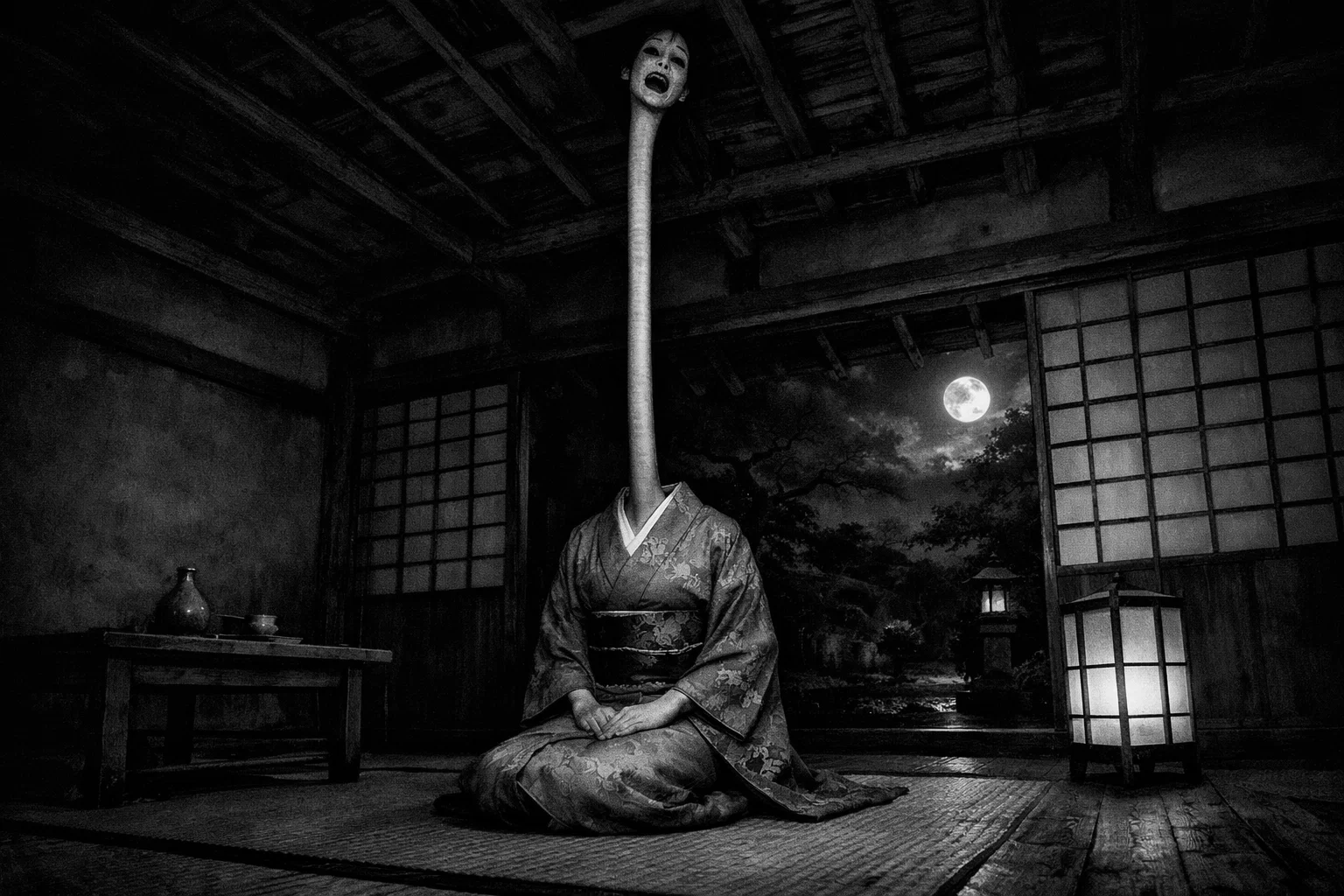

Rokurokubi are well-known monster in Japanese folklore and are considered a type of yōkai. By day, they look just like regular people, but at night, they change in surprising ways. This contrast between their normal lives and their supernatural side has made them a common subject in Japanese ghost stories for hundreds of years.
To truly understand Rokurokubi, it helps to look beyond their human appearance and focus on the unusual traits that reveal what they really are.
Summary
Overview
| Attribute | Details |
| Name | Rokurokubi |
| Alternative Names | Rokuro-kubi, Nukekubi (related variant), Hitoban |
| Similar Monsters | Nukekubi, Chonchon, Krasue, Penanggalan, Leyak, Manananggal, Palasik, Ahool, Soucouyant, Loogaroo, Tiyanak, Huli Jing, Lamia, Empusa, Gello, Mormo, Strige, Lamashtu |
| Etymology | Japanese: ‘rokuro’ (potter’s wheel or pulley) + ‘kubi’ (neck) |
| Gender | Female, Male |
| Classification | Yōkai |
| Species | Humanoid |
| Origin / Culture | Japanese (Edo Period folklore) |
| First Recorded | c. 1660s – Shokoku Hyakumonogatari |
| Active Period | Nocturnal |
| Diet | Lamp oil (wick grease), small insects, or life force |
| Habitat | Human settlements, urban areas, private homes |
| Powers & Abilities | • Neck elongation • Detachable head (variant) • Flight (variant) • Human mimicry |
| Weaknesses | • Physical obstruction of the body • Relocating the body while the head is away • Exposure of the transformation to others |
| Reproduction / Creation | Karmic curse / Deep-seated obsession / Spiritual disease (reikidō) |
| Behavior | Mischievous nocturnal trickster |
| Pop Culture | Hellboy (Sword of Storms), Touhou Project, Inuyasha, Nioh, Yo-kai Watch |
Description
Rokurokubi mostly appear in traditional Japanese urban legends. During the day, they look and act just like anyone else, often as wives, daughters, or servants in their communities. Many do not realize they are different and think their nighttime experiences are only strange or vivid dreams.
At night, their bodies change. The most common type has a neck that extends very far, allowing the head to move while the body stays still. In another version, the head comes completely off the body.
Rokurokubi are not usually shown as dangerous monsters. Instead, they are often seen as sad or unlucky, or as small troublemakers who scare people or drink lamp oil. Their stories often deal with ideas like karma, hidden guilt, or how people hide their true selves.
Yokai and Supernatural Beings Hardcover Book – Up to 28% OFF!
Explore 100 authentic illustrations of Japan’s most haunting creatures in this premium 240-page volume. From ape-like hihi kidnappers to smirking hannya and shape-shifting bakeneko, drawn from rare historical sources including first-time reproduced monster parade scrolls. Curated by a leading authority on Japanese prints – an indispensable guide to yokai horror and folklore for altars, shelves, or spooky reading.
Etymology
The name “Rokurokubi” comes from two Japanese words: rokuro, which means “potter’s wheel,” “pulley,” or “well-bucket handle,” and kubi, which means “neck.” The idea of a potter’s wheel or pulley is used as a way to picture how their neck stretches and pulls back.
Like a potter’s wheel turning or a pulley lifting a rope, the Rokurokubi’s neck is said to stretch in a smooth, almost mechanical way. In the past, the name was also used for people who stretched their necks to see better, and over time, it became linked to this supernatural being.
How to Pronounce “Rokurokubi” in English
In English, people usually say the name as roh-koo-roh-koo-bee. The “r” is pronounced softly, like the “tt” in “butter.” The “o” sounds are long, like in “go,” and the “u” is short, like in “pull.” The last “i” is pronounced “ee.” Most syllables are stressed evenly, but sometimes the third one gets a bit more emphasis.
Appearance
During the day, Rokurokubi look like ordinary people, often appearing as young women in traditional Japanese clothes like kimonos. When they are awake, nothing about their appearance sets them apart from other humans.
At night, their neck stretches out, becoming long and thin like a rope, and can reach several meters from their shoulders. The skin stays connected but becomes very stretchy. In the Nukekubi version, the head comes off completely, leaving a ring of symbols or a special mark around the neck where it separates.
When the head is stretched or removed, the face can look scary or strange, with wide eyes and a sticking-out tongue, but sometimes it still looks human, even during the change.
Powers & Weaknesses
Powers
Rokurokubi have the special ability to change their bodies. Their necks can stretch as far as needed, so their heads can move through windows, go upstairs, or enter other rooms while the body stays asleep. This helps them explore or look for food without moving their whole body. For the Nukekubi type, the head can fly on its own and is able to bite or scream.
Rokurokubi are also very good at hiding their true nature. During the day, they seem completely normal, so it is almost impossible to tell them apart from regular people unless someone sees them change at night.
Weaknesses
A Rokurokubi’s biggest weakness is that its body is helpless during the transformation. While the neck is stretched or the head is gone, the body stays still and is usually unconscious. If someone moves or hides the body, the head might not be able to return, which can cause the creature to die.
For Nukekubi, even moving the body a little while the head is away can stop the head from reattaching, which will lead to its death. They are also at risk if someone sees them; being discovered by a human can break the curse or make the creature run away in embarrassment, since they depend on keeping their secret.
NECA 8″ Clothed Sam Action Figure – Up to 24% OFF!
NECA’s meticulously crafted 8-inch clothed figure of Sam, the sinister spirit from Trick ‘r Treat. Fabric orange pajamas, removable burlap mask revealing his demonic face, lollipop weapon, bitten pumpkin accessory, and extra hands for poses. Fully articulated with real cloth clothing – the perfect eerie guardian for horror collections and year-round spookiness.
Myths, Legends & Stories
Stories about Rokurokubi have changed over time. At first, they were seen as scary monsters with detached heads. Still, later, especially during the Edo period, they became known as tricksters with long necks.
Early tales described them not just as monsters, but as people suffering from a spiritual problem called reikidō, where a troubled soul pulls the head away from the body during sleep.
The Origins and the Curse of Karma
In Japanese folklore, Rokurokubi are often seen as a sign of “Inaga,” or karmic debt. Unlike other yōkai that come from nature, these beings are usually created because of something wrong a person has done.
Most stories say a person, often a woman, becomes a Rokurokubi because of her own hidden greed or because of the wrongdoings of her father or husband. In many old tales, a Rokurokubi is created when someone holds onto a strong obsession or grudge that they cannot show while awake.
While they sleep, this inner struggle grows so strong that the spirit tries to leave the body, stretching the neck as it moves around the house or neighborhood. People saw this as a warning that the way someone appears on the outside can be changed by the secrets they carry inside.
The Legend of the Echigo Servant
One of the most detailed accounts originates from the Echigo Province and was recorded in several kaidan collections. It concerns a hardworking servant girl named Toyo, beloved by her employers for her diligence. However, her master began to notice that the household’s lamp oil was disappearing at an impossible rate.
One night, he feigned sleep and watched as Toyo’s neck began to thin and extend like a pale ribbon. The head traveled across the room, out the window, and into the garden, where it began to lick the oil from the stone lanterns (tōrō).
The master was paralyzed with fear but noted that the girl’s body remained perfectly still in her bedding. The following morning, he confronted her. To his surprise, Toyo had no memory of the event, though she complained of a “stiff neck” and dreams of flying through the air to look at the moon.
This story is important because it shows that Rokurokubi often do not know what they are doing. The person is usually innocent, but their body acts on its own, making the tale a sad one about someone troubled by their own body.
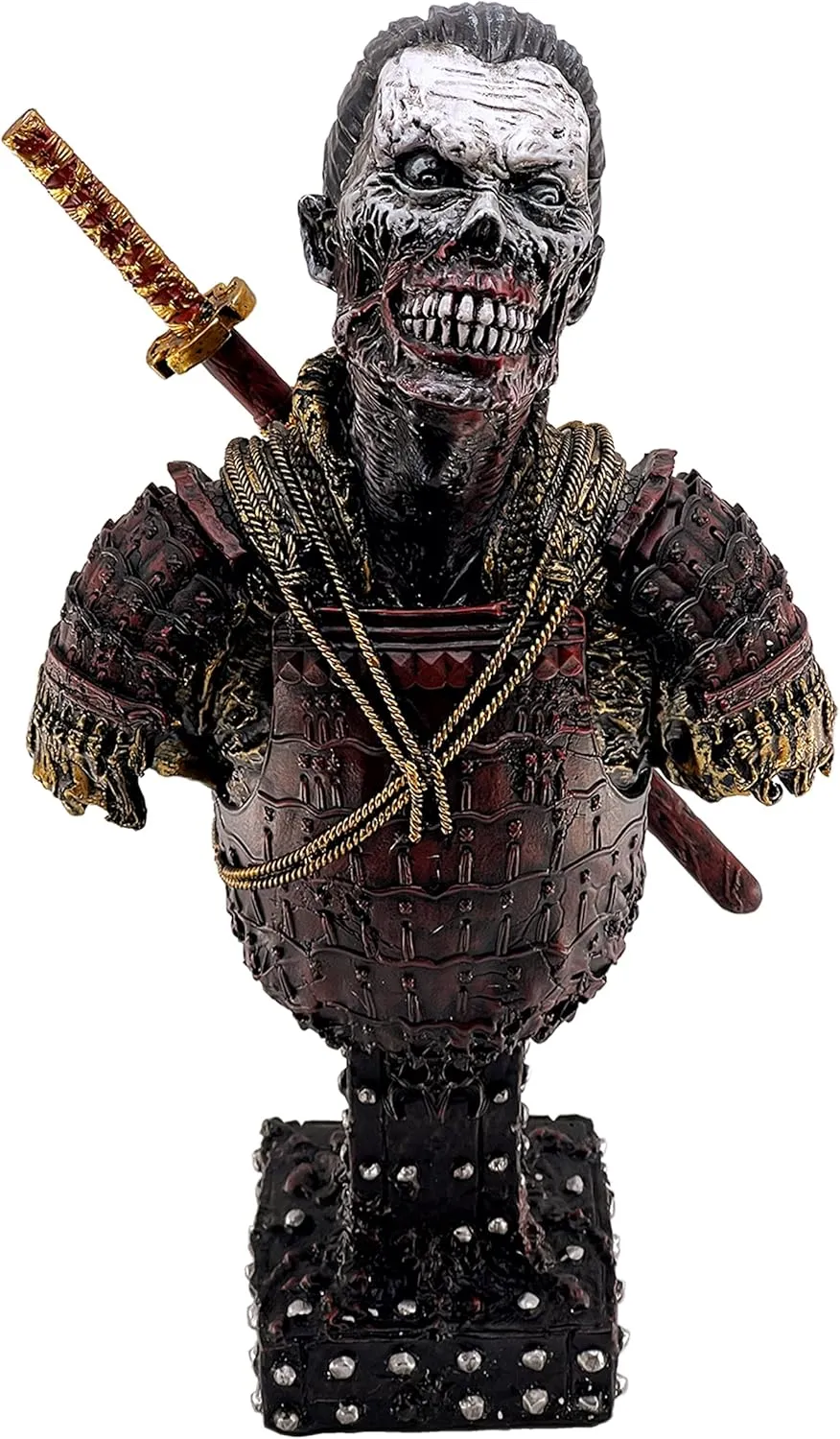
Undead Japanese Samurai Zombie – Limited Edition Resin Statue
Command attention with this intricately crafted Japanese-style Oni mask warrior sculpture from LOOYAR. Hand-painted resin/PU material captures the terrifying horns, fangs, and armored menace of the legendary demon guardian. Perfect for altars, shelves, desks, or gothic displays – a striking blend of folklore horror and samurai strength for home or office decor.
The Nukekubi of the Kiso Mountains
A more violent tradition exists regarding the Nukekubi variant, which is often conflated with the Rokurokubi. A famous story tells of a traveling monk named Kwairyo, a former samurai, who sought shelter at a hut in the Kiso Mountains. The owner of the hut, a seemingly kind woodcutter, lived there with several companions.
During the night, Kwairyo awoke to find five headless bodies lying in the next room. Recognizing the signs of a Nukekubi colony, he remembered a specific detail from ancient texts: if the body of a Nukekubi is moved, the head cannot find its way back.
Kwairyo dragged the woodcutter’s body to a hidden spot behind a tree. Soon after, the five heads returned from hunting small animals in the forest. Four heads successfully reattached, but the woodcutter’s head could not find its torso.
In a panic, the head attacked Kwairyo and bit his sleeve so hard that even after the monk killed it with his staff, the teeth stayed stuck in the cloth. This story was meant to warn people about how dangerous and vulnerable the detached-head type could be.
The Ghostly Wife of the Ronin
In the Sorori Monogatari (1663), there is an account of a ronin (masterless samurai) who discovered his wife was a Rokurokubi. He observed her neck stretching at night and, in a fit of terror and disgust, divorced her immediately.
The story goes on to show the woman’s life after her secret is found out. She is sold from one house to another, but is always sent back when people learn the truth. In the end, she has to live apart from others, showing how revealing a hidden, monstrous side can lead to being rejected by society.
The Kanbun Era Sighting
A documented “eyewitness” account from the Kanbun era (1661–1673) describes a merchant who witnessed a Rokurokubi in a busy urban district of Edo (modern-day Tokyo). The merchant claimed to see a woman’s head rising above a folding screen (byōbu) while her body remained seated behind it.
Unlike the scary mountain stories, this city tale portrayed the Rokurokubi as interesting rather than dangerous. The merchant said the neck looked like a “thin, colorful string,” and the head seemed to be looking around the room with a lot of interest.
The Red Mark of the Neck
A common theme in Japanese stories is the “Rokurokubi mark.” Folklore says that even when the neck is normal during the day, you might see a faint line or small, pale bruises around the person’s neck.
One story tells of a doctor who treated “spirit diseases” and could spot a Rokurokubi just by looking for these marks. He said the marks came from the skin stretching too much over time.
Ultimate Family Co-op Adventure – Horrified: Universal Monsters
Ravensburger’s acclaimed co-op Horrified Board Game masterpiece: Defend against Dracula, The Mummy, Invisible Man, and other icons in a beautifully themed village. Tactical pick-up-and-deliver gameplay, escalating tension, and endless variety. Ideal gateway game for families & friends, 1-5 players, 10+, with 4.8/5 star rave reviews.
Symbolism
Rokurokubi are a strong symbol of hidden identity and the two sides of human nature. They stand for the secrets people keep behind a polite face. In Japanese culture, where “honne” means true feelings and “tatemae” means public face, Rokurokubi show this divide in a real way.
The stretched neck symbolizes hidden wishes or wrongdoings that cannot be kept in a normal life. It also shows how fragile family life can be, hinting that even people close to us, like a spouse, might have a hidden, darker side that only comes out at night.
Can Rokurokubi Be Defeated?
Beating a Rokurokubi is usually about being smart and watchful, not about fighting. Since they often do not know what they are, the best way to protect yourself is to reveal their secret. If a Rokurokubi finds out someone has seen their long neck, they often feel so ashamed that they leave the community for good.
The best way to destroy a Rokurokubi is to disrupt its body while it is changing. For Nukekubi, old stories say that if you move the body or cover the neck stump, the head will not be able to reattach. If the head cannot get back before sunrise, the creature will die.
People often use religious items for protection. Putting a shimenawa, which is a sacred rice-straw rope, around where someone sleeps, or using ofuda, holy charms from a Shinto shrine, can stop the spirit from leaving the body or keep the head from coming off.
In some places, people thought that keeping a lamp burning with good oil would satisfy the creature, since Rokurokubi were often drawn to cheap oil used by poorer families. By making the environment “pure,” people believed they could calm or dispel the Rokurokubi’s bad energy.
Tags:
Related Monsters…
Azazel (Fallen Angel Turned Demon)
January 15, 2026
Hitotsume kozō (Japanese One-eyed Boy)
March 9, 2026
Arachne (Ancient Greek Half-Woman, Half-Spider Beast)
February 10, 2026
February 4, 2026
Acheri (Indian Disease Spirit)
January 29, 2026
February 5, 2026
