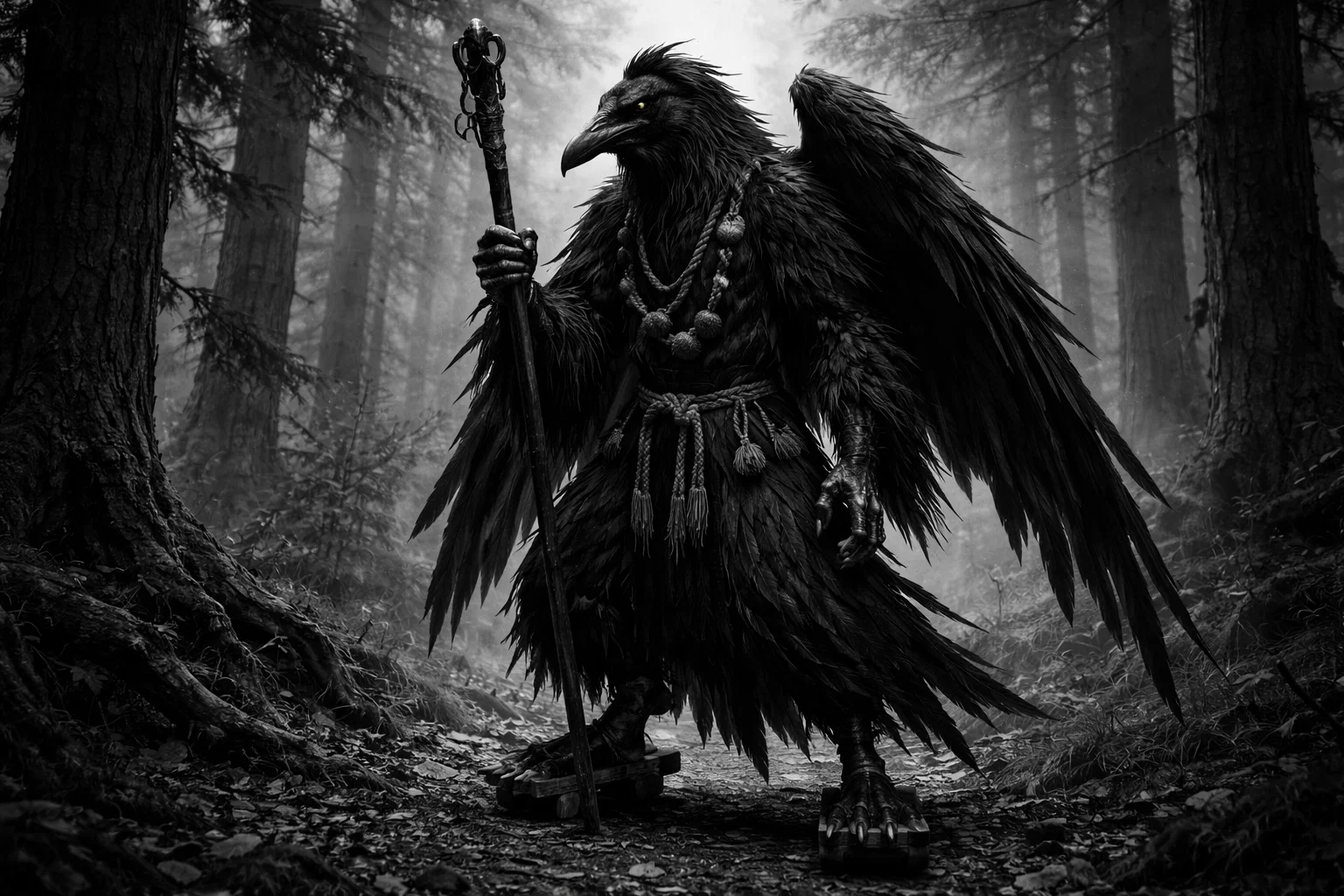

Tengu are legendary creatures from Japanese folklore, often shown as spirits or minor gods living in the mountains. At first, they were seen as troublemakers who brought war and chaos.
Still, over time, they became more complex, acting as both tricky troublemakers and protectors of sacred forests. Their mix of bird-like and human features has made them one of the most well-known figures in Shinto and Buddhist traditions.
Summary
Overview
| Attribute | Details |
| Name | Tengu |
| Alternative Names | Tiāngǒu, Amatsukitsune, Kotengu, Karasu-tengu, Konoha-tengu, Hanataka-tengu, Daitengu, Yamabushi-tengu |
| Similar Monsters | Garuda, Harpy, Siren, Thunderbird, Griffin, Raicho, Yatagarasu, Itsumade, Basan, Onmoraki, Kinnara, Gandharva, Phoenix, Simurgh, Roc, Anzu, Stymphalian Birds, Camazotz, Owlman, Mothman |
| Etymology | From Japanese ‘tengu’, derived from Chinese ‘tiāngǒu’ = celestial dog |
| Gender | Male |
| Classification | Yōkai, Kami |
| Species | Hybrid |
| Origin / Culture | Japanese (primarily Honshu, Shikoku, and Kyushu) |
| First Recorded | c. 720 CE – Nihon Shoki |
| Active Period | Always active |
| Diet | Rice, fish, sake, or metaphysical energy (spiritual corruption) |
| Habitat | High mountains, cedar forests, remote shrines |
| Powers & Abilities | • Shape-shifting into human or animal forms • Mastery of wind and weather • Telepathy and thought projection • Instantaneous movement (teleportation) • Skilled swordsmanship and martial arts |
| Weaknesses | • Spiritual seals and sutras • Offerings of mackerel • Ritual purity • Specific prayers to Fudō Myō-ō |
| Reproduction / Creation | Rebirth of arrogant priests, heretics, or warriors; occasionally born from giant eggs |
| Behavior | Solitary mountain ascetic and martial instructor |
| Pop Culture | D&D 5e Monster Manual (Kenku/Aarakocra influence) / “Touhou Project” / “Sekiro: Shadows Die Twice” / “Power Rangers: Zeo” (Tenga Warriors) / “Dead or Alive” (Nyotengu) |
Description
Tengu are supernatural beings that play an important role in Japan’s religious and cultural history. They are usually seen as yōkai (supernatural monsters) or kami (deities). They are said to live in remote forests and high mountains. Traditionally, people saw them as rivals to Buddhist monks, trying to lead them off course or interrupt religious ceremonies.
Over the years, people began to see Tengu less as evil demons and more as mountain hermits who punish the arrogant and help the humble. They are often linked to Shugendō, a religion that combines different beliefs and focuses on mountain practices.
People believe Tengu have a strict social order, with stronger Tengu leading the weaker ones. They are usually shown wearing the clothes of mountain priests (yamabushi) and carrying items like a feathered fan or a Buddhist staff.
Yokai and Supernatural Beings Hardcover Book – Up to 28% OFF!
Explore 100 authentic illustrations of Japan’s most haunting creatures in this premium 240-page volume. From ape-like hihi kidnappers to smirking hannya and shape-shifting bakeneko, drawn from rare historical sources including first-time reproduced monster parade scrolls. Curated by a leading authority on Japanese prints – an indispensable guide to yokai horror and folklore for altars, shelves, or spooky reading.
Etymology
The word “Tengu” uses Chinese characters meaning “celestial” (天) and “dog” (狗). It comes from the Chinese Tiāngǒu, a spirit or demon that looked like a barking dog and was blamed for eclipses. When this idea came to Japan in the 7th century, the name stayed the same, even though the creature’s appearance changed a lot from its dog-like roots.
In Japan, the meaning of Tengu changed from a “heavenly dog” to a bird-like spirit of the mountains. Even though the dog connection faded, the name stayed. Today, Tengu refers to two main types: the older, bird-like Karasu-tengu and the later, more human-like Daitengu.
How to Pronounce “Tengu” in English
In English, “Tengu” is usually pronounced as TEN-goo. The first part, “Ten,” rhymes with “pen.” The second part, “gu,” has a hard “g” and sounds like “goo” or the end of “taboo.” Most people stress both parts equally or put a little more emphasis on the first.
Appearance
A Tengu’s appearance changes with its rank and age. The oldest type, called Karasu-tengu (Crow Tengu), has a human-like body but the head, wings, and claws of a bird, usually a crow or black kite. They are often covered in feathers and have sharp beaks.
The stronger or more advanced Tengu is the Daitengu (Great Tengu). This type looks like a tall, muscular person with a very long, bright red nose. Even though their faces are more human, they still have large wings on their backs.
Both types usually wear the clothes of a mountain hermit, like a small black hat (tokin), a vest with pompoms (yuigesa), and wooden sandals (geta). They are almost always shown holding a hauchiwa, a fan made from seven or nine eagle or peacock feathers.
Powers & Weaknesses
Powers
Tengu are famous for their supernatural control over both the physical and spiritual worlds. Their main power is controlling the wind. With their feathered fans, they can create strong gusts that can pull up trees or make small tornadoes. They are also skilled shape-shifters and often turn into wandering priests, women, or animals to trick people.
Besides their physical powers, Tengu are known for their great skill in martial arts. They are seen as the best at using swords and staffs, and some legends say they taught famous warriors.
Their spiritual abilities include “Tengu-bi,” mysterious fireballs seen in the mountains at night, and “Tengu-kakushi,” the power to make people vanish for days or even years.
S. Petersen’s Field Guide to Lovecraftian Horrors Hardcover – Up to 24% OFF!
A beautifully crafted hardcover “field guide” to the terrors of the Cthulhu Mythos by RPG legend Sandy Petersen. Over 100 pages of exquisite full-color artwork depicting classic and obscure entities, with scientific-style entries on appearance, behavior, weaknesses, and distribution. Indispensable reference for Keepers, players, or anyone fascinated by eldritch horrors.
Weaknesses
Even though Tengu are powerful, they are weak against spiritual authority and purity rituals. Many people believe Tengu are the spirits of proud or fallen priests, so they are affected by the same Buddhist prayers and chants they once learned. Prayers to the deity Fudō Myō-ō are said to be especially good at controlling them.
Traditionally, Tengu are said to dislike certain foods and objects. Salt and mackerel are often mentioned as things that can keep them away or calm them down.
Because they follow a strict code of honor and rank, people can sometimes trick them by being very humble or by flattering them. In some areas, Tengu are also thought to be weak against iron, like other spirits of the wild.
Myths, Legends & Stories
The origin of the Tengu is embedded in a transformation of celestial phenomena into terrestrial spirits. In the year 637 CE, during the reign of Emperor Jomei, the Nihon Shoki records a massive shooting star streaking across the sky from east to west, accompanied by a thunderous roar.
The scholar-priest Minmin (also known as Bin) identified the object as a Tiāngǒu (Celestial Dog). During this formative period, Tengu were viewed as purely malevolent omens of war, resembling fire-streaked comets that presaged civil unrest.
As Buddhism’s influence expanded, the Tengu morphed into the “Great Opponent,” specifically targeting the clergy. They were believed to be the reincarnations of monks who had failed to abandon their worldly attachments and pride.
The Training of Minamoto no Yoshitsune
The most long-lasting narrative of Tengu intervention in human history involves the 12th-century hero Minamoto no Yoshitsune. While still a youth known as Ushiwaka-maru, he was sent to live at Kurama-dera temple in the mountains north of Kyoto.
Grief-stricken by the death of his father at the hands of the Taira clan, the boy wandered into the Valley of Sojo-ga-dani. There, he encountered Sōjōbō, the legendary King of the Tengu of Mount Kurama. Sōjōbō, described as a Daitengu with long white hair and a formidable red nose, took pity on the boy’s plight.
The Tengu king, along with a legion of Karasu-tengu, provided the boy with rigorous training in martial arts, strategy, and supernatural agility. The stories detail how the Karasu-tengu would swarm the boy with wooden swords, forcing him to develop the speed to dodge multiple attackers at once.
This training is credited for Yoshitsune’s later military genius and his legendary feat of defeating the giant warrior-monk Benkei on Gojo Bridge. To this day, the “Tengu of Kurama” remains a central monster in Japanese martial arts lore.
The Emperor Sutoku as a Great Tengu
A significant historical-mythological intersection occurs with the fall of Emperor Sutoku following the Hōgen Rebellion in 1156.
After his defeat and later exile to Sanuki Province, Sutoku spent his years in bitter resentment, reportedly biting his tongue and using his own blood to write sutras that cursed the imperial line. Legend states that he neglected his appearance, allowing his nails and hair to grow long until he took on the physical form of a Great Tengu.
After his death, it was believed he manifested as a powerful Daitengu to exact vengeance. Disasters that struck Kyoto in the following decades—including fires, plagues, and the deaths of high-ranking officials—were attributed to the “Tengu-Emperor.”
This story reinforced the belief that Tengu are often the spirits of those who died in a state of “Gaki-do” (the world of hungry ghosts) or “Ashura-do” (the world of constant war) due to their inability to let go of earthly grudges.
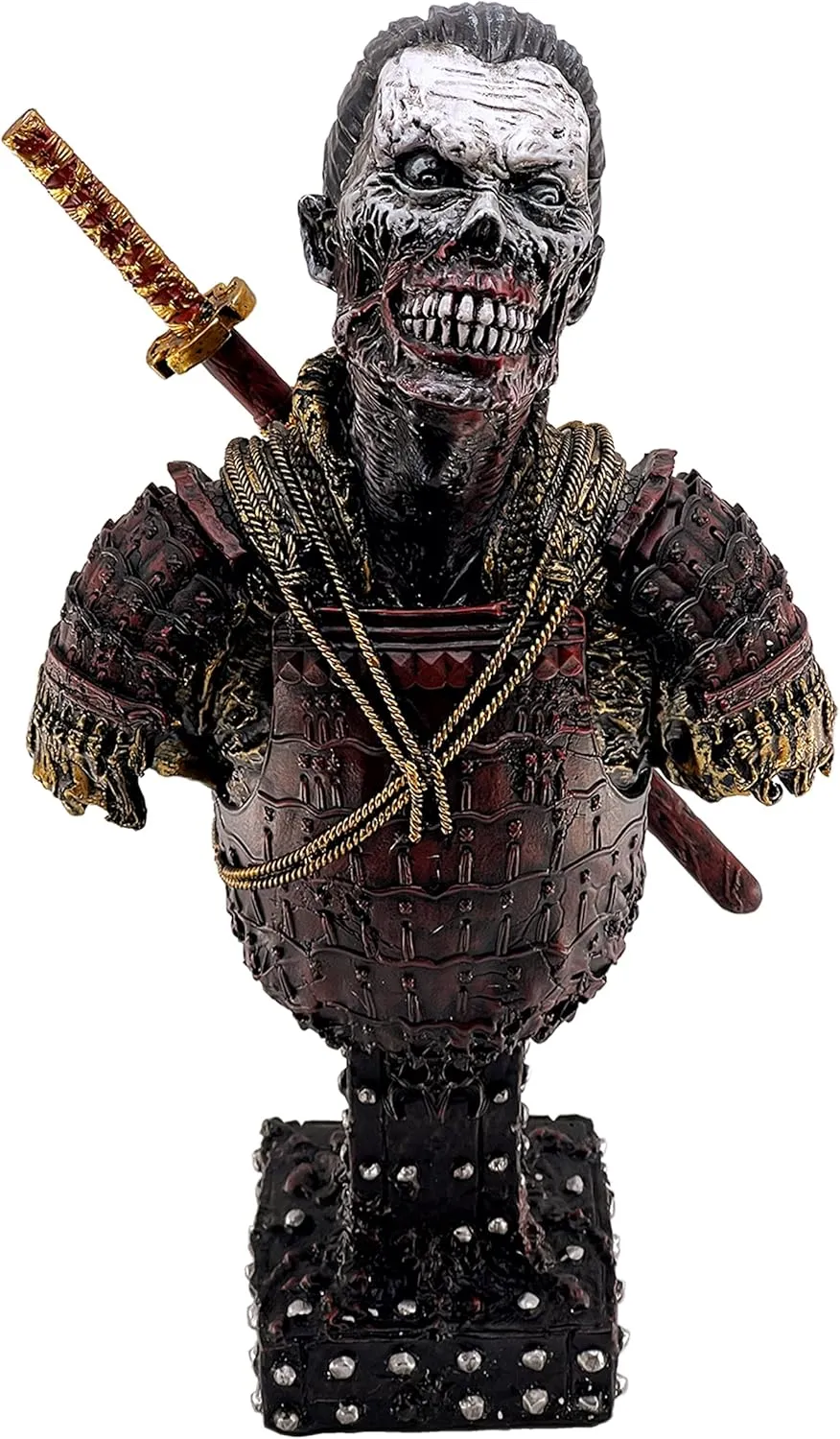
Undead Japanese Samurai Zombie – Limited Edition Resin Statue
Command attention with this intricately crafted Japanese-style Oni mask warrior sculpture from LOOYAR. Hand-painted resin/PU material captures the terrifying horns, fangs, and armored menace of the legendary demon guardian. Perfect for altars, shelves, desks, or gothic displays – a striking blend of folklore horror and samurai strength for home or office decor.
The Seven Tengu of Japan
In many regional traditions, the Tengu are not merely anonymous spirits but distinct, named entities ruling over specific mountain ranges. This group is often referred to as the Eight (or Seven) Great Tengu.
Each ruler is associated with a specific peak: Sōjōbō of Mount Kurama, Tarōbō of Mount Atago, Jirōbō of the Hira Mountains, Sanukibō of Mount Zōzu, Houbou of Mount Hiko, Buzenbō of Mount Mt. Kubote, and Sagamibō of Mount Ōyama.
One story about Tarōbō of Mount Atago describes him as a protector against fire. Despite their trickster nature, these Daitengu were eventually integrated into local Shinto practices as Gongen (Buddha’s avatars).
They were sought out by yamabushi ascetics who believed that by performing grueling mountain rituals, they could gain a portion of the Tengu’s wisdom and control over the elements.
The Tale of the Zazen-Tengu
The Konjaku Monogatarishū, a 12th-century collection of stories, contains numerous accounts of Tengu attempting to subvert Buddhist practitioners. In one important account, a Tengu disguised itself as a Buddha, appearing to a devout monk in a halo of light.
The monk was nearly deceived until a more senior and spiritually grounded priest noticed a slight irregularity in the “Buddha’s” shadow. By maintaining intense meditation and refusing to acknowledge the false vision, the priests forced the Tengu to reveal its true form—a large, wounded kite—which then fell from the sky.
The Abduction of Children (Tengu-kakushi)
Throughout the Edo period, numerous accounts were documented of Tengu-kakushi, or “hidden by a Tengu.”
Unlike Western changeling myths, these stories focused on the physical disappearance of children or young men. One factual record from the 1820s tells of a boy named Torakichi who claimed to have been taken by a “mountain man” (a Daitengu) and flown across the country.
According to Torakichi’s detailed account, which was recorded by the scholar Hirata Atsutane, the Tengu took him to other worlds and taught him about the cosmos. When Torakichi returned, he possessed knowledge of geography and medicine that a boy of his status should not have known.
While skeptics viewed these stories as evidence of mental illness or trauma, the cultural prevalence of the “Tengu-kidnapper” remained a common explanation for missing persons in mountainous regions for centuries.
The Kobura-Gaeri (Cramp of the Tengu)
In rural folklore, Tengu were often blamed for the physical ailments of those who disrespected the mountain. A common story involves a woodcutter who felled a sacred cedar tree without making a proper offering. That night, he was seized by “Kobura-gaeri”—violent, supernatural muscle cramps that contorted his body into bird-like positions.
The only cure, according to the legend, was to return to the stump of the tree and offer a specific prayer and a small amount of parched beans to the Tengu of that forest.
This narrative reinforced the Tengu’s role as the “Police of the Wilderness,” enforcing the boundaries between human civilization and the sacred forest.
Symbolism
Tengu are strong symbols of the risks of being too proud in spirit or mind. Since they are often said to come from the souls of proud scholars and priests, they symbolize the “ego” that blocks true enlightenment. At the same time, they also represent the wild and uncontrollable power of nature and the mountains.
Today in Japan, Tengu are seen more gently and often act as protective symbols for hikers and people who work in forests. Their long noses are now a sign of vanity, and the phrase “becoming a Tengu” is still used to talk about someone who is acting proud or boastful.
Can Tengu Be Defeated?
To defeat a Tengu, people believed you needed both spiritual strength and traditional protections. In old stories, the main way to keep Tengu away was to use sacred boundaries. Hanging shimenawa (special rice-straw ropes) around a house or shrine was thought to make a barrier that Tengu could not cross.
Travelers often carried amulets (ofuda) from mountain temples, especially those honoring the Gongen (deity forms), to avoid getting lost or “spirited away.” If a Tengu was causing problems, villagers would make loud noises, like banging pots or blowing conch shells, to distract the Tengu and send it back into the forest.
People also used certain plants and minerals for protection. Carrying a branch from a sacred tree or throwing salt was believed to clear away Tengu influence. In serious cases, professional exorcists or yamabushi were called to perform the “Kuji-kiri” (nine-hand-seal) ritual, which was supposed to bind the Tengu’s powers and compel it to leave.
In the end, legends say the best way to defeat a Tengu was to embarrass it by showing its vanity or by staying calm and humble in spirit.
Tags:
Related Monsters…
Akkorokamui (Ainu Monstrous Sea Kraken)
January 8, 2026
December 3, 2025
February 26, 2026
Amphisbaena (Greek Two-Headed Serpent)
January 20, 2026
February 3, 2026
