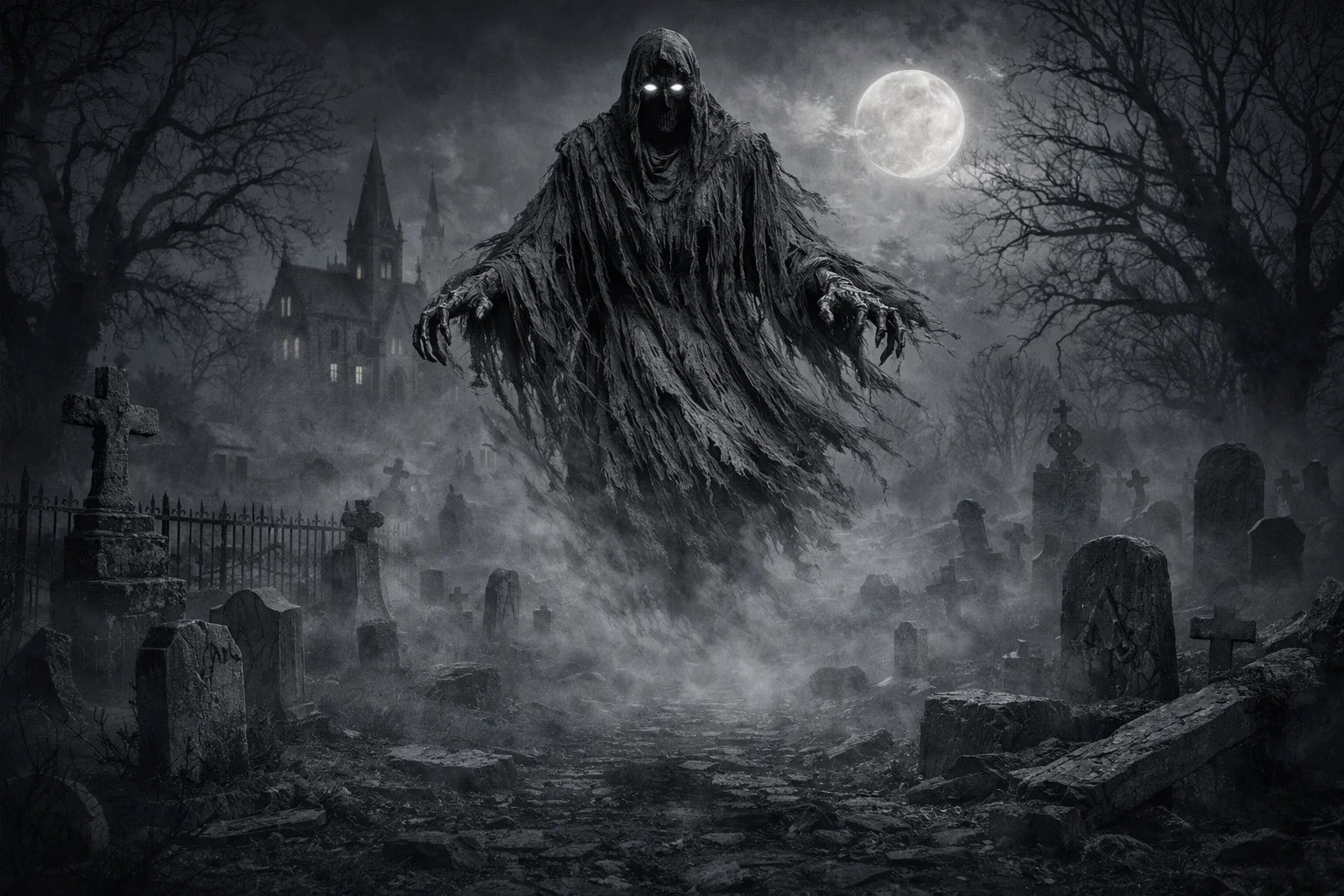

A Wraith is a type of undead being known for its ghostly form and hostility toward the living. Found in many European folk tales, it is usually seen as a sign of death or the restless spirit of someone who died violently or unfairly. Unlike ordinary ghosts, Wraiths are often shown as stronger, more dangerous spirits that try to drain the life from people they meet.
Summary
Overview
| Attribute | Details |
|---|---|
| Name | Wraith |
| Alternative Names | Wrethe, Wrayth, Werth, Warth, Warth-light, Swarth |
| Similar Monsters | Banshee, Wight, Nazgûl, Ghost, Phantom, Revenant, Draugr, Onryō, Poltergeist, Shadow Person, Lemure, Larvae, Strigoi, Dybbuk, Fetch, Dullahan, Grim Reaper, Bodach, Manes |
| Etymology | From Middle Scots “wraith” or “wrethe,” likely related to Old Norse “vörðr” meaning guardian or spirit. |
| Gender | Male, Female |
| Classification | Undead |
| Species | Spectral |
| Origin / Culture | Scottish and Northern English (British Isles) |
| First Recorded | c. 1513 – Gavin Douglas’s translation of the Aeneid (Eneados) |
| Active Period | Nocturnal / Always active |
| Diet | Life force |
| Habitat | Graveyards, ruins, battlefields, or locations of traumatic death |
| Powers & Abilities | • Invisibility • Intangibility • Life-draining touch • Fear induction • Flight or levitation |
| Weaknesses | • Silver weapons • Iron • Holy water • Sunlight • Exorcism rites |
| Reproduction / Creation | Arises from a soul experiencing a violent death, extreme grief, or a powerful curse. |
| Behavior | Solitary ambush predator |
| Pop Culture | D&D 5e Monster Manual, “The Lord of the Rings” (Nazgûl), “The Witcher 3: Wild Hunt,” “Supernatural” (TV Series), “Stargate Atlantis” |
Description
A Wraith is a ghostly, undead being that exists between the physical world and the spirit world. Unlike other spirits, it is known for being aggressive and for affecting the physical world even though it has no solid form. In the past, people often linked Wraiths to the idea of a ‘double’ or ‘fetch’—a ghostly version of a living person that warned of their coming death.
Today, Wraiths are seen as conscious beings made of negative energy. Unlike zombies, which act without thought, or vampires, which crave blood, Wraiths are motivated by a wish to end life. They usually haunt places connected to their past or spots where the boundary between life and death is believed to be weak.
The Mythical Creatures Bible. Flash Sale – Up to 23% OFF!
This beautifully designed paperback is the ultimate reference to legendary beings across history and cultures: From Biblical leviathans and behemoths to Asian kitsune, European fae, African tricksters, and ancient chimeras. Alphabetical entries with vivid illustrations, cultural context, and fascinating facts – essential for witchy libraries, ritual symbolism, or creature design inspiration.
Notable Wraiths in History and Lore
| Wraith Name | Location | Brief Overview |
| The Fetch | Ireland | A classic Irish double or spectral shadow of a living person. Seeing it in the morning portends a long life, but a nighttime sighting is a definitive omen of the person’s immediate death. |
| The Co-Walker | Scottish Highlands | Documented by Robert Kirk in 1691, these are invisible doubles that follow people and mimic their actions. They are said to be seen only by those with “Second Sight.” |
| The Swarth | Cumberland, England | A regional variation of the wraith described as a “shadow” of a person. It is often seen by neighbors or friends just moments before the actual individual suffers a fatal accident. |
| The Nazgûl | Middle-earth (Literary) | Nine human kings who succumbed to the corruption of the Rings of Power. They faded into permanent wraiths, visible only as robed shadows unless viewed by those in the spirit realm. |
| The Bodach | Scotland | An old, withered wraith often associated with specific clans. Its appearance, usually near a hearth or doorway, signals a coming tragedy or death within the household. |
| The Lacedaemonian Wraith | Ancient Sparta | The spirit of Pausanias, a Spartan general who was starved to death in a temple. His wraith was said to haunt the sanctuary so fiercely that necromancers were called to appease it. |
| The King of Terrors | European Folklore | A personification of the wraith as a skeletal, robed entity. Unlike a standard ghost, it is viewed as an active predator that harvests the vitality of the living. |
| The Churchyard Grim | Northern Europe | A spectral guardian—often the wraith of the first person buried in a cemetery—tasked with protecting the souls of the dead from the Devil. |
Etymology
The word ‘wraith’ came into English from Middle Scots. It first appeared in the early 1500s in Gavin Douglas’s translation of Virgil’s Aeneid, the Eneados, where it described a ghost or phantom.
Some language experts think ‘wraith’ may come from the Old Norse word ‘vörðr,’ meaning ‘guardian’ or ‘watcher,’ hinting at a spirit that watches over someone. Others suggest Old High German roots, but most agree that Scots-Gaelic influence best explains how the word now refers to a vengeful or prophetic spirit.
How to Pronounce “Wraith” in English
In English, ‘Wraith’ is pronounced as one syllable: /reɪθ/. The ‘W’ is silent, so it starts with an ‘r’ sound. The ‘ai’ makes a long ‘a’ sound, like in ‘ray,’ and it ends with the ‘th’ sound, as in ‘thick.’ It rhymes with ‘faith’ and ‘eighth.’
Appearance
A Wraith usually has no solid shape. It often looks like a human entity made of moving mist, smoke, or shadow. Most stories say it wears torn, dark robes or shrouds that float behind it, even when there is no wind.
A Wraith’s face is often hidden or missing. Sometimes, it has a hollow space or a pale, skull-like mask instead. If eyes are seen, they are usually described as glowing with a faint, cold light—often blue, white, or red—that stands out in the darkness.
If you can see its hands, they look long and claw-like, sometimes see-through, or just bones. The lower part of a Wraith often fades away, and it rarely touches the ground.
Powers & Weaknesses
Powers
Wraiths have several supernatural powers that help them hunt the living. Their main ability is to become intangible, so they can move through walls and doors. They can also turn completely invisible, often only noticed when the air suddenly gets much colder.
The Wraith’s most dangerous power is its ‘energy drain.’ When it touches someone, it can steal their life force or even their soul. Victims usually feel an intense, unnatural cold and quickly grow weak.
A Wraith’s presence can also cause strong, irrational fear, sometimes freezing people in place or making them run away. Some stories say Wraiths can move small objects or put out lights to scare their victims.
Weaknesses
Even though Wraiths are powerful, they have some well-known weaknesses. Sunlight can weaken them or make them disappear. Sacred objects and holy ground keep them away, and holy water burns them if it touches their ghostly form.
Certain metals can also keep Wraiths away. Cold iron is thought to break up their ghostly form, and silver is said to actually hurt them. Wraiths are often tied to the world by unfinished business or a special object, so destroying that link or performing an exorcism can get rid of them for good.
Myths, Legends & Stories
Wraiths are said to appear when a soul moves from the physical world to the spirit world, often after great emotional or physical pain. In early British Isles traditions, Wraiths did not rise from graves but from the shadow of death itself.
People believed that when a major tragedy was about to happen, a person’s soul could appear in advance as a silent, see-through double. This Wraith did not talk or act, but its presence warned that the person was already doomed by supernatural forces.
Over time, especially in the Highlands and northern England, these warning spirits grew more dangerous, becoming the harmful, life-draining Wraiths known in later stories.
Sketching from the Imagination: Creatures & Monsters Paperback – Up to 32% OFF!
Unleash your dark creativity with this 320-page paperback from 3dtotal Publishing, packed with hundreds of original creature and monster sketches from over 50 professional fantasy artists. Raw concept art, developmental drawings, and imaginative beasts ranging from dragons and demons to eldritch horrors – ideal for artists seeking inspiration for character design, RPG creatures, or spooky illustrations.
The Omen of the Double
In one of Scotland’s most persistent oral traditions, a young man was walking toward his home at dusk when he encountered himself standing on a narrow stone bridge. The entity wore the same wool cloak and carried the same walking stick, but its face was cast in a grey, sickly pallor.
The man attempted to greet his likeness, but the entity remained motionless, its eyes fixed on the rushing water below. When the man reached out to touch the double’s shoulder, his hand passed through cold mist, and the creature vanished. Shaken, the man returned home only to find that he had developed a sudden, localized frostbite where his hand had entered the apparition.
By the next sunset, he had succumbed to a fever that left his body as cold and grey as the spirit he had met. This legend reinforced the belief that the Wraith is the soul’s precursor, arriving to claim the space the living body will soon vacate.
The Warth of the Northern Fells
In the Cumberland region of England, the creature was often referred to as a “Warth” or “Swarth.” Local accounts tell of a farmer who was seen by several neighbors working in his fields at midday, even though he was miles away at a livestock market. The neighbors noted that the entity worked with an unnatural, fluid speed and never once looked up to acknowledge the sun.
When the farmer returned that evening, he was met with looks of horror; his neighbors explained they had watched his “Warth” vanish into the earth at the stroke of noon. Realizing his time was short, the farmer spent his final hours settling his debts.
He died in his sleep that night, and legend says that for years afterward, a dark, hooded shape could be seen tilling those same fields on the anniversary of his passing, unable to find rest because it had manifested while he was still clinging to life.
The Spirit of the Coffin Path
In rural European folklore, certain trails known as “church ways” or “coffin paths” were used exclusively for transporting the dead to consecrated ground. It was said that if a funeral procession was interrupted or if a body was dropped, a Wraith would rise from the spot of the accident.
One story details a winter funeral where the pallbearers slipped on a patch of ice, causing the casket to strike the frozen ground. From that moment on, a “Shrouded Wraith” was said to haunt that specific bend in the path. It did not merely appear as an omen but acted as a vengeful sentinel.
Local travelers claimed that the entity would glide alongside them, its heavy funeral shroud dragging across the snow, leaving no tracks. Those who looked directly into the shadow of its hood were said to lose their “inner light,” falling into a permanent state of melancholy until they eventually wasted away.
The Watcher of the Battlefield Cairn
Following the Battle of Culloden, stories spread of Wraiths that rose not from individuals, but from the collective agony of the fallen. Highland tradition speaks of a “Cairn Wraith”—a tall, thin entity composed of the smoke and soot of the battlefield. It was said to haunt the mounds of stones raised over the mass graves.
Unlike common ghosts that might wander, this spirit was anchored to the site of its violent end. One account tells of a scavenger who attempted to steal a silver brooch from a burial cairn under the cover of a new moon. As his hand touched the metal, a frigid wind erupted from the stones, and a dark, elongated shape rose from the earth.
The scavenger was found the next morning with his hair turned white as bone; he claimed the entity had reached into his chest and “extinguished his warmth.” He survived, but he never felt the heat of a fire again for the rest of his life.
The Faded Kings
In the most influential fictional expansion of the myth, the Wraith is portrayed as an ancient being of immense power that has “faded” into the unseen world. These were once great rulers who were gifted with rings of power that granted them long life and invisibility. However, the price of this unnatural longevity was the total erosion of their physical bodies.
Over centuries, they became neither living nor dead, existing only as shadows of their former selves. They were bound to the will of a dark lord, appearing to the world as riders in black robes to hide the fact that there was no flesh beneath the cloth. This narrative transformed the Wraith from a localized folklore omen into a global symbol of the corrupting nature of power and the eternal servitude of those who try to cheat the natural cycle of death.
NECA Collectible Texas Chainsaw Massacre Ultimate Leatherface
Horror masterpiece from NECA: 7” articulated Leatherface with swappable heads (terrifying masks and expressions), chainsaw with sound potential in pose, hammer, meat hook, and extra hands for dynamic displays. Authentic film-accurate detailing in a collector-friendly window box – perfect for witchy altars or creepy collections.
Symbolism
The Wraith mostly represents the idea that death is certain and the past can stick with us. It also stands for the ‘shadow self’ and the fear that someone’s actions or pain might last even after they’re gone.
While a ghost might represent memory or sadness, a Wraith shows the more active and consuming side of death. In stories, it often stands for ‘wasting,’ which is the slow loss of health, hope, or sanity.
Can a Wraith Be Defeated?
To defeat a Wraith, people use both physical barriers and spiritual help. Since the Wraith has no heart or brain, fighting it directly does not work. Protection often starts with ‘barrier’ items. For example, salt is a common folk remedy used to make lines that spirits cannot cross. Carrying a piece of ‘rowan wood’ or ‘cold iron’ is also believed to protect against the Wraith’s draining touch.
To truly get rid of a Wraith, people often need to deal with the reason it appeared. This might mean finding the remains of the person the Wraith once was and giving them a proper burial or cremation. If a curse is involved, breaking the curse—often by doing something just or destroying a cursed object—is needed.
In tougher situations, people use silver-bladed weapons or weapons marked with protective runes to weaken the Wraith until it disappears. Amulets made of obsidian or black tourmaline are also mentioned in modern traditions as ways to absorb the Wraith’s negative energy and protect the wearer’s strength.
How to Prevent a Person from Turning into a Wraith
In old European folklore, especially in the Scottish Highlands and northern borderlands, the time right after a violent or sudden death was seen as very risky for the soul. People believed that if certain rituals were not done, the soul might not leave and could become a Wraith. These rituals were meant to either confuse the spirit, keep it at the grave, or help it move on so it would not come back to harm the living.
The Rite of the Sin-Eater
One well-known practice was hiring a ‘Sin-Eater’ to stop a vengeful spirit from appearing. If someone died suddenly and could not confess, people would put a piece of bread and a bowl of ale on the person’s chest.
A chosen person would eat the food, which symbolized taking on the dead person’s unconfessed sins and attachments. By doing this, the Sin-Eater made the soul too ‘light’ to stay as a heavy, shadowy Wraith, breaking its tie to the world.
The Lying-in-State and the “Saining”
To stop a Wraith from appearing during the wake, people performed the ‘saining’ ritual. An elder would carry a burning torch of Pine or Rowan wood three times around the body, moving clockwise.
Rowan was chosen because its berries have a small five-pointed star on the end, which folklore says is a sign of divine protection. This symbol was believed to stop spirits from entering the physical world.
The smoke from Pine, seen as a sign of purification and the ‘breath of the forest,’ was thought to create a temporary barrier. This barrier protected the spirit from the ‘Evil Eye’ or evil forces that could turn it into something harmful.
At this time, people covered all mirrors in the house with black cloth. They believed that if the soul saw its own reflection, it might become fascinated and refuse to leave, eventually turning into a permanent Wraith in that place.
The Corpse-Door and Path Obstruction
When someone was executed or murdered, and the risk of a Wraith was highest, the body was often taken out of the house through a ‘corpse-door,’ which was a hole made in the wall instead of using the main door.
After the body was taken out, the hole was quickly sealed. People thought that if the spirit tried to return as a Wraith, it would not find a way in. On the way to the cemetery, the group would also cross running water, since spirits were believed to be unable to cross streams or rivers.
To add extra protection, mourners would scatter Elder leaves along the path. Elder was considered a ‘witch’s wood,’ but its leaves were used in burials to ward off evil spirits. The strong smell was thought to repel spirits, even if they could not smell in the usual way.
The Use of Iron and Rowan in the Shroud
When preparing the body for burial, people would sew protective items into the shroud or put them in the coffin. A small ‘iron nail’ or ‘cold iron’ coin was placed in the person’s hand to weigh down the spirit, since pure metal was thought to harm spirits. A sprig of Rowan tied with red thread was also placed over the heart.
The red thread stood for the blood of life, and the rowan meant divine protection. Together, they acted as a spiritual anchor. In some places, people also put Wormwood (Artemisia absinthium) into the coffin pillows.
This very bitter herb was used to keep away ‘sour’ spirits. People believed its bitterness would stop the soul from staying in the ‘sweet’ memories of life, making it move on to the afterlife instead of becoming a bitter Wraith.
The “Waking of the Well”
In some coastal areas, if someone drowned—a death thought likely to create a Wraith because there was no grave—family members would gather at the nearest holy well. They would pour milk or wine into the water, call the person’s name, and throw in Hazel branches.
Hazel was important in Celtic stories as the ‘Tree of Wisdom’ and was believed to bind spirits to certain places. By throwing Hazel into the well, the family tried to give the drowned person’s spirit a resting place, so it would not wander the shore as a ‘Sea-Wraith’ looking for warmth.
Tags:
Related Monsters…
December 9, 2025
Aswang (Philippine Vampire Shapeshifter)
January 14, 2026
Amphisbaena (Greek Two-Headed Serpent)
January 20, 2026
February 3, 2026
Black Annis (Blue Hag of Leicestershire)
February 18, 2026
