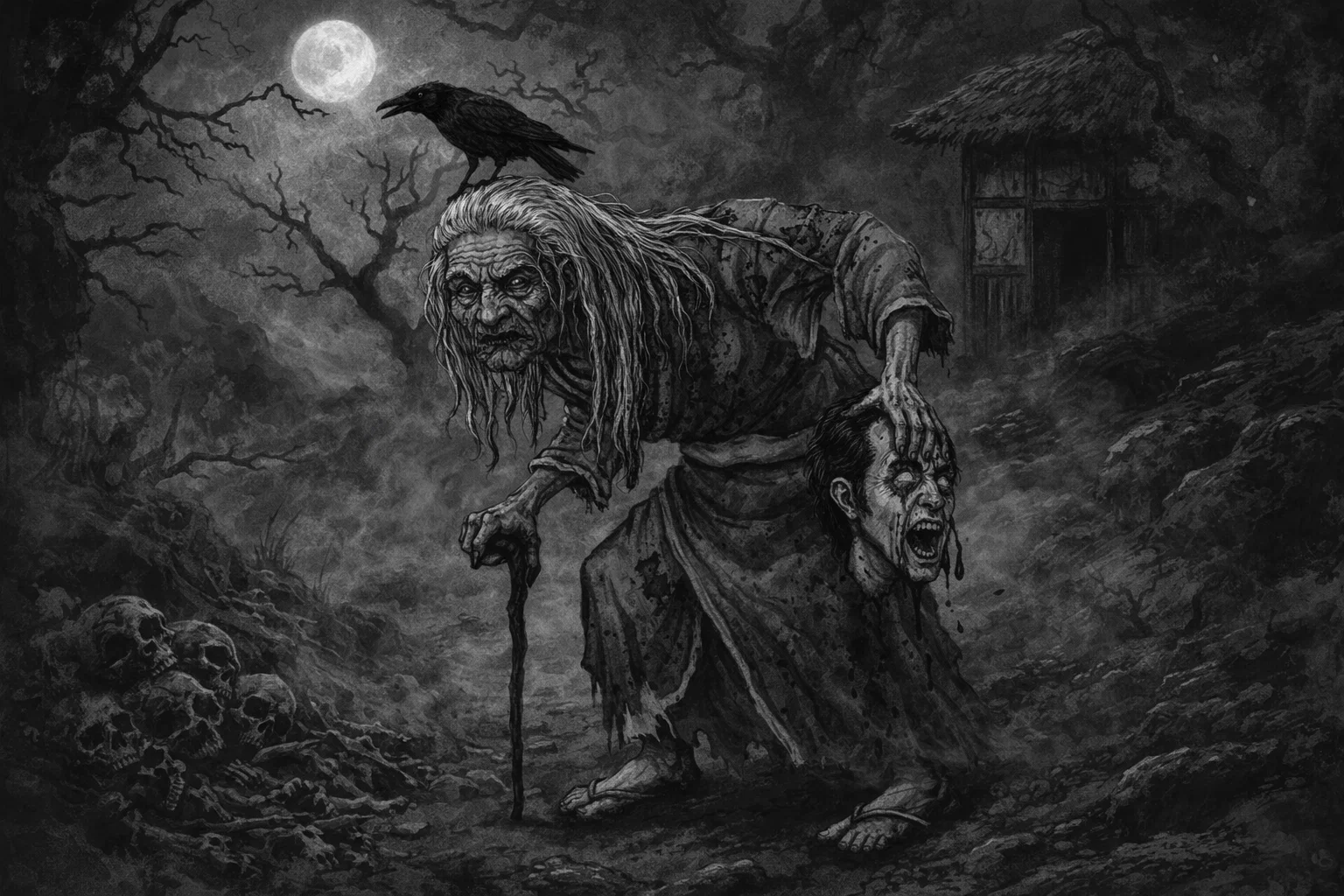

Yamauba is a powerful monster in Japanese folklore, usually shown as an old woman living in remote mountains. She stands out among supernatural beings, sometimes appearing as a frightening man-eater and other times as a caring mother.
Her reputation for living alone and being tricky has made her one of the most lasting yōkai. Stories and plays about her still stir both fear and curiosity about the dangers that might be hiding in the wild.
Summary
Overview
| Attribute | Details |
| Name | Yamauba |
| Alternative Names | Yamamba, Yamanba, Onibaba, Kome-ku-Baba |
| Similar Monsters | Baba Yaga, Black Annis, Gryla, Cailleach, Berchta, Morra, Lamia, Hecate, Rangda, Jenny Greenteeth, Empusa, Mormo, Gello, Sycorax, Yama-chichi, Yuki-onna, Ohaguro-bettari, Futakuchi-onna |
| Etymology | Japanese: ‘Yama’ (mountain) + ‘Uba’ (old woman/wet nurse) |
| Gender | Female |
| Classification | Yōkai |
| Species | Humanoid |
| Origin / Culture | Japanese (primarily Honshu and Kyushu mountains) |
| First Recorded | c. 14th century CE – Noh plays (e.g., ‘Yamba’ by Zeami Motokiyo) |
| Active Period | Always active / Nocturnal |
| Diet | Human flesh, livestock, and travelers |
| Habitat | Remote mountain huts, caves, and deep forests |
| Powers & Abilities | • shape-shifting into a kind old woman • flight/levitation • expert weaving and sewing • control over weather/storms • mountain-walking speed |
| Weaknesses | • fire/burning • prayers and Buddhist sutras • ginger (in some regional lore) • iron or sharp blades |
| Reproduction / Creation | Transformed human women who fled to the mountains or were abandoned |
| Behavior | Solitary ambush predator and occasional benevolent guardian |
| Pop Culture | ‘Pokémon’ (Jynx design), ‘Spirited Away’ (Zeniba/Yubaba), ‘Muramasa: The Demon Blade’, ‘Shin Megami Tensei’ series |
Description
Yamauba is a supernatural being who lives on the edge of human society. She is a type of yōkai, often described as an ogress or old woman who makes her home deep in Japan’s mountains. Unlike other spirits that visit villages, she prefers to stay alone in simple huts or caves far from people.
People most often meet Yamauba when they are lost in the mountains, such as travelers, hunters, or woodcutters who wander too far.
In stories, she has two sides: she is usually feared as a predator who tricks people to their deaths, but in some places, she is also seen as someone who brings fertility and hidden wisdom.
Yamauba stands for the wild and sometimes deadly power of nature, acting as a link between the human world and the spirit world.
Ultimate Family Co-op Adventure – Horrified: Universal Monsters
Ravensburger’s acclaimed co-op Horrified Board Game masterpiece: Defend against Dracula, The Mummy, Invisible Man, and other icons in a beautifully themed village. Tactical pick-up-and-deliver gameplay, escalating tension, and endless variety. Ideal gateway game for families & friends, 1-5 players, 10+, with 4.8/5 star rave reviews.

Etymology
The name Yamauba comes from two Japanese kanji. The first, yama (山), means “mountain.” The second, uba (姥), means “old woman,” “crone,” or sometimes “wet nurse.” Together, the name means “Mountain Crone.”
In some rural mountain areas, people shorten the name to Yamamba or Yamanba. The roots of the word suggest that Yamauba is not just from the mountains, but also shows the mountain’s old and caring side.
In the past, the word uba also meant “someone who takes care of others,” which fits with stories in which Yamauba acts as a foster mother to heroes.
How to Pronounce “Yamauba” in English
In English, Yamauba is pronounced yah-mah-OO-bah. The first two parts, “yah” and “mah,” both rhyme with “spa.” The “OO” sounds like the “oo” in “moon.” The last part, “bah,” usually rhymes with “raw” or “spa,” but the flat “ah” sound is closest to the Japanese pronunciation.
Appearance
Yamauba usually appears as an old woman with some hard to ignore and eerie features. Her hair is long, messy, and white or light gray, often hanging wildly around her shoulders. Her skin looks weathered and wrinkled, and is sometimes shown as yellowish or pale.
One of her most noticeable features is her mouth, which is often said to stretch from ear to ear and is filled with sharp, jagged teeth made for eating large amounts of food.
In some stories, Yamauba has a second mouth hidden under her hair on the top or back of her head. She uses this mouth to eat while her main mouth stays closed. She usually wears old, dirty clothes, often a kimono that is worn out from the weather. Even though she looks old, she is tall and strong, showing that she is much more powerful than she seems.
Powers & Weaknesses
Powers
Yamauba has many supernatural powers connected to the mountains where she lives. Her main ability is metamorphosis, so she can look like a beautiful young woman or a helpless old lady to trick travelers. She can also move very quickly over rough mountain ground, sometimes seeming to glide or fly over the slopes.
Yamauba is also closely linked to crafts like weaving. She can make fine silk or cloth incredibly fast. People say she can control the weather, calling up mist or storms to confuse anyone who enters her area. In some stories, she can stretch her arms or her hair to catch people from afar.
Weaknesses
Even though Yamauba is powerful, she has some well-known weaknesses. She is very vulnerable to fire, and many stories tell of her being defeated by being pushed into a boiling pot or a hot fireplace. Religious items, especially Buddhist sutras and charms called ofuda, can keep her away or stop her from moving.
In some local stories, Yamauba is also weak against things like ginger or the sound of a temple bell. Since she depends on tricking people, her magic often fails if someone sees through her disguise in time. Some tales say she gets weaker if she is brought down from the mountains into towns or cities.
Enchant Your Space with Witchy Gothic Posters – Up to 40% OFF!
Transform your bedroom into a creepy dark sanctuary with this vintage gothic wall art set from 97 Decor. Unframed prints featuring spooky witch pictures, horror goth aesthetics, Halloween motifs, and moody occult vibes. Premium quality posters perfect for creating a haunting witchy room decor gallery – ideal for empaths, goths, and Halloween lovers.
Myths, Legends & Stories
Origins
The story of Yamauba comes from both supernatural beliefs and the sad parts of old Japanese life. One common idea is that the first Yamauba were once real women.
In times of famine or poverty, some villages practiced ubasute, where they took elderly people to the mountains and left them there so younger people would have more food.
Legends say that these abandoned women did not always die. Instead, their anger, loneliness, and strong will to live turned them into yōkai. Over time, these women became the mountain ogresses of legend, driven by a hunger for revenge against the society that left them behind.
The Legend of Kintarō
The best-known story about Yamauba is the tale of Kintarō, the “Golden Boy.” In this legend, Yamauba is not a villain but acts as a foster mother. Kintarō was the son of a noblewoman who escaped to Mount Ashigara. After she died, a Yamauba found the baby and raised him in the wild.
With her help, Kintarō grew very strong, able to wrestle bears and talk to animals in the forest. In this story, Yamauba is shown as a wild but caring mother figure, teaching the boy about the mountains before he leaves to become the famous samurai Sakata no Kinto.
The Adachigahara Ogress
A darker and more traditional tale is that of the Ogress of Adachigahara.
In this story, a traveling priest looks for shelter and finds a lonely hut on the moor. An old woman welcomes him and is kind, but she warns him not to look in the back room while she goes out for firewood. The priest’s curiosity gets the better of him, and he peeks inside, only to find a pile of human bones.
When he realizes the old woman is a Yamauba, the priest runs away. She turns into a terrifying monster and chases him all night. He is saved only when he recites strong Buddhist prayers, which bring a divine light that defeats her and shows her true, pitiful form before she disappears.
The Weaver’s Boon
In some country stories, Yamauba is seen as a “Work-Bringer.”
One common tale tells of a poor family or a hardworking young weaver who meets an old woman in the woods. Instead of being dangerous, this Yamauba offers to help with chores or weaving. She works all night at an amazing pace, making cloth that brings the family a lot of money.
But her kindness always comes with a strict rule, like never watching her while she works. When someone breaks this rule, Yamauba disappears forever, sometimes taking the family’s good fortune with her.
Yokai and Supernatural Beings Hardcover Book – Up to 28% OFF!
Explore 100 authentic illustrations of Japan’s most haunting creatures in this premium 240-page volume. From ape-like hihi kidnappers to smirking hannya and shape-shifting bakeneko, drawn from rare historical sources including first-time reproduced monster parade scrolls. Curated by a leading authority on Japanese prints – an indispensable guide to yokai horror and folklore for altars, shelves, or spooky reading.
Symbolism
Yamauba is a complicated symbol of the “other” in Japanese culture. She stands for the fear of the unknown wild and the risks of leaving the safety of society.
On a deeper level, she is the “Devouring Mother” type—someone who can give life, like with Kintarō, but also take it away as a man-eater. Yamauba shows the two sides of the mountains: they give people things like wood and water, but also hide dangerous animals and rough land.
Can Yamauba Be Defeated?
To defeat Yamauba, people need both spiritual strength and cleverness. In many old stories, the main way to stay safe is to use sacred places.
Travelers thought that staying near a roadside shrine, called a hokora, or carrying a blessed amulet from a temple would keep Yamauba away. If she got into a house, people would use the sound of a wooden clapper or a bell, since the steady, man-made noise was believed to bother her wild spirit.
If people have to face Yamauba directly, they often use fire or clever tricks. Since she likes to lure people into her home, the best way to fight back is to use her own traps against her. This might mean hiding in the rafters and dropping something heavy on her, or tricking her into a big hot bath. If Yamauba is a spirit, a high-ranking priest is needed to perform an exorcism.
One of the most lasting ways to protect yourself, according to folklore, is to show kindness. Sometimes, treating Yamauba with real respect and without fear can turn her from an enemy into a short-term friend, though this is risky.
Tags:
Related Monsters…
Asanbosam (West African Forest Monster)
January 23, 2026
January 12, 2026
Black Annis (Blue Hag of Leicestershire)
February 18, 2026
Abominable Snowman (Himalayan Beast)
December 1, 2025
Aswang (Philippine Vampire Shapeshifter)
January 14, 2026
