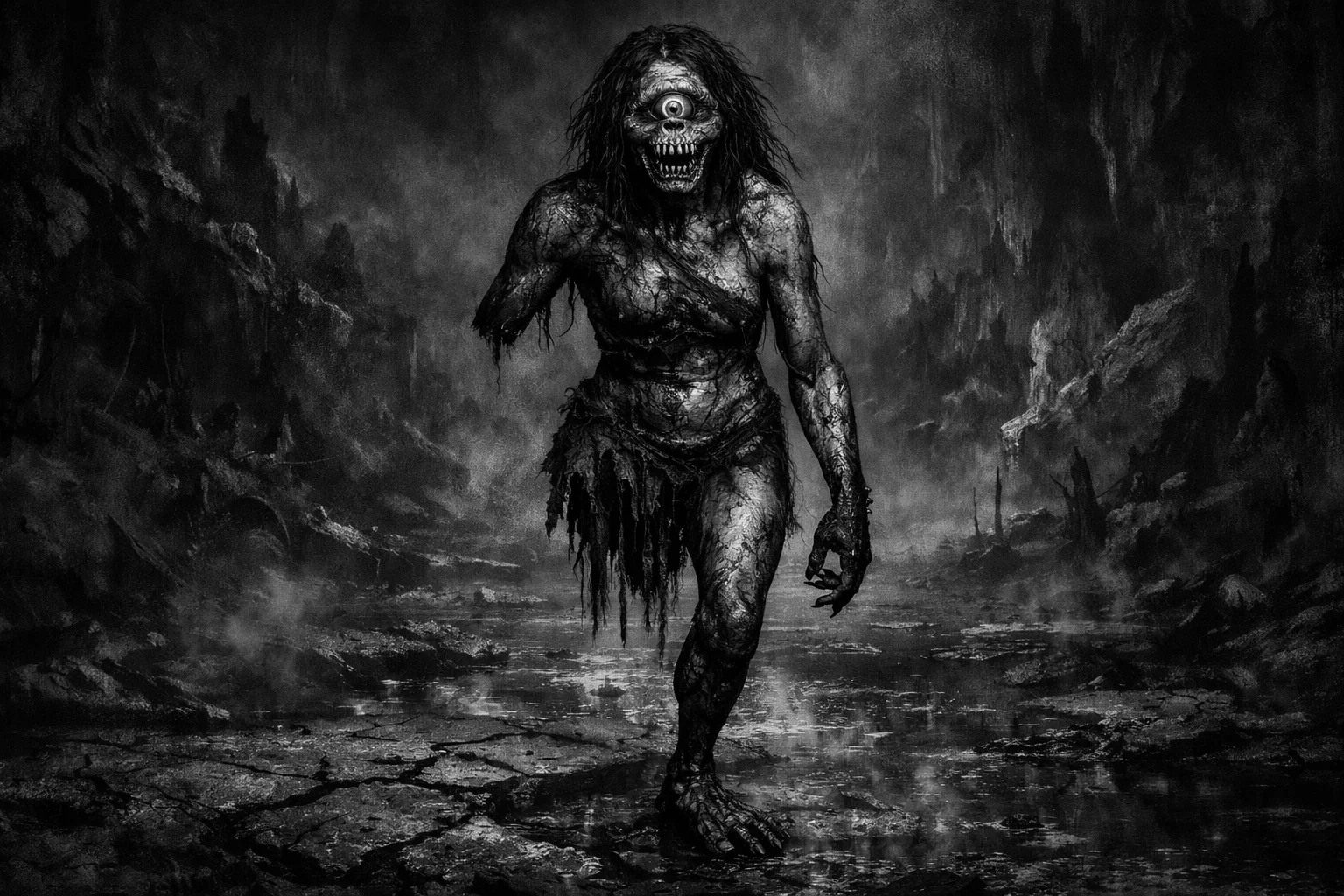

Abaasy are a “class of demons” in Yakut shamanism who live in the underworld, a realm of darkness. They have one eye, one arm, and one leg, and ride fearsome dragons while serving the ruler of the dead. These demons can bring disease and destruction to the Middle World, preying on both human and animal souls.
Summary
Overview
| Attribute | Details |
| Name | Abaasy |
| Alternative Names | Abassy, Abaahi, Abasylar (plural), Abacy |
| Similar Monsters | Oni, Rakshasa, Daeva, Div, Asura, Ghoul, Wendigo, Draugr, Jinn, Pretaloka, Hungry Ghost, Dybbuk, Alu, Utukku, Edimmu, Gallu, Keres, Vetala |
| Etymology | From the Turkic root ‘abas’ or ‘abacy’ meaning ‘evil spirit’ or ‘malevolent deity’. |
| Gender | Male, Female |
| Classification | Demonic Entity |
| Species | Humanoid / Hybrid |
| Origin / Culture | Sakha (Yakut) culture; modern-day Sakha Republic, Russia. |
| First Recorded | c. 10th–15th Century CE – Olonkho oral epic traditions. |
| Active Period | Always active (most potent at night). |
| Diet | Human souls, life force, and blood. |
| Habitat | The Lower World (underworld) and desolate Siberian wilderness. |
| Powers & Abilities | • Shapeshifting into natural phenomena, birds, animals, fish, and insects • Inducing madness and sexual manifestations • Soul consumption • Disease spreading • Dragon riding • Resurrection from remains • Voice mimicry |
| Weaknesses | • Iron weapons • Fire • Shamanic intervention • Specific protective herbs • Sacrificial offerings |
| Reproduction / Creation | Spawned by Arson Duolai (ruler of the underworld) or born from blood-red stones. |
| Behavior | Solitary or tribal predators that hunt human spirits. |
| Pop Culture | Final Fantasy (various entries), Shin Megami Tensei, Pathfinder RPG, Olonkho (UNESCO heritage performances) |
Description
Abaasy are demons from the mythology of the Sakha people (also called the Yakuts), who live in northeastern Siberia, Russia. In Yakut shamanism, the universe has three layers: the upper world of good spirits, the middle world where people live, and the lower world, or underworld. These demons allegedly live in this lowest realm, known as the kingdom of darkness.
According to the myths, these demons are the spirits of people who died long ago and became corrupted after staying near graves or abandoned places. They serve Arsan Duolai, the underworld god who eats souls and brings disease to the living.
The Abaasy are organized into nine clans, all led by the demon Ulu Tojon, whose name means “Powerful Lord.” Their second-in-command is Alyp Khara Aat Mogoidoon, a giant with three heads, six arms, and six legs, whose body is made of iron.
Sketching from the Imagination: Creatures & Monsters Paperback – Up to 32% OFF!
Unleash your dark creativity with this 320-page paperback from 3dtotal Publishing, packed with hundreds of original creature and monster sketches from over 50 professional fantasy artists. Raw concept art, developmental drawings, and imaginative beasts ranging from dragons and demons to eldritch horrors – ideal for artists seeking inspiration for character design, RPG creatures, or spooky illustrations.
Etymology
The name Abaasy comes from the Sakha word “abaasi,” which means “black.” This shows their link to the dark underworld and their role as beings of shadow and evil. The word is related to the Turkic word albastı, showing connections with other Turkic cultures.
Multiple transliterations exist across different languages and regions. In Dolgan, the name appears as Abaahı. At the same time, Bulgarian renders it as Abaasi, Russian as Abasy, Azerbaijani and Turkish as Abası, and Hungarian as Abaaszi. The alternative name Chebeldei also appears in some sources.
The root of the word highlights the strong link between these demons and darkness, both in a real and symbolic sense. In Yakut shamanism, black stands for the lower world and its evil beings, while white is linked to the good spirits of the upper world.
How to Pronounce “Abaasy” in English
Abaasy is pronounced ah-BAH-see in English. The first part is stressed slightly, with a vowel like in ‘father.’ The double ‘a’ in the middle is a long ‘ah’ sound, and the last part sounds like ‘see.’ In Yakut, it is pronounced [abaːsɯ], with a long second ‘a’ and a final sound like the Turkish dotted ‘i.’
Appearance
According to stories, they typically manifest as twisted, human-like creatures with deformed bodies. Each has one eye in the middle of its face, one arm, and one leg. Even with these features, they move quickly and skillfully. Their teeth are made of iron and can tear through flesh and bone, and their blood is poisonous.
The demons ride on monstrous dragons with two heads, eight legs, and two tails, making a frightening pair. In the Olonkho epic stories, the demons are described as ugly and terrifying, with features meant to scare anyone who sees them.
Their leader, Alyp Khara Aat Mogoidoon, is the most fearsome of all. He is a giant with three heads that look in every direction, six arms for using many weapons at once, and six legs for stability in battle. His whole body is made of iron, making him almost impossible to defeat.
In some stories, Abaasy can look different from their usual forms and sometimes appear as normal humans. This lets them trick and sneak into human communities.
Powers & Weaknesses
Powers
These demons have strong supernatural powers focused on destruction and corruption. Their main ability is to consume the souls of humans and animals, which keeps them alive and makes them stronger. They also spread diseases in the Middle World, causing many illnesses among the living.
The demons can shapeshift into many different forms to reach their goals. They can become natural forces, such as scorching heat, whirlwinds, and rocky rivers. They also turn into birds, such as ravens and three-headed mythical eagles.
Other animal forms include wolves, bulls, mythical black beasts, and large dragon-like serpents. They can even become fish (perch or pike), as well as various insects, amphibians, and reptiles.
Abaasy can drive their targets mad and cause strange experiences in people about to become shamans. Some Abaasy maidens are said to visit shamans in dreams, which means the shaman will soon be called to heal someone.
The demons can also bring themselves back to life even after they seem to be dead, growing from small pieces of their bodies. This makes them very hard to destroy for good.
NECA Ultimate Mummy 7″ Black & White Action Figure – Boris Karloff Classic Deal!
Celebrate the 90th anniversary with NECA’s stunning black-and-white Ultimate Mummy, capturing Boris Karloff’s iconic wrapped horror in exquisite detail. 7-inch scale with interchangeable heads and hands, an opening Egyptian chest accessory, and highly articulated posing. Premium sculpt recreates the legendary makeup – essential for Universal Monsters collectors and dark displays.
Weaknesses
Even though Abaasy are very powerful, they have some weaknesses. Blood sacrifices are the main way to calm these demons, as they temporarily satisfy their hunger and prevent attacks. People can make these sacrifices to Arsan Duolai or other Abaasy rulers for protection.
Moonlight is another major weakness for these demons. They avoid sunlight and moonlight, coming out only at night. Pure moonlight can blind or drive them away, as some legends tell of moonlight reflections sending attacking demons back to the underworld.
You can allegedly completely destroy an Abassy, though it requires some steps. After defeating one in battle, burning the body fully stops it from coming back. If any body parts are left, they can grow into a new demon, so total burning is necessary.
In some traditions, burying the demon with its dragon steed makes sure it cannot return. Heroes in Olonkho stories must be careful to destroy their enemies properly, because if an Abaasy is not fully destroyed, it will come back and cause more trouble.
Myths, Legends & Stories
The Three Worlds and the Great War
In the beginning of Yakut cosmology, the universe existed as a unified whole. Three great powers vied for control: Ürüng Aiyy Toion, the Great White Lord of the benevolent deities; Uluu Toion, another celestial leader; and Arsan Duolai, commander of evil spirits. These forces clashed in a devastating war that threatened to tear apart all existence. The world itself trembled under the weight of their conflict, with neither side able to claim final victory.
As the end of the world approached, the opposing sides agreed to cease their battle and divide the universe into three separate realms. The upper world was granted to the tribes of Ürüng Aiyy Toion and Uluu Toion, consisting of multiple celestial layers, including the 3rd, 7th, and 9th heavens, stacked one above the other.
The middle world became the domain of humanity and earthly creatures, existing as an indeterminate space between the cosmic extremes. The underworld, a dark land barely illuminated by a damaged sun and moon, became the kingdom of Arsan Duolai and his nine clans of Abaasy demons.
From that cosmic division, the Abaasy established their realm in the lower world. This kingdom of darkness features landscapes covered in bogs where ugly iron trees grow. It remains a place of perpetual gloom and suffering, from which the Abaasy appear to plague the middle world.
The Epic Battles in Olonkho
The Olonkho epic tradition preserves numerous accounts of conflicts between the Abaasy and the heroes of the middle world. These tales follow a consistent pattern where demons appear from the underworld to kidnap maidens, steal cattle, or simply cause destruction among human settlements. The aiyy heroes, descended from the celestial deities of the upper world, are sent down to protect humanity and restore order.
One of the most famous cycles concerns Nyurgun Bootur the Swift, a mighty hero brought from the upper world to defend the middle realm. The Abaasy continually attempt to destroy civilization and ruin human lives through various schemes. They kidnap beautiful maidens from the middle world, particularly targeting those destined to marry aiyy warriors.
Some Abaasy women, despite their demonic nature, harbor ambitions to marry aiyy warriors themselves. These demon maidens use deception and trickery, though the heroes often exploit this desire to gain assistance before abandoning the Abaasy women.
In one tale, Nyurgun Bootur descends into the underworld itself to rescue captured warriors. He confronts Uot Usutaaky, a formidable fire snake and one of the deadliest warriors of the lower realm.
After a terrible battle, Nyurgun Bootur defeats this creature and liberates the prisoners held by Tuiaarymy Kuo (an Abaasy sun maiden). The hero’s victory over the warrior maiden Kyys Nyurgun culminates in their marriage, celebrated during the middle world’s great summer festival.
The Transformations of Abaasy
Academic research into early Olonkho records from the late 19th century reveals extensive documentation of these demons’ transformation abilities. These demons shift their forms strategically, choosing shapes that serve specific purposes such as luring victims, escaping danger, or achieving rebirth after apparent death.
When hunting human prey, the entity can transform into attractive forms to approach unsuspecting victims. They become maidens of exceptional beauty or assume the shapes of familiar animals. In one recorded tale, an Abaasy took the form of a white-spotted bull to gain entry to a settlement, only revealing its true nature once inside the defensive perimeter.
To escape pursuing heroes, the Abaasy can demonstrate rapid sequential transformations. A fleeing demon might become a raven to take flight, then shift into a pike to hide in rivers, then transform into a whirlwind to scatter across the landscape. This ability to constantly change form makes capturing an Abaasy extremely difficult. Heroes must remain alert to these tactics and develop methods to counter such metamorphosis.
The resurrection ability tied to transformation proves particularly dangerous. When an Abaasy appears destroyed, even small fragments of its remains can regenerate. A drop of poisonous blood might transform into an insect, which then grows into a fish, which then becomes a larger creature, eventually regenerating the full demon.
This cycle of death and rebirth represents the eternal struggle between good and evil that pervades Yakut mythology.
Creepy Gothic Horror Posters – Limited Deal Alert!
Elevate your witchy room with 97 Decor’s masterful unframed posters blending dark gothic aesthetics, horror elements, and creepy occult art. Rich, atmospheric designs with witches, macabre motifs, and vintage spookiness – essential for creating a captivating, moody atmosphere that draws in the shadows.
The Shaman’s Relationship with Abaasy
Yakut shamanism presents a complex relationship between shamans and the Abaasy that differs from the simple antagonism found in heroic epics. For shamans, particularly those designated as black shamans, these demons can serve as spirit helpers and sources of power. These entities interact with shamans during dream states, particularly in lucid dreams and hypnagogic trances.
When Abaasy maidens appear in a shaman’s dreams for sexual encounters, this signals that the shaman will soon be called upon to heal a patient. The entities enable shamans to access the dream web that interconnects all things across space and time, traveling into both the past and the future. This shamanic understanding views the demons as necessary forces within the cosmic balance rather than purely evil beings.
The initiation of new shamans often requires an Abaasy intervention. These demons cause shamanic illness in prospective shamans, inducing experiences that normal people would consider madness.
The sexual manifestations attributed to the Abaasy serve as part of the transformative process through which an individual receives shamanistic powers. Those who survive and master this experience appear as shamans capable of navigating between the three worlds.
However, common folk greatly fear the demons due to their association with death, corruption, and sexual perversity.
Abaasy in Protective Rituals
The presence of the Abaasy in Yakut mythology extends beyond epic battles into everyday protective practices. Communities developed elaborate rituals to ward off attacks and prevent the spread of diseases by these demons. Blood sacrifices formed the central method of appeasement, with livestock offered to Arsan Duolai and other Abaasy rulers.
During certain festivals and seasonal transitions, when the boundaries between worlds grew thin, communities performed collective rituals. These ceremonies acknowledged the power of Abaasy while attempting to redirect their destructive impulses away from human settlements. Shamans served as intermediaries in these negotiations, traveling in trance states to deliver offerings and bargain with underworld powers.
The sacred animal of these demons is the raven, which is their messenger and representative in the middle world. The appearance of ravens in unusual numbers or exhibiting unusual behavior could signal impending Abaasy activity, prompting communities to take precautions.
On the other hand, the Siberian Crane represented protection against these entities, being associated with benevolent udaganki shamans of the upper world.
Symbolism
The Abaasy embody multiple symbolic meanings within Yakut culture beyond their role as simple antagonists. They represent the forces of entropy and decay that constantly threaten to unmake civilization and order. Their origin as spirits of the long-deceased symbolizes the danger of improper death rituals and the importance of maintaining correct relationships with ancestors.
The physical deformity of these demons (with their single eye, arm, and leg) symbolizes incompleteness and imbalance. This deformity contrasts with the wholeness and harmony represented by aiyy heroes, suggesting that evil manifests through distortion and lack rather than as a complete opposing force. The iron teeth and poisonous blood focus on contamination and corruption, marking them as beings that pollute whatever they touch.
Within shamanic cosmology, the Abaasy represent necessary shadow aspects of existence. They enable transformation and initiation, serving as challenges that must be confronted and integrated rather than simply destroyed. The eternal struggle between aiyy and the Abaasy symbolizes the ongoing tension between creation and destruction, order and chaos, that maintains cosmic balance.
Can an Abaasy Be Defeated?
Defeating an Abaasy requires both martial prowess and proper ritual knowledge. In combat, warriors must overcome the demons’ supernatural strength and transformational abilities. However, physical victory alone proves insufficient, as improperly destroyed, the demons can resurrect to continue their destruction.
Blood sacrifices remain the primary non-violent method of protection. Communities regularly offer livestock to appease the Abaasy and their rulers, temporarily satisfying demonic hunger. These sacrifices must follow proper ritual procedures, with shamans conducting ceremonies at appropriate times and locations. The offerings acknowledge their power while redirecting it away from human targets.
For permanent destruction, complete incineration of their corpses is essential. After defeating an Abaasy in battle, heroes must immediately burn the body to ashes, ensuring no fragment remains that could regenerate. Some traditions specify burying the remains along with the demon’s dragon mount, binding both together in the earth. Vigilance proves essential, as carelessly discarded body parts inevitably grow into new threats.
Moonlight offers another defensive tool. Reflective surfaces that capture and redirect moonlight can blind an Abaasy as it approaches, forcing it to retreat. Communities positioned mirrors or polished metal near entrances during vulnerable times to create protective barriers of lunar light.
Spiritual protection through proper cosmological alignment also helps defend against the Abaasy. Maintaining correct relationships with upper world deities, performing seasonal rituals, and supporting shamans in their spiritual work all contribute to community protection.
The epic heroes succeed not merely through individual strength but through their connection to benevolent cosmic forces that provide assistance against underworld powers.
In the end, Yakut tradition suggests that the demon cannot be permanently eliminated, only temporarily defeated and driven back to their underworld domain.
Tags:
Related Monsters…
Al-mi’raj (Arabian Horned Beast)
February 2, 2026
January 12, 2026
January 7, 2026
February 26, 2026
February 17, 2026
