
The Ahool is a flying cryptid reported primarily in the rainforests of West Java, Indonesia.
First brought to the attention of the Western scientific community in the early 20th century, the creature is described as a colossal chiropteran or primate-bat hybrid, a lot larger than any known variety of flying fox. The monster is defined by its distinct vocalization, from which its name is derived, and its aggressive territorial behavior in deep jungle canopies.
While cryptozoologists often categorize the Ahool alongside other global flying hominids (or relict pterosaurs), most descriptions align with the morphology of a gigantized microbat.
Summary
Overview
| Attribute | Details |
| Name | Ahool |
| Alternative Names | Athol, Ahoel |
| Similar Monsters | Orang Bati, Ropen, Kongamato, Olitiau, Batsquatch, Mothman, Garkain, Dhusara, Camazotz, Alan |
| Etymology | Onomatopoeic: Derived from the creature’s loud, distinct three-note cry “A-hool”. |
| Gender | Male, Female |
| Classification | Cryptid |
| Species | Beast |
| Origin / Culture | Indonesian (West Java) |
| First Recorded | 1925 – Dr. Ernest Bartels |
| Active Period | Nocturnal |
| Size | 3–4 m (10–12 ft) wingspan |
| Lifespan | Unknown |
| Diet | Large fish, small to medium forest mammals |
| Habitat | Tropical rainforests, near waterfalls and rivers |
| Powers & Abilities | • Silent flight • Enhanced night vision • Powerful gripping claws • Sonic projection (loud vocalization) |
| Weaknesses | • Bright light (photosensitivity) • Conventional physical injury • Fire |
| Reproduction / Creation | Biological reproduction |
| Behavior | Solitary aerial predator |
| Modern Sightings | 1925–Present, West Java (Mount Salak region) |
| Pop Culture | “Lost Tapes” (Animal Planet) / “Beast-Seeker” (Novel) / Cryptozoology A to Z (Encyclopedia) |
Description
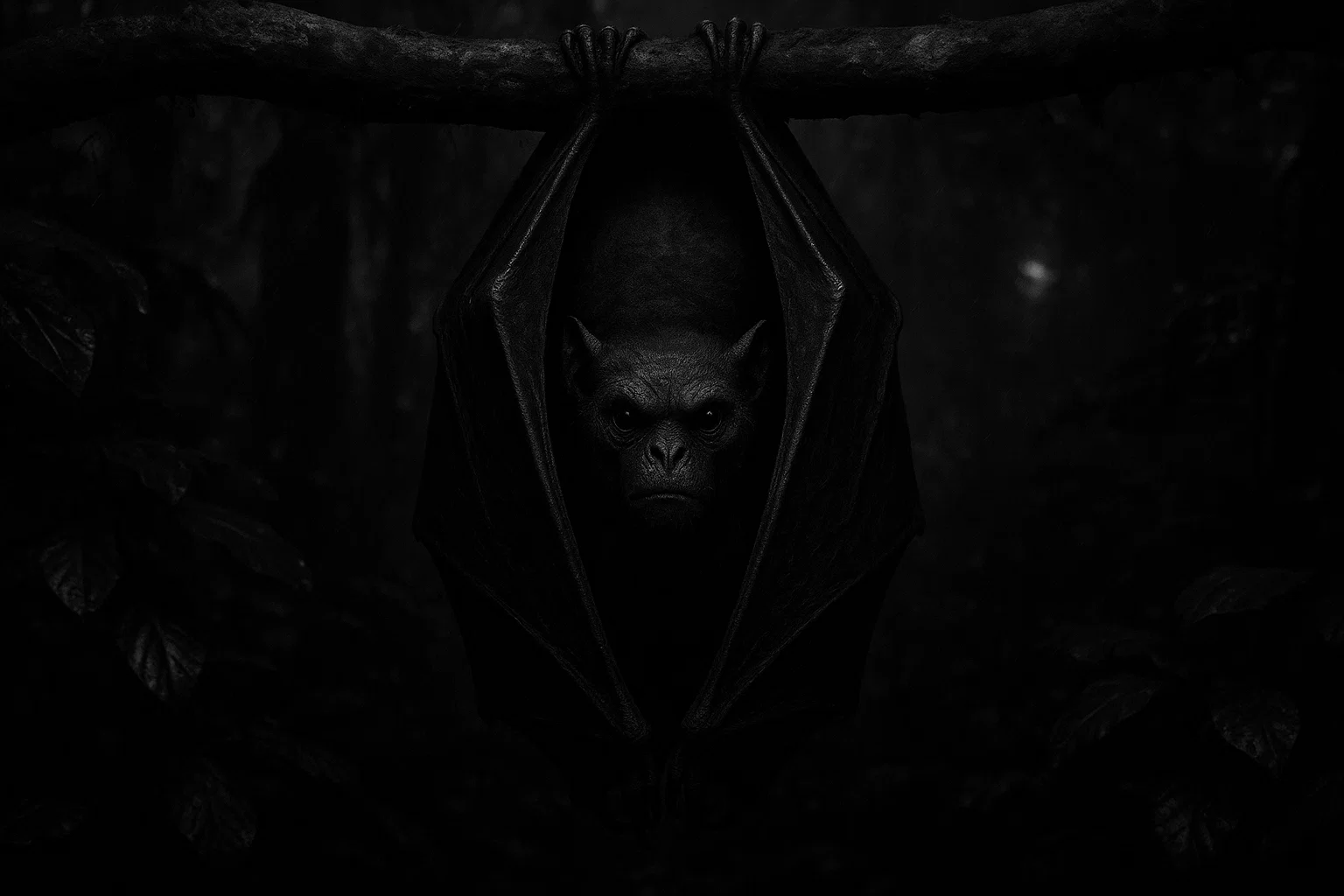
The Ahool is consistently depicted as a massive bat. However, it has distinct morphological deviations from known Megachiroptera (fruit bats).
For instance, witnesses describe the creature as having a body approximately the size of a one-year-old human child. This body is covered in short, dark grey or black fur.
The hardest to ignore feature is its face, which is frequently likened to that of a monkey or ape rather than the fox-like visage of standard flying foxes or the complex nose-leaf structures of microbats. It has large, dark eyes adapted for low-light hunting.
The wings of the Ahool are webbed and membranous, extending to a span estimated between 10 and 12 feet (approximately 3 to 4 meters). Unlike birds, the wing structure is supported by elongated finger bones, consistent with chiropteran anatomy.
Descriptions often note the presence of large claws on the forelimbs, which are used to manipulate prey. The creature is presumed to be a predator, differing from the frugivorous diet of known large bats in the region, such as the Golden-crowned flying fox.
Yokai and Supernatural Beings Hardcover Book – Up to 28% OFF!
Explore 100 authentic illustrations of Japan’s most haunting creatures in this premium 240-page volume. From ape-like hihi kidnappers to smirking hannya and shape-shifting bakeneko, drawn from rare historical sources including first-time reproduced monster parade scrolls. Curated by a leading authority on Japanese prints – an indispensable guide to yokai horror and folklore for altars, shelves, or spooky reading.

Etymology & Origins
The etymology of the name “Ahool” is strictly onomatopoeic, likely originating from the vocalization attributed to the beast. Local populations in West Java describe the call as a loud, resonating sound resembling “A-hool” or “A-hooo-uul,” typically repeated three times in succession. This cry is reported to be audible over significant distances within the dense acoustic environment of the rainforest.
The creature’s origins are embedded in the oral traditions of the Sundanese people of West Java, specifically around the slopes of Mount Salak.
However, the Ahool entered global cryptozoological literature primarily through the accounts of Dr. Ernest Bartels, a naturalist and ornithologist. Bartels, the son of a prominent ornithologist, discovered the creature during explorations in the 1920s.
While some theorists suggest the Ahool may be a surviving pterosaur (such as a dimorphodon) or a misidentified giant owl (specifically the Javan Wood Owl, Strix seloputo), the primary lore maintains its status as an unclassified giant bat.
Appearance
Ahool dominates with its impressive wingspan, which eclipses that of the largest known bats. The wings are described as reddish-brown or dark grey, leathery in texture, and spanning upwards of 12 feet. The body is compact and tough, covered in grey fur.
The head presents a simian appearance, with a flat face, forward-facing eyes, and a lack of a protruding snout, distinguishing it from the “flying fox” archetype. The limbs are equipped with significant claws, used for snatching fish from rivers or small mammals from the forest floor.
When at rest, the creature is said to hold its wings tight against its body, with its head sometimes obscured or tucked between its knees, creating a compact silhouette that conceals its true size until unfurled.
Powers & Weaknesses
Powers
The Ahool has physical attributes consistent with an apex aerial predator. Its primary ability is sustained flight, capable of maneuvering through dense canopy layers and open air with silence and precision. The wingspan provides significant lift, enabling the creature to carry prey such as large fish.
Based on its nocturnal nature and large ocular structures, the Ahool has acute night vision, allowing it to spot movement in near-total darkness. The creature’s vocalization acts as a territorial display, loud enough to intimidate rivals or potential threats.
What’s more, its claws function as formidable weapons, capable of piercing the tough hides of forest fauna or inflicting damage on human aggressors if cornered.
Weaknesses
The Ahool is susceptible to all forms of conventional physical damage, including ballistics, blunt force, and predation by larger terrestrial carnivores when grounded. It has no supernatural immunities or regenerative capabilities.
The creature appears to be strictly nocturnal, implying a vulnerability to or aversion to bright light. Intense illumination would likely disorient the creature or force it to retreat. Additionally, its reliance on flight makes it vulnerable to injury to the thin wing membranes; a torn wing would render the Ahool flightless and likely lead to starvation or predation.
Myths, Legends & Stories
The Waterfall Encounter (1925)
Dr. Ernest Bartels provided the first detailed Western account of the Ahool while exploring a waterfall on the slopes of the Salak Mountains in West Java. While navigating the dense vegetation near the Tjemoro River, Bartels observed a massive creature perched on a rock ledge above the cascading water. Initially, he believed the shape to be a large man resting.
As Bartels observed, the creature suddenly alerted to his presence. It did not stand as a human would but instead unfurled immense, leathery wings. The creature launched itself into the air, revealing a wingspan Bartels estimated to be roughly 12 feet. It emitted a distinct, deep cry—”Ahool”—before vanishing into the jungle canopy.
Undead Japanese Samurai Zombie – Limited Edition Resin Statue
Command attention with this intricately crafted Japanese-style Oni mask warrior sculpture from LOOYAR. Hand-painted resin/PU material captures the terrifying horns, fangs, and armored menace of the legendary demon guardian. Perfect for altars, shelves, desks, or gothic displays – a striking blend of folklore horror and samurai strength for home or office decor.
The Midnight Cry (1927)
Two years after his initial sighting, Dr. Bartels experienced a second encounter near the Tjiengamea River. Lying in his thatched hut within the jungle at approximately 11:30 PM, Bartels was awakened by a loud, resonant cry overhead. The sound was unmistakably the “A-hool” vocalization he had heard previously.
Bartels rushed outside with a torch/lamp, but the creature was beyond the reach of the light. However, the sky was clear and illuminated by stars, allowing him to discern a massive, dark silhouette gliding directly over the hut. The shape confirmed his earlier observations of the wing structure and size.
The Mystery of the Giant Owl
While not a narrative myth, a prevalent counter-narrative within the lore involves the Javan Wood Owl (Strix seloputo). Skeptics and ornithologists argue that the Ahool legends are misidentifications of this bird.
The owl has a significant wingspan (though smaller than the reported Ahool), a round, flat face that could be mistaken for a monkey’s in low light, and a loud, distinctive call.
However, local adherence to the leathery-wing description and the sheer size reported by Bartels maintains the distinction between the known owl and the cryptid Ahool in cryptozoological circles.
Symbolism
The Ahool symbolizes the persistent mysteries of the natural world, specifically the “lost world” archetype associated with deep, unexplored rainforests. It represents the interface between known zoology and folklore, embodying the fear of the night sky and the primal anxiety elicited by bats.
In a broader context, the Ahool serves as a placeholder for the possibility of surviving prehistoric megafauna, challenging the completeness of the modern scientific catalog.
Tags:
Related Monsters…
Arachne (Ancient Greek Half-Woman, Half-Spider Beast)
February 10, 2026
Antaeus (Invincible Earth Giant)
January 5, 2026
Baku (Dream-Eating Japanese Monster)
February 24, 2026
Basilisk (European Reptilian Beast)
February 11, 2026
February 3, 2026
