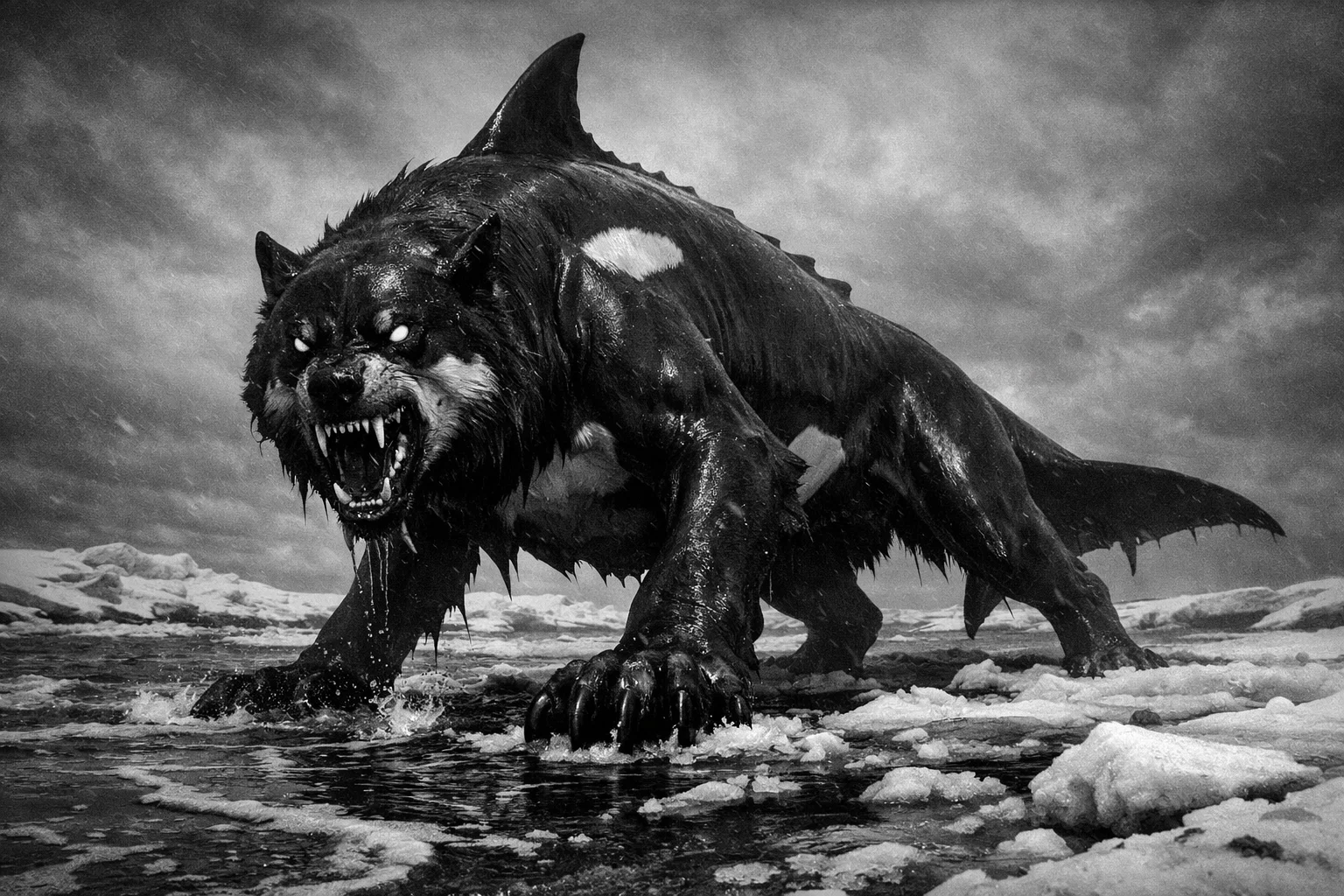

The Akhlut is a fierce predator found in both the spiritual and physical worlds of the Arctic. Known for its dual nature, it connects the sea and the land. By shifting between two top predators of the North, it stands out as a symbol of both marine and land-based threats. Stories about the Akhlut warn travelers and highlight nature’s power to change.
Summary
Overview
| Attribute | Details |
| Name | Akhlut |
| Alternative Names | Aklut, Akhluat |
| Similar Monsters | Amhuluk, Ahuizotl, Bakunawa, Bunyip, Cama Zotz, Capelobo, Carbunclo, Charybdis, Cipactli, Dobhar-chu, Each-uisge, Iku-Turso, Kelpie, Makara, Mishipeshu, Nguruvilu, Qalupalik, Suilead, Taniwha, Umdhlebi |
| Etymology | Inuktitut: ‘Akhlut’ refers specifically to the orca (killer whale). |
| Gender | Male, Female |
| Classification | Cryptid, Spirit |
| Species | Hybrid |
| Origin / Culture | Inuit (Alaska and Northern Canada) |
| First Recorded | Oral tradition; documented by ethnographers in the 19th and 20th centuries. |
| Active Period | Always active |
| Diet | Human flesh, seals, caribou |
| Habitat | Arctic oceans and coastal tundra |
| Powers & Abilities | • Shapeshifting between orca and wolf forms • Enhanced tracking over ice and water • Superhuman aquatic and terrestrial speed |
| Weaknesses | • Leaving the water (temporary vulnerability) • Tracking its wolf-to-orca footprints |
| Reproduction / Creation | Born from the spirit of a predatory orca seeking land prey. |
| Behavior | Solitary ambush predator |
| Modern Sightings | Rarely reported in modern cryptozoology, mostly confined to historical folklore. |
| Pop Culture | Dungeons & Dragons (various editions), Pathfinder Roleplaying Game, The Secret World (video game), various Inuit art collections. |
Description
The Akhlut is an important creature in Inuit folklore. It stands out because it can live in both the ocean and on the frozen tundra, serving as a top predator in both environments. Unlike other spirits that stay in one area, the Akhlut is always moving and hunting in different environments.
People see the Akhlut as a dangerous creature that mixes traits from different animals. It is often linked to the orca, but on land, it acts like a hungry wolf. Arctic hunters and travelers respected and feared it, knowing it could follow someone from the shore far into the snowy land.
The Mythical Creatures Bible. Flash Sale – Up to 23% OFF!
This beautifully designed paperback is the ultimate reference to legendary beings across history and cultures: From Biblical leviathans and behemoths to Asian kitsune, European fae, African tricksters, and ancient chimeras. Alphabetical entries with vivid illustrations, cultural context, and fascinating facts – essential for witchy libraries, ritual symbolism, or creature design inspiration.
Etymology
The word “Akhlut” comes from the Inuktitut language. It is the usual term for the orca, or killer whale (Orcinus orca). In Inuit mythology, though, it also refers to a supernatural creature that can move between the sea and the land.
The name highlights the orca’s role as a “killer” or “hunter.” Inuit people noticed that orcas are smart and hunt in groups, much like wolves. This gives the name a sense of a top predator. All versions of the name come from this Arctic root, showing how closely the creature is tied to local wildlife.
How to Pronounce “Akhlut” in English
In English, “Akhlut” is usually said as AHK-loot. The first part, “Akh,” has a hard “k” sound, but in some native dialects, it sounds more like the “ch” in “loch.” The second part, “lut,” rhymes with “boot” or “flute” and ends with a clear “t.”
Appearance
The Akhlut’s form changes with its environment, but it is best known as a mix of two animals. In the water, it looks like a huge orca with black and white coloring and a tall dorsal fin. Even then, it might show hints of its land side, like flippers that look more like legs.
When the Akhlut comes onto land, it turns into a giant wolf. It often keeps some orca features, like smooth, dark skin instead of fur or a dorsal fin on its back. Its tracks are a key sign: wolf prints that go to or from the ocean, often stopping right at the water.
Powers & Weaknesses
Powers
The Akhlut’s main supernatural power is metamorphosis. It can change its body to live in deep water or on snowy land. This lets it chase prey that would usually be safe by crossing from sea to land.
The Akhlut is also known for its great stamina and speed. In water, it moves like a top predator, and on land, it can outrun a wolf pack. According to lore, the creature has a spiritual sense that lets it find people or animals across long stretches of ice. Its hunger is legendary, extending beyond normal needs due to its dual spirit.
Weaknesses
The Akhlut’s power depends on where it is. It is weakest at the shoreline, where it has to change form to keep hunting. Stories say that if someone goes far enough inland, away from water, the Akhlut will feel the need to return to the sea to keep its spirit alive.
The Akhlut’s tracks are unique, changing from paws to flippers. Skilled hunters can spot these signs and avoid their path. Few stories tell of anyone killing an Akhlut; most people rely on avoiding it and recognizing its tracks to stay safe.
Myths, Legends & Stories
The story of the Akhlut starts with the Inuit’s close look at nature. For them, the orca was more than just a fish or whale—it was the “wolf of the sea.” This was true in how orcas hunted in groups, used smart tactics, and acted much like wolves on land. In old beliefs, the line between a wolf’s spirit and an orca’s spirit was thin, and the Akhlut showed what happened when that line was crossed.
Oral tradition says the first Akhlut appeared when a strong orca became curious about animals on the ice. Hungry for something new, its spirit changed its body, growing legs and fur to chase a caribou near the water. Since then, the Akhlut has been a lasting part of Arctic stories, a predator that fits in no single world.
Bulfinch’s Mythology Leather-Bound Classics Edition – Up to 43% OFF!
Own the timeless masterpiece in luxurious flexi leather-bound format from Canterbury Classics. Thomas Bulfinch’s complete compilation: The Age of Fable (Greek/Roman gods & heroes), The Age of Chivalry (King Arthur & knights), and Legends of Charlemagne – over 800 pages of elegantly retold ancient myths, Norse lore, and medieval romances. Gilded edges, ribbon marker, and premium binding make this a stunning heirloom for occult libraries or dark academia shelves.
The Hunter and the Shoreline
One well-known story tells of a hunter who found wolf tracks on a remote beach. He followed them, hoping to find a pelt, but saw the tracks came from the icy ocean, not the forest. As he went inland, he noticed the prints were bigger than any wolf’s and heard a steady dragging sound, like something heavy was being pulled.
As the sun set, the hunter realized he was now being hunted. The tracks circled back, and he was surrounded by a creature that moved in a strange, wavy way. In the fading light, he saw a huge, dark animal with the strong legs of a wolf and the shiny skin of a killer whale.
Scared, the hunter ran to a rocky spot that the creature couldn’t climb. He waited all night, listening to its angry growls, which sounded like a mix of a wolf’s howl and a whale’s whistle. In the morning, the tracks went straight back to the water and disappeared.
The Village of the Sea-Wolf
In another version, the Akhlut is portrayed as a vengeful spirit rather than just a lone hunter. In this story, a village wasted the meat of a stranded whale, angering the orcas. Soon after, the village was troubled by wolves that no one could catch. These wolves came during big snowstorms, taking dogs and even children from the village edges.
The village shaman entered a trance to talk to the spirits. He saw orcas jumping from the water and turning into wolves when they landed on the snow. He understood that the orcas were getting revenge by coming onto land.
The villagers had to apologize and return bones to the sea in special rituals to calm the Akhlut and turn them back into whales. This story taught that both sea and land must be respected, since creatures from one can become threats in the other.
Symbolism
The Akhlut mainly stands for being “in-between.” It shows the thin line between ocean and land, two worlds that meet at the shore. The Akhlut represents change and the idea that nature is flexible—a predator in one place can become a predator in another.
The Akhlut also stands for endless hunger. By leaving its usual home, it shows it won’t settle for its given place. It reminds the Inuit that danger can come from anywhere, even from places like the water’s edge, where you might not expect it.
Can Akhlut Be Defeated?
Beating an Akhlut is usually about surviving and escaping, not fighting it head-on. Since it is a strong spirit, weapons like spears or harpoons rarely work unless the hunter is very skilled and hits the “spirit-center,” which is thought to be behind the dorsal fin.
People protect themselves from the Akhlut mainly by:
- Staying alert at the shoreline: Avoid places where ice meets the sea, especially if you see large, unusual tracks.
- Wearing amulets and charms: People sometimes wear small carvings of orcas or wolves made from walrus ivory to show respect to these spirits and, in theory, keep them from attacking.
- Showing ritual respect: By following strict rules about how to treat sea life, people hope orcas won’t feel the need to become land-beasts for revenge.
- Geographic evasion: The only sure way to stay safe is to move deep into the mountains, far from salt water, since the Akhlut’s power weakens the farther it gets from the sea.
Tags:
Related Monsters…
Aspidochelone (Giant Sea Beast)
February 6, 2026
December 2, 2025
Amphiptere (Ancient Winged Serpent Dragon)
December 9, 2025
Alkonost (Russian Half-Bird, Half-Woman)
December 8, 2025
Azazel (Fallen Angel Turned Demon)
January 15, 2026
