
Akkorokamui is a huge sea creature from the folklore of the Ainu people, who are the original residents of Hokkaido, Sakhalin, and the Kuril Islands.
According to legend, this giant octopus guards Funka Bay and is so large and colorful that it can turn the sea a deep red. Local fishermen have always been wary of it, since its great strength and protective nature make it a serious danger to any boat that enters its territory.
Summary
Overview
| Attribute | Details |
| Name | Akkorokamui |
| Alternative Names | Atkor Kamuy, At-kor-kamuy |
| Similar Monsters | Kraken, Lusca, Hafgufa, Scylla, Umibōzu, Carcinos, Heikegani, Iku-Turso, Hydra, Aspidochelone, Taniwha, Cipactli |
| Etymology | Ainu: “at” (string/tentacle) + “kor” (possess) + “kamuy” (spirit/god), meaning “the string-holding deity.” |
| Gender | Male |
| Classification | Divine Entity |
| Species | Beast |
| Origin / Culture | Ainu (Hokkaido, Japan) |
| First Recorded | Oral tradition; documented in 19th-century ethnography. |
| Active Period | Always active |
| Size | Up to 120 meters in length. |
| Diet | Whales, fish, and capsized sailors. |
| Habitat | Funka Bay (Uchiura Bay), Hokkaido. |
| Powers & Abilities | • Limb regeneration • Ability to change water color • Massive physical constriction • Camouflage |
| Weaknesses | • Strong-smelling substances (tobacco) • Sharp iron tools • Repelled by extreme heat |
| Reproduction / Creation | Born from the discarded remains of a giant spider. |
| Behavior | Solitary ambush predator |
| Modern Sightings | 19th century–present, Funka Bay sightings. |
| Pop Culture | Yo-kai Watch / Megami Tensei series / Monster Hunter (inspired designs) |
Description
Akkorokamui is a prominent creature in Ainu mythology, a kamuy, or divine spirit, that inhabits the coastal waters of northern Japan. It is primarily associated with Funka Bay, where it is believed to live as a territorial guardian of the deep.
Unlike typical monsters that exist purely as malevolent forces, this entity has a complex position in the spiritual hierarchy of the Ainu, representing both a physical danger to maritime travel and a powerful deity that requires appeasement through ritual and respect.
The Ainu people perform rituals to calm Akkorokamui, which often involve giving food like fish and saying prayers to show respect for its divine nature. Community elders usually lead these ceremonies at certain times or before setting out to sea, hoping to keep everyone safe and ensure good conditions for travel.
This creature is known for its huge size and for staying underwater until it decides to attack. People often see it as a powerful force of nature rather than just an animal. It eats large sea creatures, but when it comes to humans, it is famous for destroying ships. Anyone entering its territory is very careful and may bring special items to try to keep the creature away if it appears.
Sketching from the Imagination: Creatures & Monsters Paperback – Up to 32% OFF!
Unleash your dark creativity with this 320-page paperback from 3dtotal Publishing, packed with hundreds of original creature and monster sketches from over 50 professional fantasy artists. Raw concept art, developmental drawings, and imaginative beasts ranging from dragons and demons to eldritch horrors – ideal for artists seeking inspiration for character design, RPG creatures, or spooky illustrations.
Etymology
The name Akkorokamui comes from the Ainu language and is made up of the words at, kor, and kamuy. It means string or cord, which refers to the long tentacles of an octopus. Kor means “possessing” or “holding,” and kamuy is the Ainu word for a god or spirit. So, the name means “the string-holding deity” or “the god with tentacles.”
In some local dialects, Akkorokamui is called Atkor Kamuy, and different Ainu communities have their own ways of describing and naming this legendary creature.
For example, in southern areas, the creature may be called Akkor Kamuy, showing small changes in pronunciation and language. Neighboring cultures, like those in nearby Russian regions, also have their own stories and beliefs about similar sea creatures, which adds to the variety of legends.
These different names all highlight the creature’s status as a divine being in Ainu beliefs, setting it apart from ordinary animals (huype). The focus on “strings” points to its many strong tentacles, which are a key part of how people describe and remember it.
Appearance
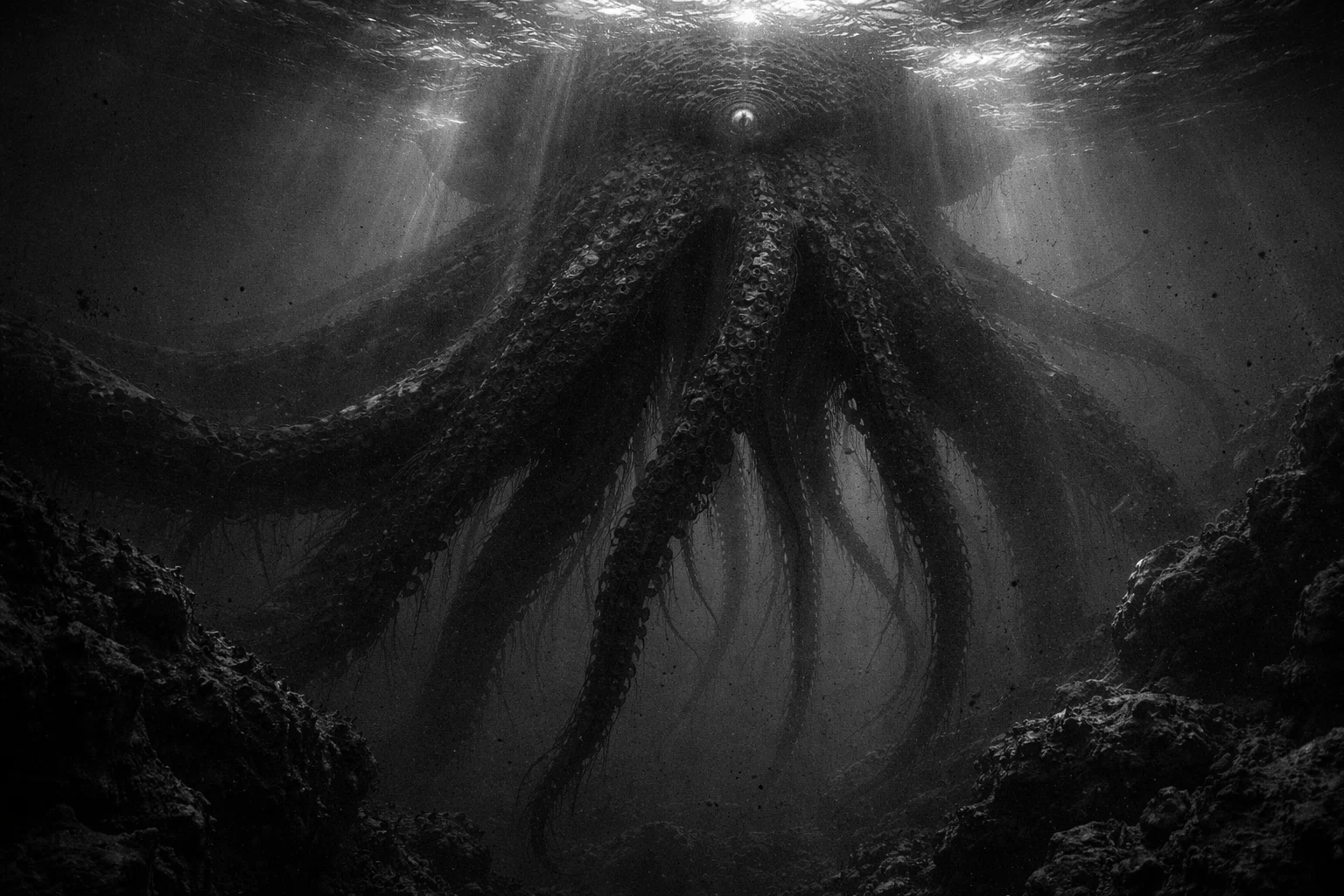
Akkorokamui is said to be a huge, bright red octopus. Its arms can stretch up to 120 meters, which is long enough to wrap around whole ships. Its skin is a glowing scarlet, so bright that it makes the water look bloody even before it attacks.
The creature has a soft, flexible body like other octopuses, which lets it move easily, even though it is so big. It has large, smart-looking eyes that reflect what is around it. Because of its size, people sometimes mistake it for small islands or a moving reef when it is near the surface. When it moves, it stirs up the water and creates big waves.
Powers & Weaknesses
Powers
Akkorokamui is extremely strong and can crush wooden ships or pull large whales underwater. One of its most famous supernatural powers is that it can regrow its tentacles quickly if one is cut off during a fight.
The creature can also alter how the water appears by releasing fluids or using its own light to turn the sea deep red. This acts as a warning and can confuse its prey. It is also very good at hiding, blending into the seafloor or appearing as natural features to surprise ships.
Creepy Gothic Horror Posters – Limited Deal Alert!
Elevate your witchy room with 97 Decor’s masterful unframed posters blending dark gothic aesthetics, horror elements, and creepy occult art. Rich, atmospheric designs with witches, macabre motifs, and vintage spookiness – essential for creating a captivating, moody atmosphere that draws in the shadows.
Weaknesses
Even though it is seen as a god, Akkorokamui has certain dislikes. Ainu stories say it hates strong smells, especially tobacco. In the past, sailors would bring tobacco, blow smoke over the water, or throw dried leaves into the sea to keep the creature away. It is also said to be weak against sharp iron weapons, which can pierce its tough skin when wooden tools are ineffective.
Some stories say the creature stays away from very hot areas, so people living by the shore sometimes use fire to keep it away. Making the right offerings and showing fear or respect are also believed to help avoid angering it.
Myths, Legends & Stories
The Birth of the Sea God
The origin of Akkorokamui begins not in the water, but on land. According to an Ainu legend, there once lived a massive spider named Yaoshikep in the mountains near the coast. This spider was so immense that it terrorized the local villages, consuming livestock and humans alike. The villagers prayed to the gods for intervention. In response, a powerful deity descended and attacked the spider.
During the struggle, the spider was severely wounded and fled toward the sea to escape the divine retribution. As it plunged into the cold waters of Funka Bay, its body underwent a profound transformation.
The terrestrial features of the spider—its hairs and segmented legs—melted away and reshaped into the smooth, tentacled form of a giant octopus. In this new environment, the creature grew even larger and took on a deep red color, becoming the bay’s kamuy.
The Repulsion by the Village Elder
In one popular folklore account, a group of fishermen was caught in the middle of the bay when the water suddenly turned red, signaling the ascent of Akkorokamui. The giant tentacles began to crest over the sides of their boat, threatening to pull them into the depths. An elder among the crew, remembering the ancient taboos of the creature, took out his pipe and began to smoke heavily.
He blew the thick, acrid tobacco smoke directly onto the reaching tentacles. The creature, revolted by the scent of the tobacco, recoiled in pain and submerged back into the dark water.
This story is frequently used to explain why tobacco became a mandatory item for any Ainu traveler venturing onto the sea, serving as a practical tool for survival against the divine cephalopod.
The Warning of the Red Tide
Another legend says the creature is a sign of danger. Akkorokamui does not always attack because it is hungry; sometimes it is just protecting its territory. If the sea turns red without is storm, people see it as the monster’s “breath” or “ink” spreading through the bay.
In these stories, the creature is like a gatekeeper. If villagers see the red tide and turn back, nothing happens to them. But if they ignore the warning and keep going, Akkorokamui comes up and destroys their boat as punishment for not respecting the boundaries set by the spirit.
Symbolism
Akkorokamui is a strong symbol of the wild and unpredictable nature of the ocean.
In Ainu culture, it marks the line between the familiar land and the mysterious, risky world of the deep sea. Its bright red color stands for both life and danger, showing the sea’s gifts like fish and whales, as well as the blood of those lost. It shows that the kamuy is a being to be respected, not defeated.
The need for rituals and items like tobacco in the Akkorokamui legend points out the importance of being prepared, respecting nature, and recognizing that humans are small in the face to the power of the natural world.
Many cultures have stories like Akkorokamui about sea gods or monsters that show both the dangers and the gifts of the ocean. For example, Scandinavian folklore tells of the Kraken, a giant sea monster living near Norway and Greenland that can pull ships underwater.
Similarly, the Greek mythology features Charybdis, a sea monster that causes massive whirlpools, posing a constant threat. Greek mythology also has Charybdis. This sea monster creates huge whirlpools and is always a danger to sailors.
These stories show that people everywhere are fascinated by the sea’s mysterious power and believe that nature must be respected because it can be unpredictable.
Tags:
Related Monsters…
Akaname (Japanese Filth-Licking Yokai)
January 5, 2026
Amphisbaena (Greek Two-Headed Serpent)
January 20, 2026
Antaeus (Invincible Earth Giant)
January 5, 2026
Azhi Dahaka (Persian Three-Headed Dragon)
January 19, 2026
Azazel (Fallen Angel Turned Demon)
January 15, 2026
