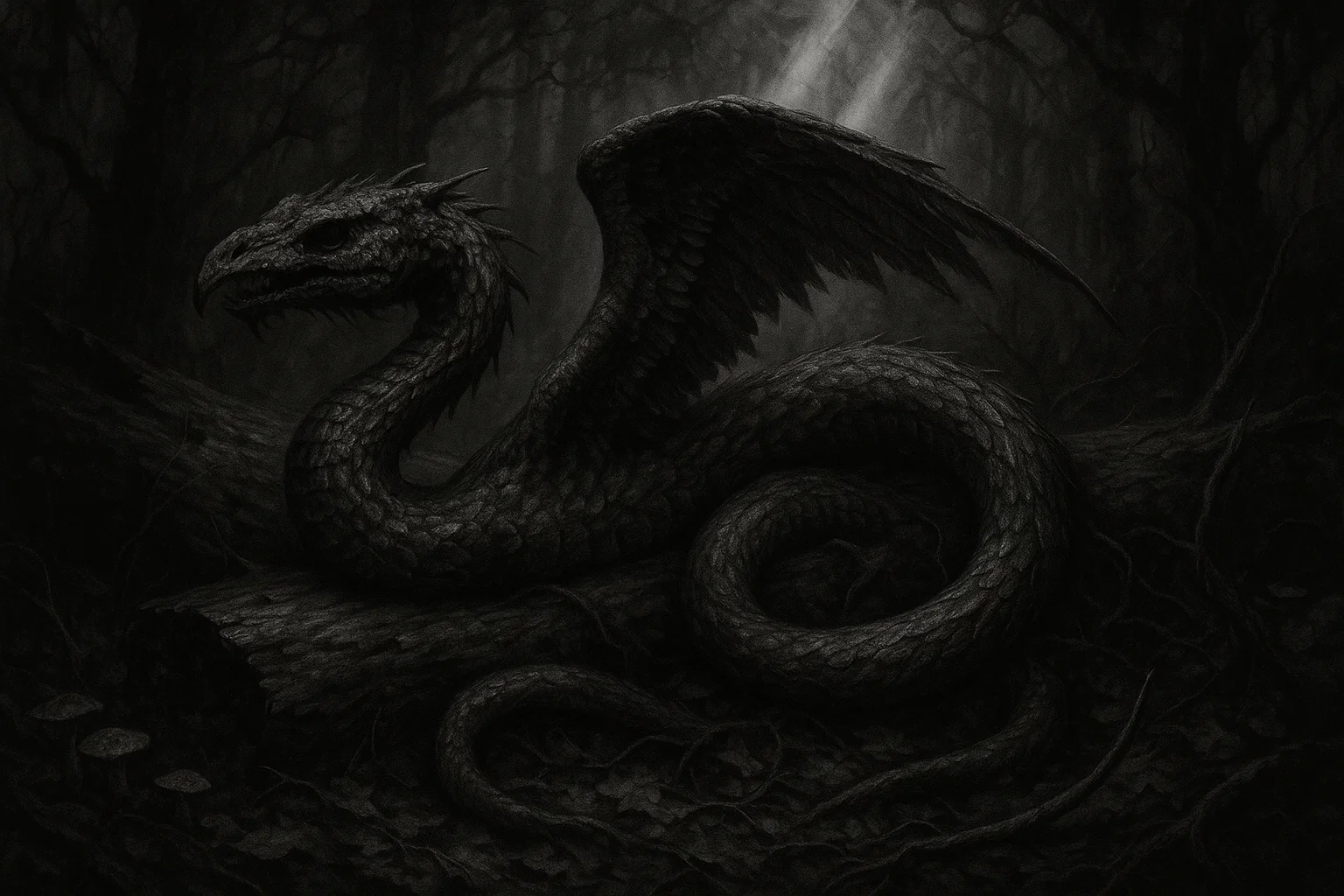

The Amphiptere is a snake-like creature defined by its unique anatomy: a limbless body and a single pair of wings. Primarily documented in European legends and specific taxonomies of mythical beasts, the monster is a distinct classification within the wider family of dragons and winged snakes.
Though it doesn’t have the deep mythological accounts of its counterparts, its presence in classical texts and noble armorial bearings solidifies its place within historical European symbolism.
Summary
Overview
| Attribute | Details |
| Name | Amphiptere |
| Alternative Names | Amphithere, Amphitere, Jaculus, Volucer, Phipthere |
| Similar Monsters | Lindworm, Wyvern, Knucker, Basilisk, Cockatrice, Ouroboros, Asp, Dracones, Naga, Feathered Serpent, Tatzelwurm, Guivre, Lambton Worm |
| Etymology | From Greek ‘amphi’ = on both sides, and ‘pteron’ = wing, meaning “two-winged” |
| Gender | Genderless |
| Classification | Reptilian Entity |
| Species | Beast |
| Origin / Culture | European (primarily British, French, and German heraldry; classical sources) |
| First Recorded | c. 77 CE – Pliny the Elder’s Natural History; specific heraldic usage solidifies c. 16th century CE; documented in Edward Topsell’s 1608 Bestiary |
| Active Period | Always active |
| Size | Variable; often depicted as smaller than a standard dragon, with long serpentine body |
| Lifespan | Unknown |
| Diet | Unknown |
| Habitat | Air, sometimes terrestrial |
| Powers & Abilities | • Flight • Constriction • Hypnosis/Illusion |
| Weaknesses | • Most weapons |
| Reproduction / Creation | Unknown; presumed born/created |
| Behavior | Symbolic, not known for independent behavior; sometimes described as a vigilant guardian. |
| Pop Culture | Dungeons & Dragons, Harry Potter, Fantastic Beasts and Where to Find Them (Occamy), Dragonology |
Description
The Amphiptere is a specific class of the winged serpent, distinguished by its lack of any limbs other than a pair of wings situated near its head. Unlike the four-legged dragon or two-legged wyvern, the Amphiptere has a long, slender body covered in scales.
Historically, it is represented as a symbolic monster in European armorial bearings, where it represents swiftness, vigilance, and authority. Its function is primarily that of a distinctive, formal entity used to adorn coats of arms and seals, signifying a family or institution’s prestige. The creature’s primary domain is the air, a fact underscored by its namesake.
Bulfinch’s Mythology Leather-Bound Classics Edition – Up to 43% OFF!
Own the timeless masterpiece in luxurious flexi leather-bound format from Canterbury Classics. Thomas Bulfinch’s complete compilation: The Age of Fable (Greek/Roman gods & heroes), The Age of Chivalry (King Arthur & knights), and Legends of Charlemagne – over 800 pages of elegantly retold ancient myths, Norse lore, and medieval romances. Gilded edges, ribbon marker, and premium binding make this a stunning heirloom for occult libraries or dark academia shelves.
Etymology
The name Amphiptere is derived from the ancient Greek, a compound construction using the prefix amphi (αμϕι), which denotes “on both sides” or “two sorts,” and the noun pteron (πτϵˊρον), meaning “wing” or “feather.”
Because of that, the name literally translates to “two-winged.” This terminology provides a precise anatomical description, differentiating it immediately from other draconic forms.
The name is also often confused with or used interchangeably with the Jaculus (Latin for “javelin” or “dart”), a mythical flying serpent mentioned in Roman literature, such as Lucan’s Pharsalia. This confusion comes from both creatures sharing the trait of being a swift, flying snake, linking the formal Greek term to a descriptive Roman counterpart.
Appearance
The creature’s look is defined by its snake-like body and the complete lack of forelegs or hind legs. Its long trunk is covered in scales, which are frequently depicted in heraldry as shades of greenish-yellow or adorned with bright, light-colored feathers.
The wings are its sole limbs, often depicted as feathered (like a bird’s) or membranous (like a bat’s). The head is typically draconic, occasionally featuring a beak-like snout or a small crest. Its tail often terminates in a distinct feature, such as an arrow-tip or a barbed spike, emphasizing its capacity to strike or wound.
When depicted, the body is frequently shown coiled, ready to spring or constrict, underscoring its dual nature as both an aerial and a constricting predator.
Powers & Weaknesses
Powers
The Amphiptere’s defining power is flight, enabled by its prominent wings, which allow rapid aerial movement and surveillance. Its snake-like form enables constriction, in which it uses its muscular body to crush opponents or coil around objects it is guarding.
What’s more, in some traditions associated with mythical guardians, the Amphiptere is attributed with the power of hypnosis or illusion, using its gaze to temporarily paralyze or confuse those attempting to seize protected treasure.
It is occasionally associated with the powers of its relatives, such as a venomous bite or spit, though this is not a universally confirmed trait of the heraldic creature. Its unique combination of flight and constriction makes it a versatile predator or sentinel.
Weaknesses (100-150 words)
Due to its origins in heraldry and formal classification rather than in deep folklore, the Amphiptere doesn’t have the specific apotropaic weaknesses (such as silver or iron) common to many other legendary monsters.
Consequently, its vulnerabilities are considered physical. It is susceptible to standard weaponry capable of piercing its scaled hide, such as swords, lances, and arrows. Destroying or sufficiently damaging its wings would immediately remove its primary advantage, flight, forcing it onto the ground, where its lack of legs would render it a lot less mobile and vulnerable.
In lore, some sources imply that distracting the creature with an object or a mirror might break its hypnotic gaze. However, direct physical force remains the most reliable method of incapacitation.
Myths, Legends & Stories (300-800 words)
Most Amphiptere’s myths and legends are focused on three primary historical streams: classical natural history, medieval heraldry, and later bestiary classification. Its origin story is not a singular mythological event but the evolution of an idea.
Classical Antecedents
The concept of the winged serpent traces back to classical accounts of flying reptiles that posed a danger to humans. The Roman writer Pliny the Elder, in his Natural History (circa 77 CE), described various serpents, including a swift, winged variant often identified with the Jaculus (javelin snake).
This creature was said to launch itself from trees onto prey below, blurring the line between aerial and terrestrial predators. Later authors, such as Aelian, further classified various snake creatures.
These early, semi-scientific descriptions of “dracones” and winged reptiles established a factual (for the time) basis for a limbless, flying serpent that the later European Amphiptere would formalize.
The Heraldic Adoption
The Amphiptere achieved its most defined identity through its integration into European heraldry during the Late Middle Ages and Renaissance. It was chosen as a unique and powerful emblem, often used by noble families like the House of Lorraine.
In armorial bearings, the creature’s snake-like body and wings symbolized the mastery of both the earthly and spiritual or aerial realms, representing a lineage that was both grounded and aspirational. The monster was a visual representation of vigilant guardianship and swift justice.
This official, aristocratic adoption cemented the Amphiptere’s anatomical specifications and symbolic meaning, distinguishing it from the more generic dragon or wyvern in a formal, regulated context.
NECA Collectible Texas Chainsaw Massacre Ultimate Leatherface
Horror masterpiece from NECA: 7” articulated Leatherface with swappable heads (terrifying masks and expressions), chainsaw with sound potential in pose, hammer, meat hook, and extra hands for dynamic displays. Authentic film-accurate detailing in a collector-friendly window box – perfect for witchy altars or creepy collections.

Lore of Power and Body Parts
Though it doesn’t have extensive narrative folklore, the Amphiptere, through its association with powerful dragons, developed specific attributes concerning its body. In various bestiary accounts, the creature was rumored to hold vast secret knowledge, knowing all but one of the world’s deepest mysteries.
What’s more, its body parts were believed to possess potent properties. It was said to be able to sprout warriors when sown into the earth, a myth borrowed from the story of Cadmus and the dragon’s teeth.
Its blood, if prepared correctly, was fabled to grant the drinker the ability to understand the language of animals. These scattered, alchemical attributes elevated the creature beyond a simple beast, making it a source of rare magical components and a secret of scholastic lore.
Symbolism (50-150 words)
The Amphiptere is a focused symbol of Power and Authority, primarily derived from its high-status usage in heraldry. Its dual nature—a coiling body (earthly power) supported by wings (celestial power/flight)—signifies a comprehensive Mastery over Different Realms.
It represents Vigilance and Guardianship, often depicted wrapped around a shield or crest as an eternal sentinel, capable of swiftly dispensing justice or defending an asset.
Its use on the arms of the House of Lorraine and similar noble houses further established its symbolic association with lineage and aristocratic distinction, serving as an emblem of a family’s ancient and long-lasting status.
Tags:
Related Monsters…
Rokurokubi (Japanese Long-Necked Woman)
March 3, 2026
January 12, 2026
Abominable Snowman (Himalayan Beast)
December 1, 2025
Arachne (Ancient Greek Half-Woman, Half-Spider Beast)
February 10, 2026
January 7, 2026
