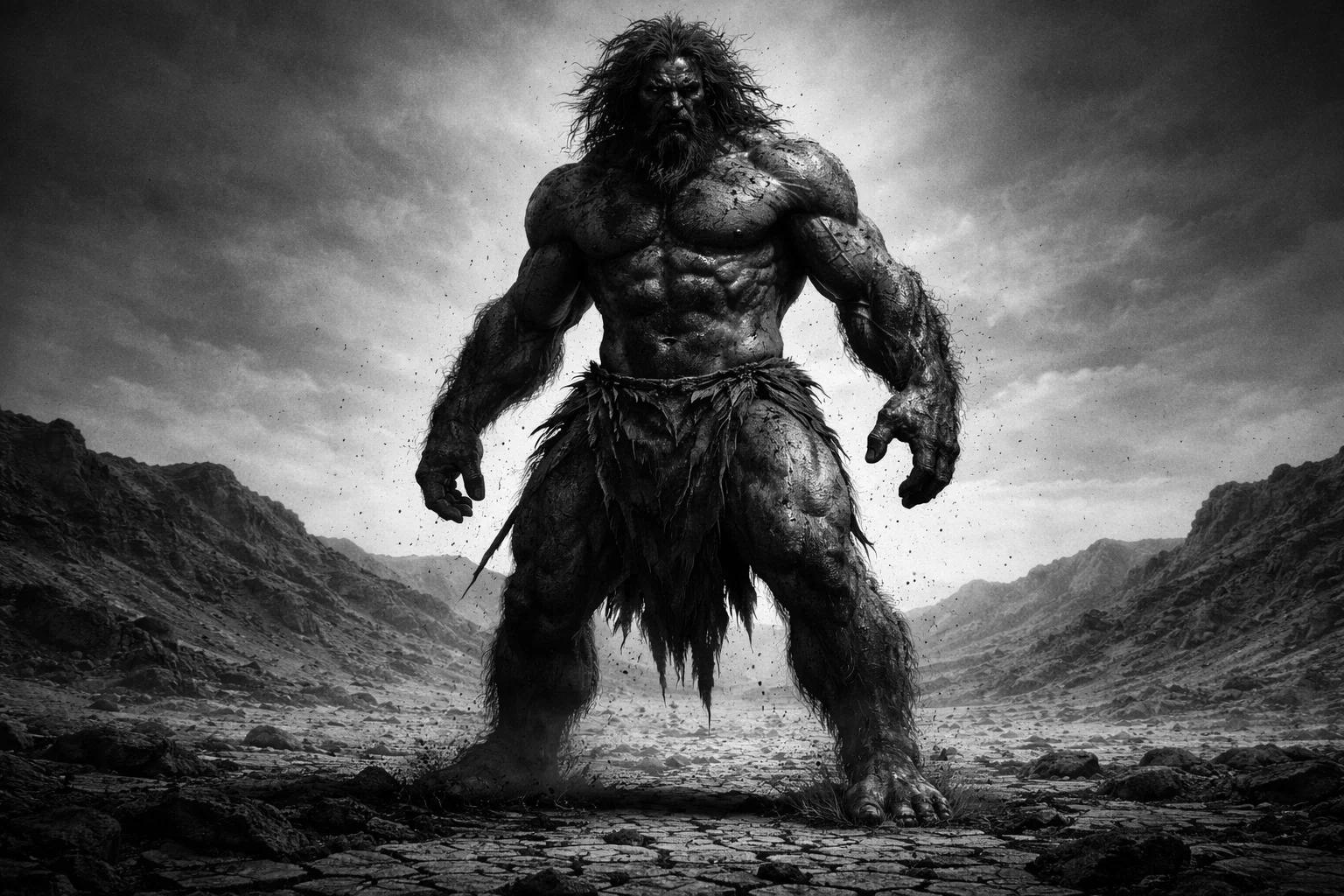

Antaeus is a giant from Greek mythology, famous for his great size and for forcing travelers to wrestle him. As the son of Poseidon and Gaia, he was a powerful monster in Libya. His special bond with the earth made him nearly impossible to defeat in a fight.
Summary
Overview
| Attribute | Details |
|---|---|
| Name | Antaeus |
| Alternative Names | Antaios, Antée |
| Similar Monsters | Alcyoneus, Enceladus, Polybotes, Porphyrion, Ephialtes, Otus, Typhon, Geryon, Cacus, Damasen, Orion, Talos |
| Etymology | From Greek ‘Antaios’ meaning ‘Opponent’ or ‘Hostile’ |
| Gender | Male |
| Classification | Giant |
| Species | Humanoid |
| Origin / Culture | Greek (Libya, North Africa) |
| First Recorded | c. 700 BCE – Hesiod’s Theogony |
| Active Period | Always active |
| Size | Variable; described as massive or colossal (often 15-60+ feet in later accounts) |
| Lifespan | Immortal (unless specific weakness exploited) |
| Diet | Human flesh (implied by the skulls of his victims) |
| Habitat | Coastal Libya, specifically the desert near Irasa |
| Powers & Abilities | • Earth-based regeneration • Indomitable physical strength • Invulnerability while grounded |
| Weaknesses | • Separation from the earth • Suspension in the air • Physical crushing while airborne |
| Reproduction / Creation | Born from the union of Poseidon and Gaia |
| Behavior | Solitary ambush predator and territorial combatant |
| Pop Culture | Dante’s Inferno / Percy Jackson & The Olympians / God of War series |
Description
Antaeus is a giant of North African origin who served as a territorial guardian and a lethal antagonist to travelers. He is categorized as a son of the sea god Poseidon and the earth goddess Gaia. This lineage granted him a direct link to the terrestrial world, which functioned as the source of his power.
He ruled a kingdom in Libya and stopped anyone who tried to cross his land. Instead of letting them pass, he made them wrestle him, and these matches always ended in the opponent’s death.
Antaeus regained his strength every time he touched the ground, making him unbeatable. He kept the skulls of his victims to build or decorate a temple for his father. His rule ended when he met the hero Heracles during Heracles’ twelfth labor.
Etymology
The name Antaeus comes from the Ancient Greek word Antaios, which is based on anta, meaning “opposite,” “against,” or “in front of.” So, his name means “The Opponent” or “He who confronts,” describing how he blocked travelers and forced them to fight.
In Greek myths, names often described a character’s role in the story. By calling him “The Opponent,” Antaeus is seen as an obstacle for heroes. Some researchers think his story may connect to Libyan or Berber cultures, but the main sources use are Greek. The name Antaeus, from Greek Antaios, is still used in Western stories and myths.
Appearance
Antaeus is shown as a giant, much bigger than any human, sometimes even taller than buildings or natural features. He is described as a strong, muscular wrestler, built for strength and grappling rather than speed.
He is usually shown with wild hair and a rough beard, showing his untamed nature and life in the Libyan desert. His skin is often dusty or dirty from always touching the earth. Unlike the Greek gods, Antaeus does not wear fancy armor or clothes. He is frequently shown naked or in simple animal skins, highlighting his primitive roots.
Powers & Weaknesses
Powers
The primary power of Antaeus is his earth-based regeneration. Because he is a son of Gaia, the Earth itself is an infinite source of energy and healing for him. Every time he is thrown to the ground or makes physical contact with the soil, his strength is completely renewed, and any injuries he has sustained are instantly healed.
This ability makes him effectively tireless in a wrestling match. At the same time, his opponents grow weary, and Antaeus becomes stronger with every fall. Additionally, he has supernatural physical strength, allowing him to crush human opponents with ease.
His endurance is also heightened, as he does not require rest or sustenance as long as he remains in contact with his mother, the Earth.
Bulfinch’s Mythology Leather-Bound Classics Edition – Up to 43% OFF!
Own the timeless masterpiece in luxurious flexi leather-bound format from Canterbury Classics. Thomas Bulfinch’s complete compilation: The Age of Fable (Greek/Roman gods & heroes), The Age of Chivalry (King Arthur & knights), and Legends of Charlemagne – over 800 pages of elegantly retold ancient myths, Norse lore, and medieval romances. Gilded edges, ribbon marker, and premium binding make this a stunning heirloom for occult libraries or dark academia shelves.
Weaknesses
The weakness of Antaeus is entirely conditional and tied to his source of power. If he is removed from contact with the ground, his regenerative abilities cease immediately. Without the constant influx of energy from Gaia, he has the physical limits of a standard giant, making him vulnerable to physical harm.
He cannot fly or levitate, meaning he is dependent on the surface beneath his feet. To defeat him, an opponent must find a way to lift him into the air and keep him suspended. Once airborne, he can be strangled, crushed, or otherwise sent, as he has no secondary means of defense or recovery.
This vulnerability is specific and absolute; even a few inches of separation from the soil is sufficient to neutralize his invincibility.
Myths, Legends & Stories
The most famous story about Antaeus is his fight with the Greek hero Heracles. This happened when Heracles was searching for the Golden Apples of the Hesperides. As Heracles passed through Libya, Antaeus challenged him to a wrestling match, as he did with all travelers. Antaeus had never lost before.
The Wrestling Match
The match started with both fighters grappling with each other. Heracles, known for his incredible strength, kept throwing his opponent, Antaeus, to the ground.
However, every time Antaeus hit the earth, he seemed to come back even stronger. Heracles noticed that the more force he used to slam Antaeus down, the tougher the giant became. After a few rounds, Heracles figured out that Antaeus gained his strength from touching the ground, or the Earth.
To win the fight, Heracles changed his strategy. He lifted Antaeus high into the air, preventing him from making contact with the ground. Antaeus fought hard, but without that connection to the soil, he lost his power.
Eventually, Heracles either crushed or strangled him, depending on which version of the story you hear. With his strength gone, Antaeus met his end in Heracles’ grip.
The Skulls of the Vanquished
Before his death, Antaeus was known for a gruesome architectural project. It was said that he intended to build a temple to his father, Poseidon, using the skulls of the travelers he had murdered. This detail highlights his role as a “bad host” in Greek mythology, a creature who violated the sacred laws of xenia, or hospitality.
In Greek culture, xenia was a fundamental moral code that emphasized the reciprocal respect and protection between host and guest. Violating xenia was more than a personal affront; it was considered an offense against Zeus, the guardian of travelers and guests.
By turning his guests into building materials, Antaeus symbolized the uncivilized wilderness that stood in opposition to the values of the Greek city-states.
The Tomb of Antaeus
Later stories and Roman writers, such as Plutarch, mention the “Tomb of Antaeus” in North Africa. The Roman general Sertorius once visited the tomb and, doubting the giant’s size, had it opened. His soldiers found a skeleton measuring 60 cubits.
Sertorius was so impressed that he performed a sacrifice and had the tomb closed again, helping to keep Antaeus’s legend alive in the area.
Ultimate Family Co-op Adventure – Horrified: Universal Monsters
Ravensburger’s acclaimed co-op Horrified Board Game masterpiece: Defend against Dracula, The Mummy, Invisible Man, and other icons in a beautifully themed village. Tactical pick-up-and-deliver gameplay, escalating tension, and endless variety. Ideal gateway game for families & friends, 1-5 players, 10+, with 4.8/5 star rave reviews.

Symbolism
Antaeus is a primary symbol of the connection between an individual and their roots or environment. He represents the concept that strength is derived from one’s origins and that losing touch with those foundations leads to vulnerability.
In a philosophical sense, he personifies “chthonic” power, the raw, unrefined energy of the earth that is eventually overcome by the “olympian” intellect and strategic prowess of heroes like Heracles. He is a warning regarding hospitality, representing the dangers of the untamed world beyond the boundaries of civilization and law.
In modern contexts, Antaeus’s symbolism can relate to themes of personal identity and resilience. Just as he drew strength from the earth, individuals today might find strength in their cultural roots, community, or environment. This idea suggests that staying connected to one’s origin can boost self-awareness and personal strength.
Antaeus can also serve as a metaphor for environmental conservation, highlighting the importance of maintaining a connection to the natural world amid technological and urban development. Similarly, he reflects on how enabling environments are essential for personal growth, echoing contemporary discussions on mental health and the significance of supportive surroundings.
Tags:
Related Monsters…
Argus Panoptes (Hundred-Eyed Giant)
January 13, 2026
January 12, 2026
January 28, 2026
Aswang (Philippine Vampire Shapeshifter)
January 14, 2026
Aqrabuamelu (Mesopotamian Scorpion-Man Beast)
February 9, 2026
