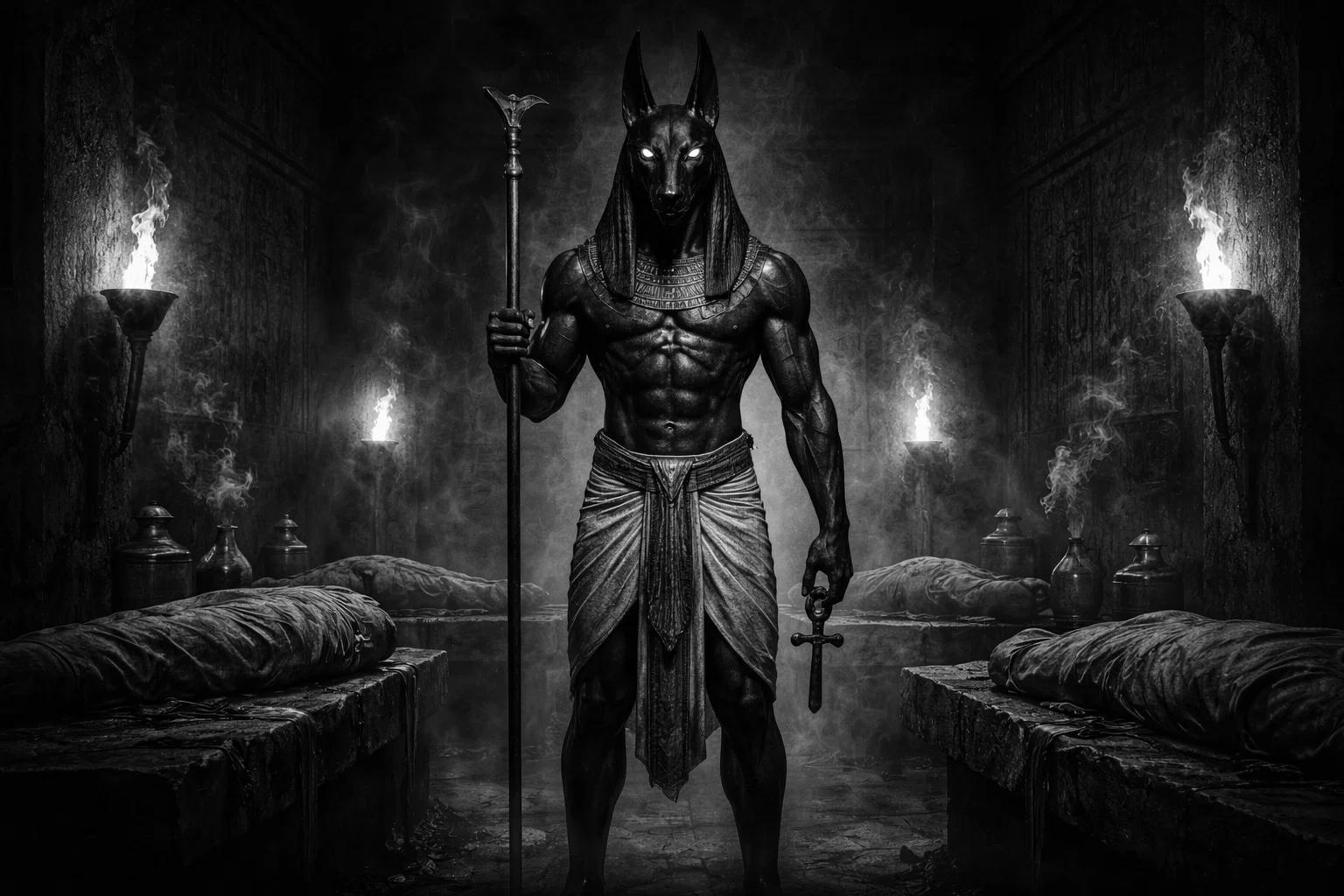

Anubis is a major god in ancient Egyptian funerary traditions, known for protecting graves and guiding the dead. He plays a key role in helping souls move from life to the afterlife. By watching over the body and judging the soul, he helps keep the cosmic balance called Ma’at. (In Egyptian culture, Ma’at stands for truth, balance, and order, maintaining harmony in the world and in people’s lives.)
Summary
Overview
| Attribute | Details |
| Name | Anubis |
| Alternative Names | Anpu, Inpu, Ienpw, Ipw, Yinepu, Hermanubis |
| Similar Monsters | Cerberus, Wepwawet, Duamutef, Sed, Khenti-Amentiu, Xolotl, Fenrir, Garmr, Hellhound, Cadejo, Black Shuck, Grim, Aniwye, Orthrus |
| Etymology | Egyptian ‘Inpw’ likely meaning ‘to decay’ or ‘royal child’ |
| Gender | Male |
| Classification | Divine Entity |
| Species | Hybrid |
| Origin / Culture | Ancient Egyptian (Nile Valley) |
| First Recorded | c. 3100–2890 BCE – First Dynasty inscriptions |
| Active Period | Always active |
| Lifespan | Immortal |
| Diet | Metaphysical offerings, hearts of the deceased |
| Habitat | Necropolises and the Duat (Underworld) |
| Powers & Abilities | • Guiding souls through the afterlife • Weighing the heart against truth • Mummification and preservation • Protection against evil spirits |
| Weaknesses | • Violation of Ma’at (Cosmic Order) • Oblivion of the name/memory • Corruption of the mummified vessel |
| Reproduction / Creation | Born from the union of Osiris and Nephthys (or Ra and Hesat) |
| Behavior | Protective guardian |
| Pop Culture | “The Mummy” (1999) / American Gods (Novel/TV Series) / Assassin’s Creed Origins / Smite |
Description
Anubis is an important entity in ancient Egyptian burial practices. He was the patron of embalmers and ruled over the dead before Osiris became more prominent. He is not a monster like a wild animal, but a psychopomp (one who guides souls from life to the afterlife).
He operates within the Duat, the Egyptian underworld, which is a complex and dangerous world full of various perils that the deceased must get through safely.
The Duat is believed to be an intermediary stage between the living world and the afterlife, filled with numerous challenges and examinations that souls must overcome to reach their final judgment. Here, Anubis ensures that the deceased successfully completes these trials.
As the guardian of the necropolis, Anubis protects both the spirit and the body in the tomb. He also judges souls at the most important moment in the afterlife, deciding their moral value. Anubis stands between the wild desert and the ordered life along the Nile, symbolizing the shift from life to eternity.
Etymology
The name Anubis comes from the Greek version of the Egyptian name Inpu (or Anpu). In hieroglyphs, it is often written as jpw. Researchers still debate the exact origin, but many link it to the word “inp,” meaning “to decay,” which fits his early role in the dead body’s transformation.
Scholars have different ideas about the name’s origin. Some think it comes from various languages and dialects over time. Another theory is that it means “royal child,” which would show Anubis’s high status among the gods.
During the Hellenistic period, Anubis’s name was combined with the Greek god Hermes to form Hermanubis, showing his role as a messenger and guide. Titles like Khenty-Amentiu (“Foremost of the Westerners”) highlight his importance over the cemeteries on the Nile’s west bank.
Appearance
Anubis is shown in two main forms. One is as a black jackal or wild dog, lying down with a long nose, big upright ears, and a thick tail. The black fur is not natural for jackals, but it symbolizes the rich soil of the Nile and the color of a body after embalming.
The more common form is a human body with a jackal’s head. He is usually shown wearing a kilt and often holds a was-sceptre and an ankh. He also wears a special collar and a wig. Anubis is frequently seen standing or kneeling by the scales of justice or leaning over a mummy during embalming.
Powers & Weaknesses
Powers
Anubis has complete control over mummification, using divine knowledge to stop the body from decaying. One of his main powers is the “opening of the mouth” ritual, which restores the senses to the soul so it can eat, speak, and breathe in the afterlife.
In this ritual, priests touched the mouth of the dead with special tools, giving the soul the power to interact with both the living and the spirit world. His most important power is the Weighing of the Heart, where he uses the Scales of Justice to decide a soul’s fate. He can also travel safely through the dangerous Duat and protect tombs from evil spirits and grave robbers.
NECA Ultimate Mummy 7″ Black & White Action Figure – Boris Karloff Classic Deal!
Celebrate the 90th anniversary with NECA’s stunning black-and-white Ultimate Mummy, capturing Boris Karloff’s iconic wrapped horror in exquisite detail. 7-inch scale with interchangeable heads and hands, an opening Egyptian chest accessory, and highly articulated posing. Premium sculpt recreates the legendary makeup – essential for Universal Monsters collectors and dark displays.
Weaknesses
He must always follow the laws of Ma’at and cannot go against truth and balance. If a soul passes the test, he must let it enter the afterlife, and he cannot save a soul that fails. His power depends on the body’s preservation and the person’s name being remembered. If the body is destroyed or the name is erased from history, Anubis cannot guide that soul.
As a god of transition, Anubis’s power is mostly limited to the moment of death and the underworld. He has little influence in the world of the living unless called by special funeral rituals.
Myths, Legends & Stories
The Secret Birth and the Great Adoption
The origin of Anubis is a tale of divine entanglement and survival. Nephthys, representing the unseen and the darkness, found herself in a loveless union with Set, the god of storms. Seeking to align herself with the light of Osiris, she used her magic to mimic the appearance and fragrance of Isis. The deception was successful, and from their union, Anubis was conceived.
When the infant was born with the features of a jackal, Nephthys feared Set would murder the child to hide her infidelity. She left the newborn in a thicket of papyrus reeds along the Nile’s edge. Isis, through her prophetic wisdom, tracked the child’s scent.
Rather than acting out of jealousy toward her husband’s illegitimate son, she adopted him. She trained him in the arts of protection and magic, making him her most trusted vanguard. This bond ensured that when the war between Set and Osiris began, Anubis remained the fierce defender of the rightful throne.
The Reconstruction of the Divine King
The death of Osiris was not merely a murder but a systematic attempt to erase him from existence. After Set hacked Osiris into fourteen pieces and scattered them across the Egyptian provinces, the world fell into a spiritual drought. Anubis used his keen canine sense of smell to track every fragment, from the Delta to the southern cataracts.
Once the pieces were reunited, Anubis faced the challenge of a decaying god. He created the wabet, or “pure place,” which became the first embalming workshop. He meticulously reassembled the anatomy, sewing the skin back together and filling the cavities with natron salts and aromatic spices to halt the rot.
He then invented the ritual of wrapping, using “the bandages of the weaver-goddess Tayet” to hold the divine form together. This was the birth of the “Mummy of the West,” and by successfully preserving the king’s body, Anubis proved that death could be managed and mastered through ritual precision.
The Flaying of the Leopard
The enmity between Anubis and Set reached its peak when Set attempted to desecrate the tomb where the mummy of Osiris lay. Set took the form of a leopard, hoping his predatory speed and camouflage would allow him to bypass the tomb’s defenses. However, Anubis was the “Lord of the Sacred Land,” and no shadow could move in the necropolis without his notice.
A violent struggle ensued at the threshold of the tomb. Anubis wrestled the leopard to the ground, overpowering the chaotic god. To punish Set and warn all future transgressors, Anubis used a ritual knife to skin the leopard while Set was still in that form.
He then pressed a branding iron against the hide, creating the permanent black rosettes found on leopard fur today. He wore the skin as a trophy and later draped it over a pole, creating the Imiut fetish. This powerful, magical object marked the boundary between the living and the dead.
The Opening of the Mouth and Eyes
Beyond mere preservation, Anubis was responsible for the “Opening of the Mouth” ceremony, a mythic ritual designed to restore the soul’s functionality. In the legends, the deceased arrived in the Duat as a “cold shadow,” unable to speak or perceive their surroundings. Anubis would use a sacred tool called an adze, fashioned from meteoric iron, to touch the mummy’s face or the deceased’s statue.
This was not a physical act but a metaphysical awakening. Through this story, Anubis is credited with giving the dead the ability to breathe the air of the underworld, to eat the offerings left by their descendants, and to speak the secret names of the gatekeepers they would encounter.
Without this specific intervention by Anubis, the soul would remain a “dumb spirit,” wandering the darkness without the means to justify itself before the gods.
The Mythical Creatures Bible. Flash Sale – Up to 23% OFF!
This beautifully designed paperback is the ultimate reference to legendary beings across history and cultures: From Biblical leviathans and behemoths to Asian kitsune, European fae, African tricksters, and ancient chimeras. Alphabetical entries with vivid illustrations, cultural context, and fascinating facts – essential for witchy libraries, ritual symbolism, or creature design inspiration.
The Weighing of the Heart and the Final Fate
In the climax of the Egyptian soul’s journey, Anubis leads the deceased by the hand into the Hall of Ma’at. The hall is lined with forty-two “Assessors of the Dead,” each a terrifying minor deity.
At the center stands the Great Scales. Anubis, serving as the celestial engineer, checks the weights to ensure they have not been tampered with by evil forces.
The deceased must recite the “Negative Confession,” claiming they have not stolen, murdered, or lied. As they speak, Anubis watches the heart. If the heart fluctuates or grows heavy with the weight of a lie, the scales tip. In the most detailed versions of this myth, Anubis’s role is one of somber empathy; he provides the quiet presence necessary for the soul to face its own truth.
When the feather of Ma’at is placed on the opposite tray, the silence is absolute. If the balance is perfect, Anubis utters the command for the gates of the Field of Reeds to open, personally escorting the “Justified One” past the snapping jaws of Ammit.
Symbolism
Anubis symbolizes the duality of death, both the terrifying aspect of decomposition and the hopeful prospect of resurrection. His black coloration represents the regenerative soil of the Nile, linking the end of life to the potential for new growth.
As a jackal, he symbolizes the vigilance required to protect the dead from the scavengers of the desert. He is a symbol of transition, marking the liminal space between the physical and the spiritual. What’s more, the scales he operates represent the absolute necessity of moral integrity, suggesting that the afterlife is a meritocracy governed by truth.
In a broader mythological context, Anubis’s role as a guide for the dead can be compared to figures such as the Greek Charon, who ferries souls across the river Styx, and the Norse goddess Hel, who presides over the realm of the dead.
Tags:
Related Monsters…
Aqrabuamelu (Mesopotamian Scorpion-Man Beast)
February 9, 2026
Asanbosam (West African Forest Monster)
January 23, 2026
Amphisbaena (Greek Two-Headed Serpent)
January 20, 2026
January 7, 2026
