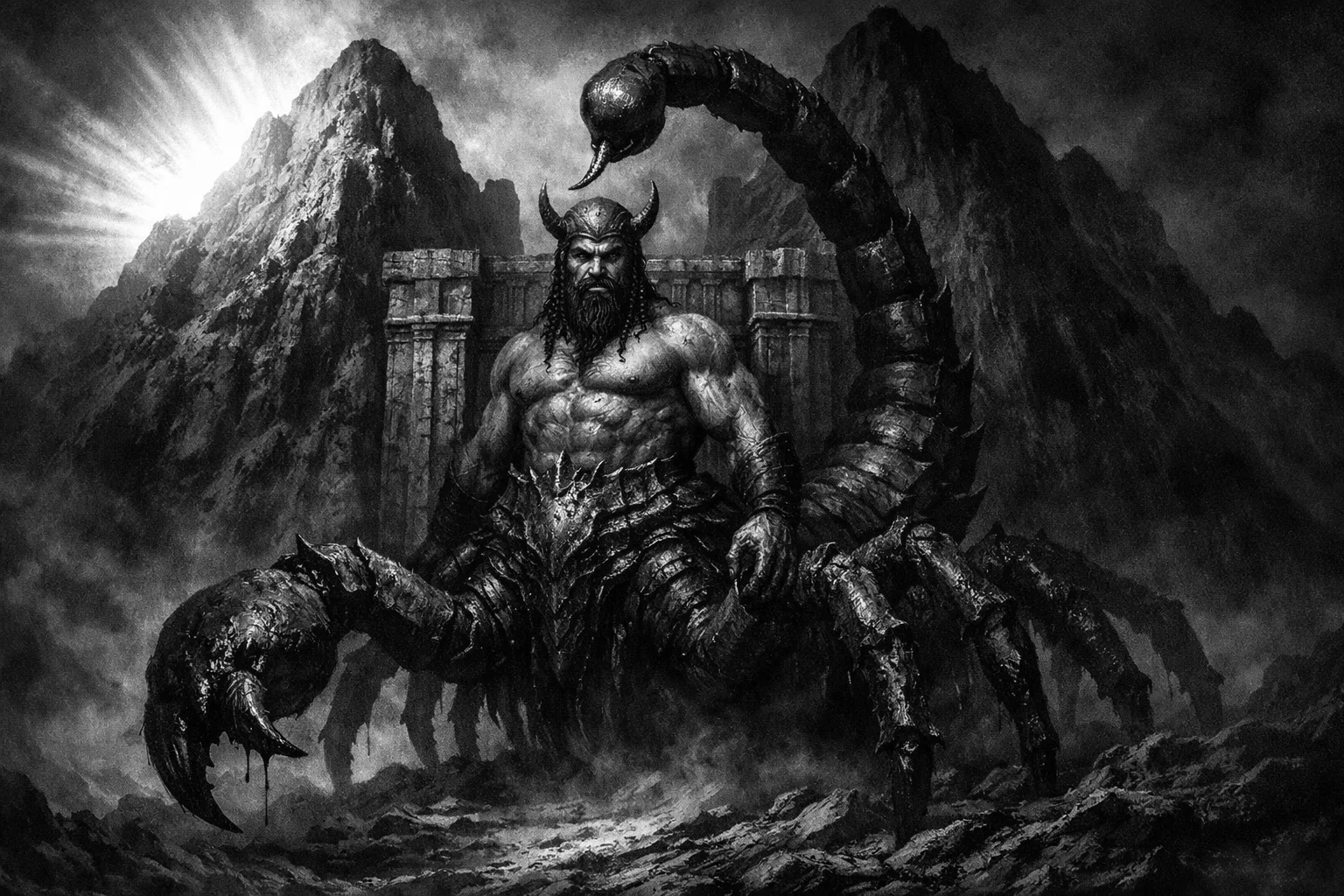

The Aqrabuamelu, also known as Scorpion-Men, are hybrid beings from Mesopotamian mythology. The goddess Tiamat first created them to fight against the younger gods.
After the war, they became protectors, most famously guarding the gates of Mount Mashu, where the sun rises and sets. They are shown as strong sentinels with the power of both humans and scorpions.
Summary
Overview
| Attribute | Details |
| Name | Aqrabuamelu |
| Alternative Names | Girtablilu, Girtablullû, Aqrabu-amelu, Scorpion-Man |
| Similar Monsters | Pazuzu, Lamassu, Shedu, Centaur, Minotaur, Manticore, Gorgon, Chimera, Harpy, Sphinx, Naga, Selket, Serket, Myrmidon, Arachne, Anubis |
| Etymology | Akkadian: “Aqrabu” meaning scorpion and “Amelu” meaning man. |
| Gender | Male, Female |
| Classification | Divine Guardian |
| Species | Hybrid |
| Origin / Culture | Mesopotamian (Sumerian, Akkadian, Babylonian, Assyrian) |
| First Recorded | c. 2100 BCE – Epic of Gilgamesh |
| Active Period | Always active |
| Size | Giant (Heads reach the heavens) |
| Lifespan | Immortal |
| Diet | Unknown |
| Habitat | Mount Mashu (Mountains of the Sunrise) |
| Powers & Abilities | • Absolute Gaze (Glance causes death) • Solar Shielding • Celestial Gatekeeping |
| Weaknesses | • Divine Command • Ritual Appeasement |
| Reproduction / Creation | Created by the goddess Tiamat from the primordial sea. |
| Behavior | Protective guardian |
| Pop Culture | The Mummy Returns (2001) / D&D 5e (Girtablilu) / Age of Mythology / Scorpion King |
Description
The Aqrabuamelu appears in the myths and stories of ancient Mesopotamia, including Sumerian, Akkadian, and Babylonian cultures. They are known as large, powerful hybrid guardians. At first, they were created as warriors in a cosmic battle, but later they became linked to the sun god Shamash.
In ancient texts, their main role is to guard sacred boundaries, especially where the mortal world meets the divine. They are often shown as a male and a female pair standing at the gates of the mountains.
Although they are frightening and dangerous, they are not usually shown as evil toward humans unless someone provokes them or tries to enter forbidden places without permission from the gods.
The Mythical Creatures Bible. Flash Sale – Up to 23% OFF!
This beautifully designed paperback is the ultimate reference to legendary beings across history and cultures: From Biblical leviathans and behemoths to Asian kitsune, European fae, African tricksters, and ancient chimeras. Alphabetical entries with vivid illustrations, cultural context, and fascinating facts – essential for witchy libraries, ritual symbolism, or creature design inspiration.
Etymology
The name Aqrabuamelu comes from Akkadian, a language widely spoken in ancient Mesopotamia. It is made up of two words: ‘aqrabu’ means “scorpion,” and ‘amelu’ means “man” or “human being.” The word for scorpion is also found in other Semitic languages, like the Hebrew ‘aqrab.
Together, the name describe the creature’s mixed nature. In older Sumerian texts, it is called Girtablullû. In Sumerian, ‘girtab’ means “scorpion,” and ‘lullû’ means “primitive man” or “humanity.”
So, as the language changed over time, the name always kept its meaning as a human-scorpion mix.
How to Pronounce “Aqrabuamelu” in English
In English, people usually say the name as ah-krah-boo-ah-meh-loo, with the stress on the ‘meh’ syllable. The ‘q’ is pronounced like a ‘k,’ and the vowels sound like ‘a’ in ‘father,’ ‘u’ in ‘blue,’ and ‘e’ in ‘met.’
Appearance
The Aqrabuamelu is a huge creature that mixes human and scorpion features. From the waist up, it looks like a man or woman, often shown with a strong, warrior’s build and sometimes with a beard, as seen in Mesopotamian art.
The lower half is all scorpion, with a segmented body and several pairs of jointed legs for moving quickly over rocks. A long, flexible tail curves over its back and ends in a large, venomous stinger.
Many stories and artworks show these creatures as so large that their heads touch the sky or ‘reach the heavens,’ while their lower bodies are level with the underworld or the base of the mountains.
Powers & Weaknesses
Powers
The main power of the Aqrabuamelu is its ‘terrifying glance’ or deadly gaze. Ancient texts say that just seeing them can scare mortals to death. This gaze is described as a halo or ‘melammu,’ a shining, divine light that shows their holy and fearsome power.
Besides their deadly gaze, they are extremely strong and can handle the intense energy of the sun. As guardians of the sun god’s path, they are not harmed by the sun’s bright light or heat.
They can open or close the gates of the sky, controlling who can travel the paths of the gods. Their scorpion sting is said to be supernaturally strong and can stop anyone who tries to sneak past them.
Sketching from the Imagination: Creatures & Monsters Paperback – Up to 32% OFF!
Unleash your dark creativity with this 320-page paperback from 3dtotal Publishing, packed with hundreds of original creature and monster sketches from over 50 professional fantasy artists. Raw concept art, developmental drawings, and imaginative beasts ranging from dragons and demons to eldritch horrors – ideal for artists seeking inspiration for character design, RPG creatures, or spooky illustrations.
Weaknesses
The Aqrabuamelu have few known physical weaknesses because they were made as divine beings to guard forever.
However, they must obey the rules set by the gods and follow the orders of the sun god Shamash (called Utu in Sumerian). This means that someone with the gods’ favor or a special order, like Gilgamesh, can pass by them safely.
They respond to proper greetings and respect. In stories, they can be reasonable and may let someone pass if the person shows they are part divine or very brave.
They cannot be killed easily by normal weapons, but they have to stay at the gates of Mount Mashu and do not chase enemies, so being stuck in one place is their main weakness.
Myths, Legends & Stories
The Creation by Tiamat
The story of the Aqrabuamelu starts in the Enuma Elish, the Babylonian creation myth. Long ago, the sea goddess Tiamat became angry after the younger gods killed her partner, Apsu. To get revenge and show her power, she created eleven monsters.
These ‘children of Tiamat’ were made to be unbeatable in battle and to scare the gods. The group included the Horned Serpent, the Mushkhushshu dragon, the Ugallu demon, and the Girtablullû, or Scorpion-Men.
In the great war for the throne of Heaven, the Aqrabuamelu fought with Tiamat’s general, Qingu. They were said to have ‘venom instead of blood.’ But when the storm god Marduk fought Tiamat, he defeated her and her army.
Some monsters were destroyed, but Marduk spared others and gave them new roles in the world. The Scorpion-Men were changed from destroyers to eternal guardians of the boundaries between worlds.
The Epic of Gilgamesh
The best-known story about the Aqrabuamelu is Gilgamesh’s search for immortality. After his friend Enkidu died, Gilgamesh traveled far to find Utnapishtim, who had survived the Great Flood and been granted eternal life. This journey took him to Mount Mashu, the mountain with two peaks that guarded the sun’s path.
When Gilgamesh reached the mountain’s entrance, he met the Scorpion-Man and his wife, who guarded the gate. The story says their ‘terror’ was so great that it ‘covered the mountains.’
Gilgamesh was frozen with fear for a moment, but he covered his face and kept going. The Scorpion-Man saw that Gilgamesh was part divine and told his wife that this visitor was not just a normal human.
The Dialogue at the Gate
The meeting between Gilgamesh and the Aqrabuamelu is a key moment in the story. The Scorpion-Man asked why Gilgamesh had come so far through danger. Gilgamesh explained he was grieving for Enkidu and wanted to learn the secret of life from Utnapishtim.
At first, the Scorpion-Man warned Gilgamesh that the way ahead was impossible. He said the mountain had a tunnel of darkness twelve leagues long, which was the path the sun took each night, and that no mortal had ever made it through.
Even after the warning, Gilgamesh did not give up. Seeing his determination and divine heritage, the Scorpion-Man finally agreed. He opened the gate and let Gilgamesh pass, wishing him luck on his dangerous journey through the darkness.
NECA Collectible Texas Chainsaw Massacre Ultimate Leatherface
Horror masterpiece from NECA: 7” articulated Leatherface with swappable heads (terrifying masks and expressions), chainsaw with sound potential in pose, hammer, meat hook, and extra hands for dynamic displays. Authentic film-accurate detailing in a collector-friendly window box – perfect for witchy altars or creepy collections.
Symbolism
The Aqrabuamelu symbolizes the boundary between what is known and what is unknown. As guardians of the sun’s path, they show the change from day to night, life to death, and human to divine. Their mixed forms, part human and part scorpion, represent both human intelligence and the fierce defenses of animals.
People in Mesopotamia often kept small statues or amulets of Scorpion-Men as protective symbols. These objects were meant to guard against evil spirits, showing that even a creature from chaos could become a loyal protector.
Can Aqrabuamelu Be Defeated?
Ancient stories say that a normal person cannot defeat an Aqrabuamelu in a fight. Their huge size and deadly gaze make attacking them hopeless. Still, people in Mesopotamia were concerned with how to protect themselves from these beings or get past them.
In ancient times, the main way to deal with these creatures was through protective magic and help from the gods. To safely meet a guardian like this, a person needed the favor of a powerful god, especially Shamash, the sun god.
People believed that amulets made of stone or clay, with prayers or pictures of a Scorpion-Man, could use the creature’s power to protect them from evil spirits.
There were also special spells in the Maqlû or Šurpu series, ancient Babylonian ritual tablets, used to control or calm supernatural beings. These rituals used salt, cedar, and pure water to create a holy space. By showing respect to the creature and using the right greetings, a traveler hoped to avoid harm.
Tags:
Related Monsters…
Aspidochelone (Giant Sea Beast)
February 6, 2026
Alkonost (Russian Half-Bird, Half-Woman)
December 8, 2025
Black Annis (Blue Hag of Leicestershire)
February 18, 2026
February 5, 2026
