
Bakeneko is a powerful supernatural creature from Japanese folklore. It describes how an ordinary house cat can turn into a dangerous spirit.
Unlike the lucky cat figures seen in modern times, the Bakeneko is a darker version that changes as a cat grows older, larger, or faces certain conditions. Stories about it have made Japanese families cautious about how they care for their cats.
Summary
Overview
| Attribute | Details |
| Name | Bakeneko |
| Alternative Names | Kaibyo, Bake-neko, Changed Cat, Monster Cat |
| Similar Monsters | Kitsune, Tanuki, Nekomata, Kasha, Mujina, Bauk, Rakshasa, Weretiger, Skinwalker, Kelpie, Selkie, Pooka, Jinn, Aswang, Huli Jing, Kumiho, Teumessian Fox, Ca Sith, Gwyllgi |
| Etymology | Japanese: ‘bake’ (transform/change) and ‘neko’ (cat) |
| Gender | Male, Female |
| Classification | Yōkai |
| Species | Beast / Spectral |
| Origin / Culture | Japanese (Honshu, Shikoku, and Kyushu) |
| First Recorded | c. 17th Century – Edo Period folklore and literature |
| Active Period | Nocturnal |
| Lifespan | Immortal after transformation |
| Diet | Lamp oil, human flesh, fish, and carrion |
| Habitat | Domestic households, abandoned mansions, and mountain villages |
| Powers & Abilities | • Shape-shifting into human form • Reanimating and controlling corpses • Manipulating blue fire (ghost-fire) • Speaking human languages • Cursing households |
| Weaknesses | • Cutting of the tail before transformation • Holy talismans (Ofuda) • Physical iron weapons • Being discovered in its true form |
| Reproduction / Creation | Natural cat reaching 12–13 years of age, weighing over 3.75 kg, or growing an exceptionally long tail |
| Behavior | Mischievous and often vengeful household infiltrator |
| Pop Culture | “Mononoke” (2007) / “The Cat Returns” (2002) / “Inuyasha” (Kirara) / “Yo-kai Watch” (Jibanyan) / “Naruto” (Matatabi) |
Description
Bakeneko is a type of yōkai, or supernatural being, that starts as a normal house cat. If the cat lives long enough, it gains special powers and can act in ways that seem human or even evil.
In Japanese stories, a Bakeneko is not born as a monster. Instead, it becomes one as it ages in unusual ways or develops traits that mark it as crossing from the natural world into the supernatural.
This creature is closely linked to the home, which makes it feel like a personal and unsettling threat. According to lore, the creature haunts the families that raised it, sometimes seeking revenge or simply acting on its newfound wild instincts.
Unlike other yōkai that live in the wild, the Bakeneko lives among people. It hides in plain sight until it decides to show its more dangerous side.
Sketching from the Imagination: Creatures & Monsters Paperback – Up to 32% OFF!
Unleash your dark creativity with this 320-page paperback from 3dtotal Publishing, packed with hundreds of original creature and monster sketches from over 50 professional fantasy artists. Raw concept art, developmental drawings, and imaginative beasts ranging from dragons and demons to eldritch horrors – ideal for artists seeking inspiration for character design, RPG creatures, or spooky illustrations.
Etymology
The word Bakeneko comes from two Japanese words: “bake,” which means “to transform” or “to change,” and “neko,” which means “cat.” So, Bakeneko literally means “changed cat” or “transforming cat.”
This name sets the Bakeneko apart from a regular cat by showing it is a “bakemono,” or something that changes. In the old Japanese language, the name suggests the cat has become something magical and unstable.
Other metamorph yōkai share this word root, which highlights that the Bakeneko’s main trait is its ability to change form.
How to Pronounce “Bakeneko” in English
In English, Bakeneko is usually pronounced bah-keh-neh-koh, with each syllable pronounced evenly. “Ba” is like in “father,” “ke” as in “kettle,” “ne” as in “net,” and “ko” like the “co” in “coast,” but shorter.
Appearance
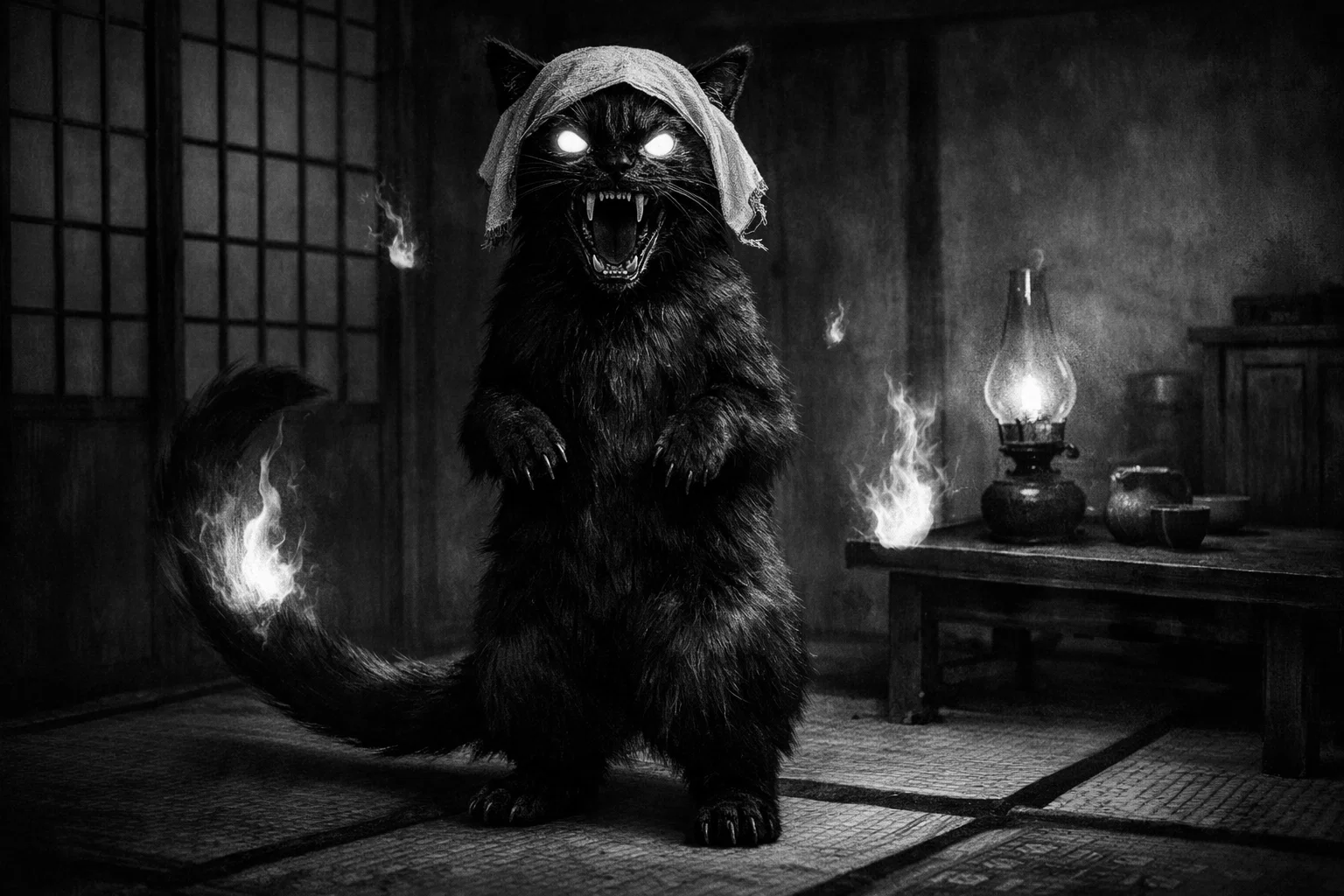
Normally, the Bakeneko looks like a regular house cat, but it is often bigger than usual. Its fur can be any color, though many stories mention calico or black cats. A very long tail is a main sign that a cat is turning into a Bakeneko.
When showing its supernatural side, the Bakeneko often walks on its back legs like a person. Sometimes, it wears a towel or cloth on its head, especially when it is “dancing.”
When it becomes aggressive, the Bakeneko can grow as big as a large dog or even a person. Its eyes still look like a cat’s, but glow, and its mouth can open wider than normal to eat bigger prey or speak like a human.
Powers & Weaknesses
Powers
The Bakeneko can turn into a human, sometimes by killing someone in a family and taking their place. It can speak like a person to trick others. It also has a special link to the dead. If it jumps over a new corpse, it can make the body move again and use it to scare or control people.
The Bakeneko is also linked to “hi-no-tama,” or ghost-fire. Blue flames sometimes appear around it or at the end of its tail. This fire is not for warmth but shows the creature is near. The Bakeneko is very strong for its size and can place curses on people who mistreat it or other cats.
Yokai and Supernatural Beings Hardcover Book – Up to 28% OFF!
Explore 100 authentic illustrations of Japan’s most haunting creatures in this premium 240-page volume. From ape-like hihi kidnappers to smirking hannya and shape-shifting bakeneko, drawn from rare historical sources including first-time reproduced monster parade scrolls. Curated by a leading authority on Japanese prints – an indispensable guide to yokai horror and folklore for altars, shelves, or spooky reading.
Weaknesses
The main way to prevent a cat from turning into a Bakeneko is to change its body before it transforms. In the past, many Japanese people cut their cats’ tails short so they would not grow long enough to cause a change. Once a cat becomes a yōkai, it can be killed with iron weapons like swords or spears, just like a normal animal.
Spiritual protections work too. Ofuda, which are paper charms blessed by priests, can be put on doors and windows to keep the Bakeneko out. Since it is good at hiding, making it see its own reflection, or using bright light or prayers can show its true cat form. This makes it easier to attack or drive away.
Myths, Legends & Stories
Origins
Stories about the Bakeneko became common during the Edo period (1603–1868), when cats were important for keeping silkworms and grain safe from mice. Since cats often roamed freely, people started to believe many superstitions about them.
People thought that if a cat lived long enough, it would eventually change. They said that when a cat turned twelve, its soul became full of experience, letting it use the world’s “natural energy” to transform.
Another story says cats got a taste for human oil and blood by licking lamp oil made from fish. People thought this strange behavior in the dim light meant the cat was feeding on the spirit of the home.
The Nabeshima Cat
One of the most famous Bakeneko stories is the “Nabeshima Cat Disturbance” from the Saga Domain. The legend says Prince Nabeshima Mitsushige was being entertained by his loyal subject, Ryuzuji Matashichi.
After some political problems, Matashichi was put to death. His mother, heartbroken, told her pet cat about her pain before she died, too. The cat licked her blood and turned into a giant Bakeneko.
The Bakeneko snuck into the castle, killed the Prince’s favorite concubine, Otyo, and took her place. Each night, the fake Otyo made the Prince weaker and sicker. He had nightmares, and no doctor could help him. A young soldier, Itō Sōda, finally noticed that the concubine lacked a human shadow, revealing the truth.
Itō chased the creature through the palace and finally trapped it in the garden. The cat reverted to its monster form and was killed, ending the curse on the Nabeshima family.
The Dancing Cat of Tokyo
In a lighter but still strange story from old Edo (now Tokyo), a merchant started to think his cat was not normal. Each night, the cat left and came back in the morning smelling like sake and fancy oil. One night, the merchant followed the cat to an empty shrine.
There, he saw dozens of cats standing on their hind legs, towels on their heads. They danced in a circle and sang in human voices about how much they loved the night. The merchant’s cat was leading the dance.
When the merchant made a noise by accident, the cats quickly reverted to normal and ran away. He never talked about it to his cat, afraid that if the cat knew his secret had been discovered, it might have to kill him to protect the other cats.
The Corpse Stealer
In some villages, people feared the Bakeneko not for its ability to change shape, but for its power over the dead. Many stories tell of funerals where a big cat jumped over the coffin.
In these tales, the dead person would suddenly sit up or walk, controlled by the cat’s spirit. The body might dance or attack people at the funeral. Because of this, families would watch the body closely to keep cats away, fearing the Bakeneko would use the corpse for revenge or to make fun of the living.
Ultimate Family Co-op Adventure – Horrified: Universal Monsters
Ravensburger’s acclaimed co-op Horrified Board Game masterpiece: Defend against Dracula, The Mummy, Invisible Man, and other icons in a beautifully themed village. Tactical pick-up-and-deliver gameplay, escalating tension, and endless variety. Ideal gateway game for families & friends, 1-5 players, 10+, with 4.8/5 star rave reviews.

Symbolism
The Bakeneko is a symbol of how pets can have both tame and wild sides. It shows that even the most loyal cat still has a mysterious, ancient part inside.
The Bakeneko is also linked to the idea of “tsukumo-gami,” which means that things or animals that live a long time gain a spirit. More broadly, it represents the fear that someone close can suddenly become a threat. It also shows old Japanese concerns about aging and the problems that can accompany a long life.
Can Bakeneko Be Defeated?
To defeat a Bakeneko, people used both physical and spiritual methods. In the past, the best way was to prevent it from appearing in the first place.
Owners would watch their cats’ tails closely and sometimes cut them short so they would not get long enough to cause a transformation. If a cat seemed like a Bakeneko, people would feed it special herbs or salted fish, thinking these foods would upset its powers and make it show its true form.
People used protective charms from Shinto shrines to keep a Bakeneko out of bedrooms. They also put heavy iron pots on suspected reanimated bodies to stop a cat from taking control. If the Bakeneko had already turned into a human, the best way to reveal it was with a mirror, since its reflection would always show its real cat ears or tail.
Once the Bakeneko is revealed, it loses much of its power. Hitting it with a blessed sword or a heavy iron rod is usually enough to kill it.
Tags:
Related Monsters…
Abominable Snowman (Himalayan Beast)
December 1, 2025
Akkorokamui (Ainu Monstrous Sea Kraken)
January 8, 2026
January 12, 2026
Alkonost (Russian Half-Bird, Half-Woman)
December 8, 2025
January 7, 2026
Argus Panoptes (Hundred-Eyed Giant)
January 13, 2026
