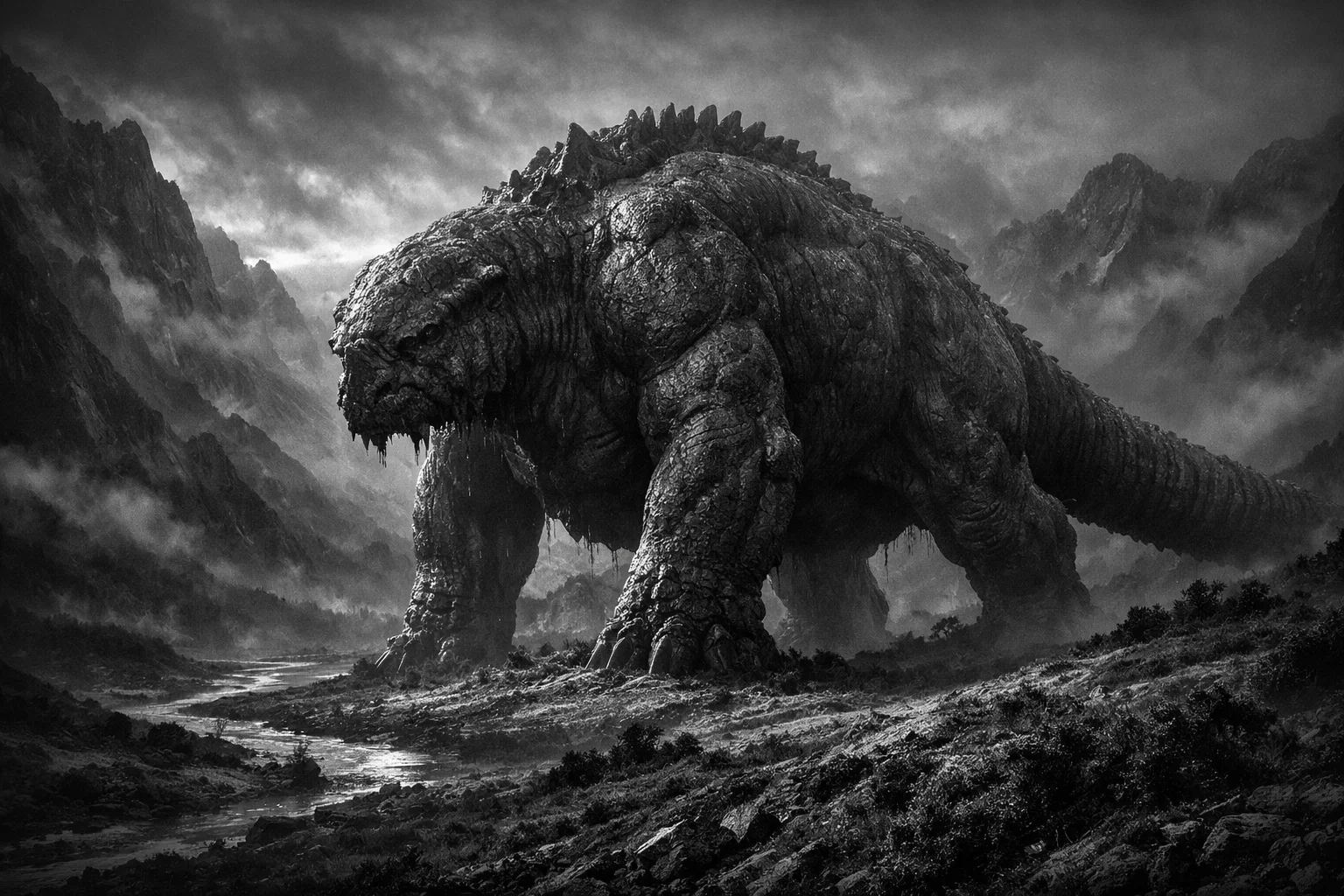

Behemoth is an ancient creature of enormous size, first mentioned in religious texts from the Near East. It stands for the wild strength of the land and is seen as the land-based counterpart to the sea creature Leviathan.
Behemoth is often shown as the biggest land animal ever, with bones as strong as bronze and a tail like a cedar tree. In stories and religious texts, it reminds people of the huge, wild forces that only a creator can control.
Summary
Overview
| Attribute | Details |
| Name | Behemoth |
| Alternative Names | B’hemot, Behemot, Bahamut (Islamic adaptation), Pehemout |
| Similar Monsters | Leviathan, Ziz, Re’em, Tarasque, Aspidochelone, Fastitocalon, Hafgufa, Lyngbakr, Jörmungandr, Cipactli, Tiamat, Typhon, Echidna, Yam, Mot, Lotan, Gugalanna, Humbaba, Fenrir |
| Etymology | From Hebrew ‘behemah’ (beast), used as a plural of majesty (‘bĕhēmōt’) to signify ‘Great Beast’. |
| Gender | Male |
| Classification | Primordial Beast |
| Species | Beast |
| Origin / Culture | Jewish / Levantine (Ancient Israel) |
| First Recorded | c. 6th–4th century BCE – Book of Job |
| Active Period | Always active |
| Size | Colossal (mountain-sized in later Midrashic tradition) |
| Lifespan | Immortal (until the end of time) |
| Diet | Grass and vegetation (consumed in massive quantities) |
| Habitat | The mountains or the marshy fens of the Jordan River |
| Powers & Abilities | • Invulnerability to human weaponry • Immense physical strength • Control over terrestrial stability |
| Weaknesses | • Only its Creator can approach it with a sword • Destined to slay/be slain by Leviathan |
| Reproduction / Creation | Created by God on the sixth day of creation |
| Behavior | Solitary grazing herbivore |
| Pop Culture | Final Fantasy series / D&D Monster Manual / Godzilla: King of the Monsters (2019) / Master and Margarita (Bulgakov) |
Description
Behemoth is described as the greatest land creature, appearing in early religious writings as a symbol of unmatched strength. It is seen as an ancient monster living in wild places, especially where water meets land or in high mountains.
Unlike many mythical monsters that threaten people, Behemoth eats plants and ignores human society. It stays in its own area, showing the wild and powerful energy of the earth.
In religious stories, Behemoth is one of three great creatures: it rules the land, Leviathan rules the sea, and Ziz rules the sky. Behemoth is seen as perfectly made and impossible for any human to harm. Its life is part of the universe’s order, and it is often called “the beginning of the ways of God,” meaning it was one of the first or most important animals created.
The Mythical Creatures Bible. Flash Sale – Up to 23% OFF!
This beautifully designed paperback is the ultimate reference to legendary beings across history and cultures: From Biblical leviathans and behemoths to Asian kitsune, European fae, African tricksters, and ancient chimeras. Alphabetical entries with vivid illustrations, cultural context, and fascinating facts – essential for witchy libraries, ritual symbolism, or creature design inspiration.
Etymology
The name comes from a Hebrew word that is the plural form of “beast” or “cattle.” In this case, the plural ending is used to show greatness, not to mean there are many creatures. So, the name really means “The Beast of Beasts” or “The Ultimate Beast.”
Some experts think the name might also come from the Egyptian word p-ehe-mu, meaning “water-ox,” which would connect Behemoth to the hippopotamus, but this is still debated. As the story spread to other cultures, the name changed.
In Arabic tradition, it became Bahamut, and the creature turned from a land animal into a giant fish that has up the world.
How to Pronounce “Behemoth” in English
In English, people usually say ‘Behemoth’ as /bɪˈhiːməθ/ (bih-HEE-muth), with the stress on the second syllable. Some groups use /vəˈheɪmoʊt/ to match the Hebrew sound, but the first way is more common.
Appearance
Behemoth is described as a huge, heavy four-legged animal. Its most famous feature is its tail, which is said to be as thick and stiff as a cedar tree. Its legs are as strong as iron or bronze, showing it has a very strong body. Its skin cannot be pierced by normal weapons, and it has a powerful neck.
Today, some people think Behemoth sounds like a hippopotamus, elephant, or even a dinosaur, but old stories describe it as a mix of different traits. It eats grass like an ox but is as strong as a mountain.
Behemoth is so large that it stays calm even when a river like the Jordan flows against its mouth. It is also said to eat the plants from a thousand mountains.
Powers & Weaknesses
Powers
Behemoth has incredible strength and endurance, greater than any other land animal. Its main power is that no human tool or weapon can harm it, not even iron or brass. It can also not be moved by floods or earthquakes.
In later stories, Behemoth is given a special role in the universe. People believed its meat would feed the good people in the afterlife at a great feast. Its strength stands for the lasting power of the earth. It does not have magic, but its body is so strong that it is like a living fortress.
Weaknesses
Behemoth’s only weakness is that it is completely under the control of its Creator. Only the one who made it can harm it, so no human or lesser being can hurt it.
Behemoth also has a set fate. In end-of-the-world stories, it is meant to fight Leviathan in a final battle. They will fight each other, and both will die.
This ending is not because Behemoth is weak, but because it is part of the universe’s plan. Other than this, there are no weaknesses that people can use against it.
Bulfinch’s Mythology Leather-Bound Classics Edition – Up to 43% OFF!
Own the timeless masterpiece in luxurious flexi leather-bound format from Canterbury Classics. Thomas Bulfinch’s complete compilation: The Age of Fable (Greek/Roman gods & heroes), The Age of Chivalry (King Arthur & knights), and Legends of Charlemagne – over 800 pages of elegantly retold ancient myths, Norse lore, and medieval romances. Gilded edges, ribbon marker, and premium binding make this a stunning heirloom for occult libraries or dark academia shelves.
Myths, Legends & Stories
Behemoth’s story comes from ancient Near Eastern beliefs. It is a key monster in the Hebrew Book of Job, written between the 6th and 4th centuries BCE. According to Jewish tradition, Behemoth was made on the sixth day of creation to rule over all land animals.
At first, it was said there were two Behemoths, one male and one female. But according to the Pesiqta de-Rav Kahana, the Creator saw that having both would destroy the earth due to their size and hunger.
To save the world’s plants and mountains, the female Behemoth was killed, and her meat was saved in brine for good people. The male was left alone, unable to have offspring, and wandered the “Thousand Mountains” east of the Garden of Eden.
The Guardian of the Thousand Mountains
In Jewish stories, Behemoth is a huge plant-eater with a special job in nature. Each day, it eats the plants from a thousand mountains, but every night the plants grow back by a miracle. This keeps Behemoth full and stops it from moving into places where people live.
Besides eating, Behemoth also controls animal behavior. The Midrash Konen says that during the summer solstice, Behemoth roars so loudly that the sound echoes through all forests and scares every predator on earth.
This yearly roar calms down predators for the rest of the year. Without it, animals like lions, wolves, and eagles would become so fierce that they would wipe out farm animals and weaker creatures.
The Stand at the River Jordan
A well-known story about Behemoth is how it stays calm during natural disasters. In the Book of Job, Behemoth stands in the Jordan River and does not move, even when the river rushes against its mouth, while other animals would run away.
This story shows that Behemoth is like part of the earth itself. Later tales say it drinks all the water from the Jordan River in one gulp each year but never gets thirsty, because it is kept alive by the waters of the “Abyss.”
The Conflict with Leviathan
A main story in end-of-the-world writings, like the Book of Enoch, tells what happens to Behemoth at the end of time. Behemoth and Leviathan, the sea monster, are linked. According to lore, in the Messianic age, they will fight each other in a final battle.
In this final fight, Leviathan tries to wrap around Behemoth and stab it with sharp scales. At the same time, Behemoth uses its horns to attack Leviathan. This is not a fight between good and evil, but a ritual to end the world. In the end, the creator steps in, and both creatures die.
Afterward, Leviathan’s skin is used to make a glowing tent, and the meat from Behemoth, Leviathan, and the giant bird Ziz is served as a special feast for the good people. This “Messianic Banquet” shows that chaos has been tamed and a new age of plenty has begun.
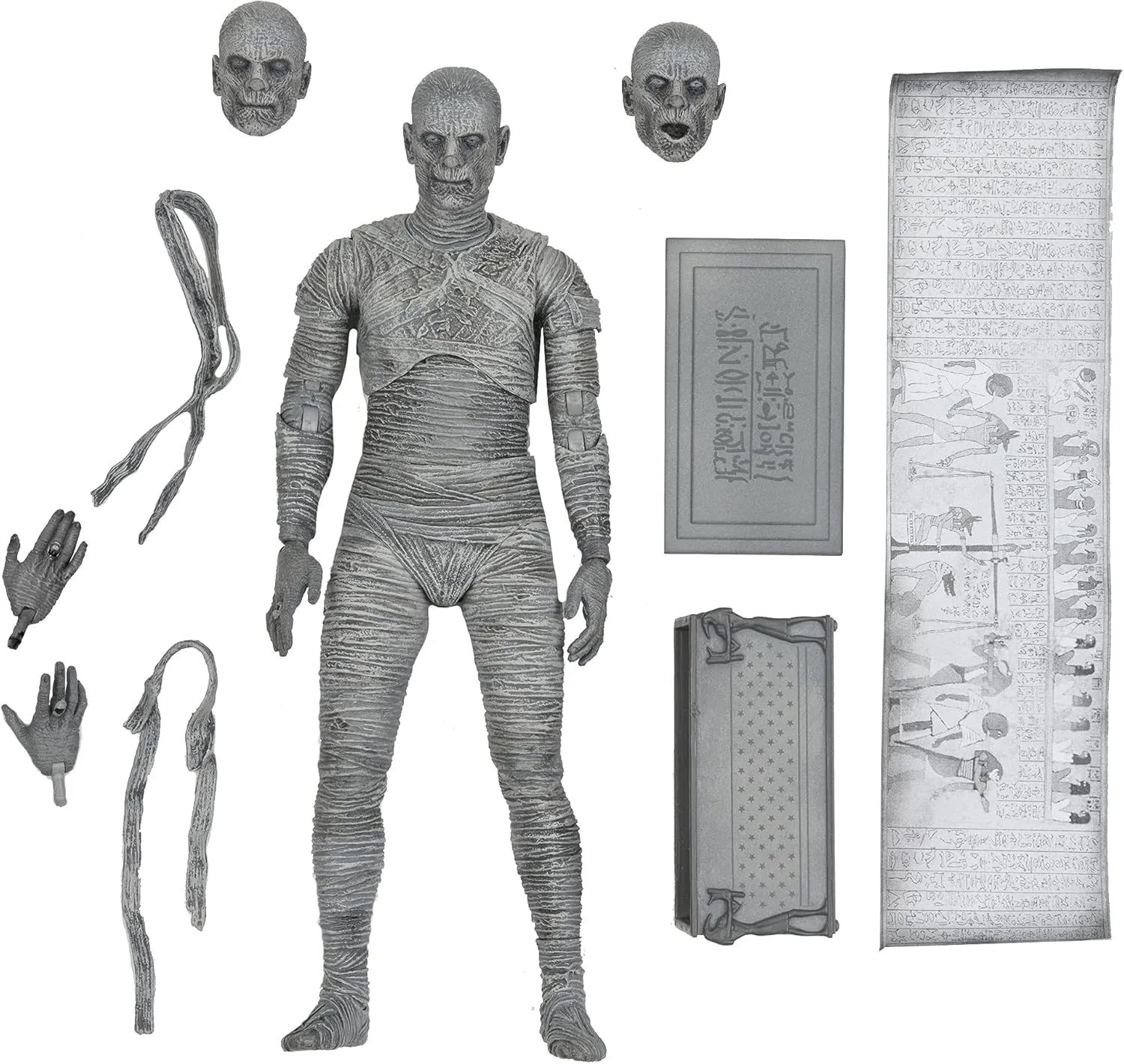
NECA Ultimate Mummy 7″ Black & White Action Figure – Boris Karloff Classic Deal!
Celebrate the 90th anniversary with NECA’s stunning black-and-white Ultimate Mummy, capturing Boris Karloff’s iconic wrapped horror in exquisite detail. 7-inch scale with interchangeable heads and hands, an opening Egyptian chest accessory, and highly articulated posing. Premium sculpt recreates the legendary makeup – essential for Universal Monsters collectors and dark displays.
The Transformation into Bahamut
As stories from the Levant spread to Arabia, Behemoth’s story changed. In early Islamic writings, such as those of Al-Qazwini, Behemoth became Bahamut. This giant fish holds up the entire world (rather than a land animal).
In these stories, the world sits on a huge bull called Kuyutha, which has thousands of eyes, ears, and legs. The bull stands on Bahamut, the giant fish. Under the fish is a sea, then air, then fire. This shows how the “Great Beast” became a central monster in later Middle Eastern tales.
Symbolism
Behemoth is a main symbol of divine power and the greatness of nature. It stands for the parts of the world that people cannot control or fully understand.
Unlike cattle or horses, which people have tamed, Behemoth cannot be controlled. This shows that the universe was not made just for humans. Behemoth also stands for stability and strength on land, while Leviathan represents the wild, changing sea.
In philosophy, Behemoth is used to show the idea of the “sublime”—something so big and powerful that it makes people feel both amazed and small.
Can Behemoth Be Defeated?
Old stories and religious texts say that no human can defeat Behemoth. There are no tales of anyone ever hurting it. Unlike other monsters, Behemoth cannot be stopped by iron, salt, or magic words. People do not need protection from it, since it is not dangerous to humans and stays in its own wild area.
Still, to avoid Behemoth or the “shaking of the earth” it might cause, old traditions say that living a good life and following divine laws is the only real protection. No object, like a crystal, stone, or herb, can affect it.
The only way Behemoth is ever “defeated” is through the Creator’s plan at the end of time. People do not try to defeat Behemoth; instead, they accept its role in the world. The protection people wanted was not from the beast, but from the wild forces of nature it stands for, which they managed through prayer and following religious rules, not magic.
Tags:
Related Monsters…
January 7, 2026
Black Annis (Blue Hag of Leicestershire)
February 18, 2026
Argus Panoptes (Hundred-Eyed Giant)
January 13, 2026
Black Shuck (Ghost Dog from East Anglia)
January 26, 2026
Antaeus (Invincible Earth Giant)
January 5, 2026
